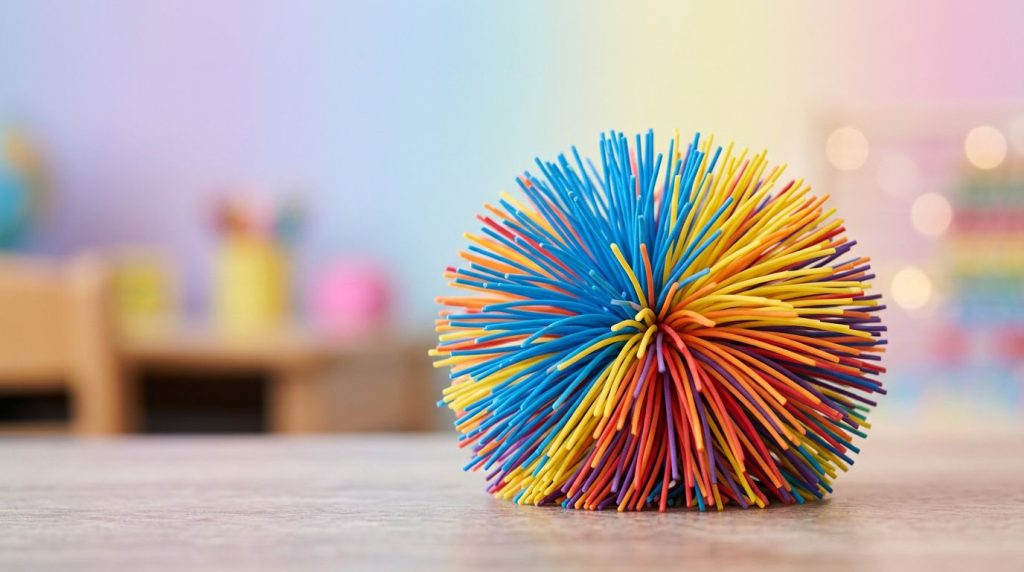
Some toys asked you to imagine a whole world. The Koosh Ball asked you to pick it up once, and that was enough.
If you were anywhere near a toy aisle, classroom, or living room in the late 1980s, you probably remember the feeling of that original Koosh. It was soft, springy, a little weird, and impossible to ignore. It was not loud, and it did not need batteries. It simply landed in your hand and made perfect sense.
Key Takeaways
- Sensory Appeal: The Koosh ball stood out because of its unique tactile experience, using soft rubber filaments that were satisfying to squeeze and easy to catch.
- Simplicity and Accessibility: Unlike many complex 80s toys, the Koosh ball required no batteries, instructions, or rules, making it immediately playable for all ages.
- Versatility: The ball transcended typical play patterns, serving as both a relaxing desk fidget toy and an active tool for group games and classroom play.
- Lasting Legacy: By focusing on physical sensation rather than a temporary trend or cartoon tie-in, the Koosh ball avoided being perceived as ‘too young,’ helping it remain a beloved piece of retro nostalgia.
The Feel Was the Whole Point
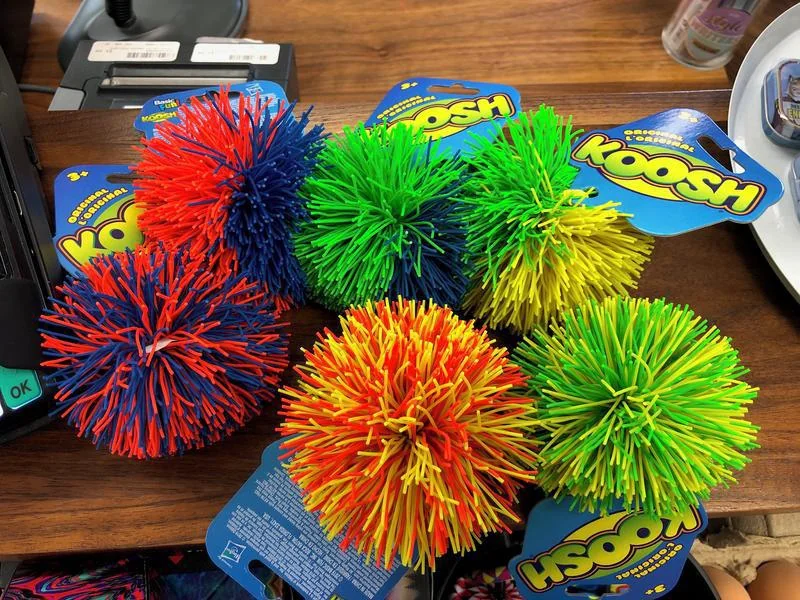
The first thing about a Koosh ball was not how it looked, even though it looked like a neon sea creature escaped into suburbia. The first thing was the texture.
Those strands of soft rubber brushed across your palm and fingers in a way no other toy did. It was not slick like a Super Ball, not squishy like putty, and not hard like an action figure you forgot in the hallway and stepped on at 2 a.m. This unique toy ball had give. It had bounce. It had that tiny, satisfying thwap when you tossed it from hand to hand.
That tactile experience made the Koosh ball a beloved fidget toy decades before the term became mainstream.
Kids squeezed it because it felt good, and adults squeezed it for the exact same reason. That broad appeal mattered. Most toys lived in clear lanes, where dolls were one category and action figures were another. The Koosh ball slipped past all those barriers and became a thing you reached for without thinking.
It also had zero intimidation factor. You did not need rules, teams, or instructions. You did not even need good aim. Because the strands slowed it down and softened the impact, the ball was remarkably easy to catch. For younger kids, that was gold. For everyone else, it meant one more throw, then another, and five minutes gone before you noticed.
A Koosh ball did not win you over with complexity. It won because your hand liked it immediately.
That instant connection is why the toy stuck in memory. Plenty of 80s toys were flashy, but few were this physical.
How a Bundle of Rubber Became an 80s Hit
The origin story is almost as charming as the toy itself. Scott H. Stillinger created the first version in 1986 after attempting to design a toy that was easier for his young children to catch. He achieved this by bundling thousands of natural rubber filaments around a steel-bound core, resulting in the iconic, spiky design we know today. Stanford Magazine’s look at the invention captures the simple brilliance of the idea. The name came from the sound the toy made when it landed in a hand, “koosh,” which feels so perfect it almost sounds made up.
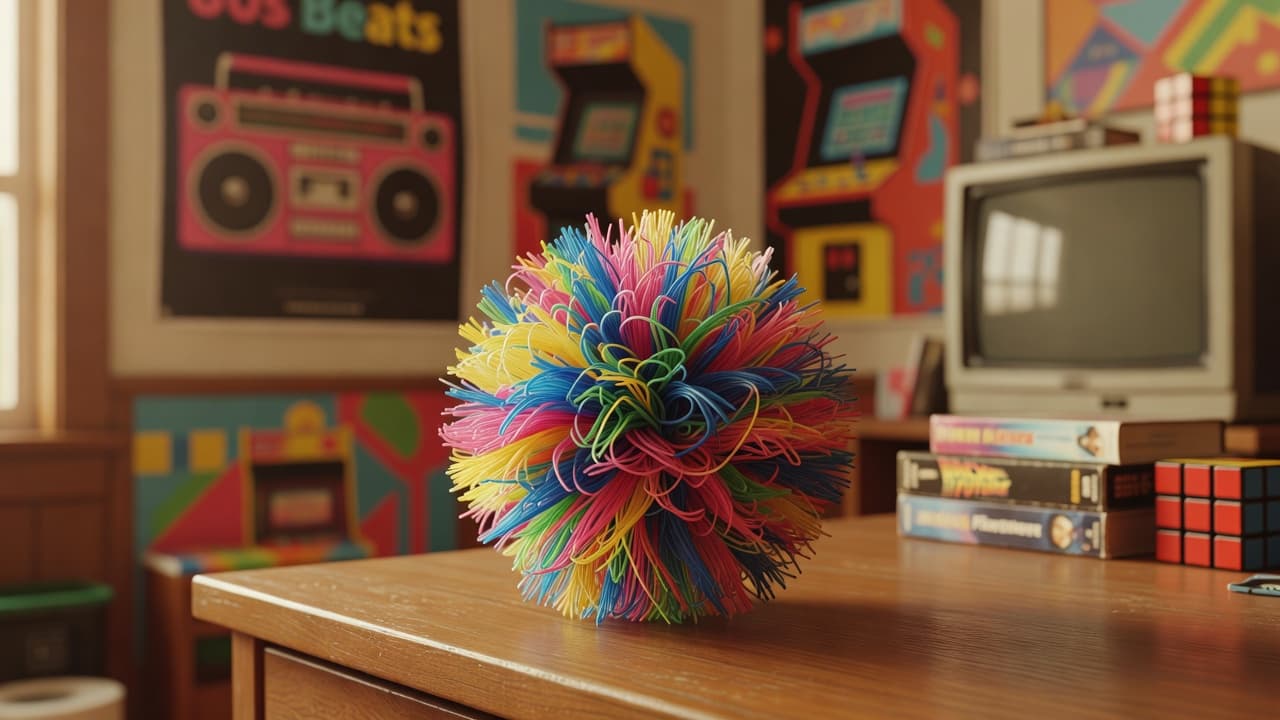
That simplicity was the magic. The late 80s loved big toy hooks, but this one was immediate. See it, touch it, toss it. Done. No long commercial pitch was needed.
It hit at the right moment, too. The decade was packed with toys that transformed, talked, glowed, zipped, and shouted for your attention. The Koosh ball took the opposite route. It was tactile instead of theatrical, which felt fresh.
There is a good rundown of the toy’s early growth in Mental Floss’s Koosh facts, including how fast the concept caught on once people handled it. That part matters. The Koosh ball was never just a thing you saw on a shelf. It was a thing someone put in your hand. After that, the sale was halfway done.
By the end of the 80s, it had gone from novelty to fixture. Not every toy makes that jump. Plenty arrive with hype and disappear by the next spring. The Koosh ball lasted because the appeal was not tied to a movie, a cartoon, or a catchphrase. It was tied to touch.
Why It Took Over Classrooms and Playgrounds
A Koosh ball belonged almost anywhere kids gathered. That was part of its quiet genius.
On the playground, it worked as a catch toy for kids who hated the sting of a hard ball. It easily transitioned from indoor play to outdoor games, and it quickly became a favorite among beach toys because its rubbery strands meant it would not roll away or get lost in the sand as easily as a traditional toy ball. In classrooms, it became the kind of object teachers tolerated because it was soft, light, and easy to control. One toss across a reading circle, no drama.
You could play with it in structured ways, sure. Catch games, target tosses, or little made-up contests. But it also excelled as a between-moments toy. Waiting for dinner. Sitting on the carpet. Riding in the car. Standing in line while your parent finished one more errand. That is rare territory for a toy. It was not only for playtime; it slid into regular life.
The sensory part explains a lot. As one of the most iconic tactile toys of the era, the strands moved against your skin. The ball compressed without feeling mushy. It bounced, but never with chaotic energy. Compared with a tennis ball, it was gentler. Compared with a stress ball, it was more playful. Compared with almost anything else in the toy box, it invited constant handling.
That is why so many people remember it less as a game and more as a presence. A desk toy. A backpack toy. A glove compartment toy. A thing that migrated around the house and never seemed out of place.
There was also no social gatekeeping around it. You did not need to know a character, collect a set, or understand a fantasy world. Someone handed you a Koosh ball and you were already in.
What Made the Koosh Ball Different From Other 80s Toys
The 80s were stacked with icons, and most had a strong identity. You had plush toys with emotional pull, gadgets with sound and lights, and characters kids wanted because TV told them to. The Koosh ball felt different because it was not asking you to buy into a story. It was asking your senses to vote.
That let it sit beside all kinds of favorites without competing on the same terms. A kid might adore Popples plush toys for their zip-up trick, beg for a Teddy Ruxpin talking bear, or challenge a friend to a Skip-It contest at recess. The Koosh ball did not replace those toys. It lived in a totally separate lane. While the brand began with the company OddzOn, its enduring appeal eventually saw it pass to major toy manufacturers like Hasbro. Today, the tactile legacy continues as it is produced by PlayMonster.
A few things made it stand out:
- It was active and calming at the same time.
- It felt novel, even before you threw it.
- It worked for solo fidgeting and group play.
- It did not age out fast, because older kids and adults liked it too.
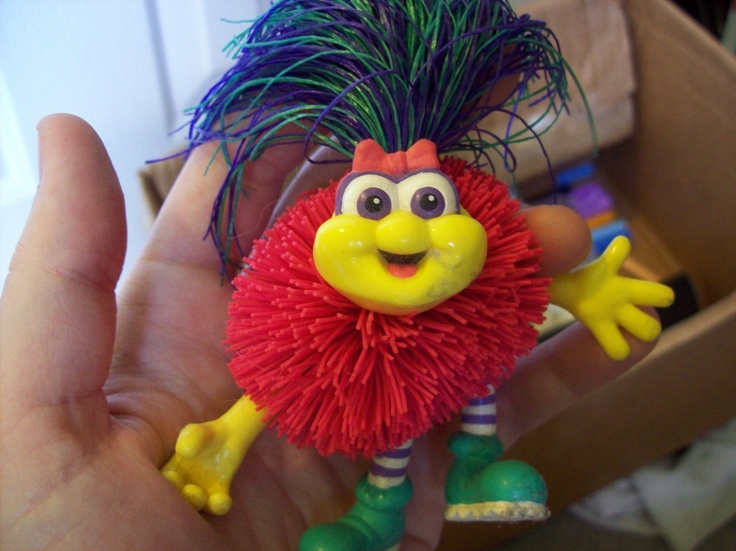
- The brand successfully expanded into character-based lines like Koosh Kins to maintain its reach.
That last point is huge. Plenty of toy crazes burn bright and then get dropped the second a kid decides something feels babyish. The Koosh ball dodged that trap. It never came off as too young. It was not cute in the cuddly sense. It was not aggressive either. It was bright, odd, and satisfying, which gave it a longer runway.
You can see why it stuck in memory more vividly than some toys with bigger marketing budgets. It had a gimmick, yes, but the gimmick was physical sensation. That is much harder to outgrow.
Why It Still Has a Place in Retro Culture
Some nostalgia is all image. You remember the box, the commercial, or the logo. The Koosh ball is different because memory kicks in through your hand first.
You can spot one across a room and almost feel it before you touch it. That kind of sensory recall is powerful. It is the same reason old scratch-and-sniff stickers, slap bracelets, and jelly shoes still light up a certain part of the brain. The body remembers.
The Koosh ball also fits the bigger story of 80s play. This was a decade that loved personality, color, and weirdly specific ideas. It also loved toys that crossed lines. A kid could hug classic Pound Puppies, race to the VCR for cartoons, then spend the next half hour absentmindedly tossing a Koosh ball around the room. That mix of emotion, spectacle, and pure tactile fun is the decade in miniature.
Even now, the toy has that instantly recognizable look. Wikipedia’s Koosh ball entry notes how the line expanded over time, but the original version is still the one people picture first. Beyond the basic design, fans remember the expansive reach of the brand, ranging from the cosmic themes of the Koosh Galaxy series to the excitement of the Star Wars Koosh collaborations. Collectors also gravitated toward character-themed Koosh Cameos, while those looking for more action could experiment with the paddle playset or the long-distance fun of the Koosh Woosh launcher. The classic ball remains the foundation of these memories, as those bright strands and that signature rubbery bounce instantly transport you back in time.
Not every 80s toy can do that without batteries, theme music, or a single catchphrase.
Frequently Asked Questions
Who invented the Koosh ball?
The Koosh ball was created in 1986 by Scott H. Stillinger. He developed the design after looking for a toy that would be easier for his own young children to catch and hold onto.
Where does the name ‘Koosh’ come from?
The name is onomatopoeic, inspired by the distinct, soft sound the ball made when it landed in someone’s hand. The inventor felt the word perfectly captured the experience of catching the toy.
Why was the Koosh ball so popular in classrooms?
Teachers often tolerated the Koosh ball because it was light, soft, and easy to control. Its rubbery design ensured it wouldn’t bounce uncontrollably or cause damage, making it a safe choice for indoor environments.
Did the Koosh ball have any character-based versions?
Yes, the brand expanded significantly over the years to include themed lines like Koosh Kins and Koosh Galaxy. There were also collaborations with major franchises like Star Wars and various playsets like the Koosh Woosh launcher.
Why It Still Feels So Right
The Koosh ball lasted because it met people at the most basic level: touch, motion, and play. There was no setup required, no pressure to perform, and no need to explain why it was fun.
That is why it still pops up in retro conversations with so much affection. You did not have to be the biggest toy collector on the block to love one. You only had to hold it once, give it a squeeze, and hear your brain say that this thing rules. Ultimately, the Koosh Ball remains the gold standard of the modern fidget toy, offering a simple, low-pressure way for anyone to engage their senses and find a moment of tactile satisfaction.