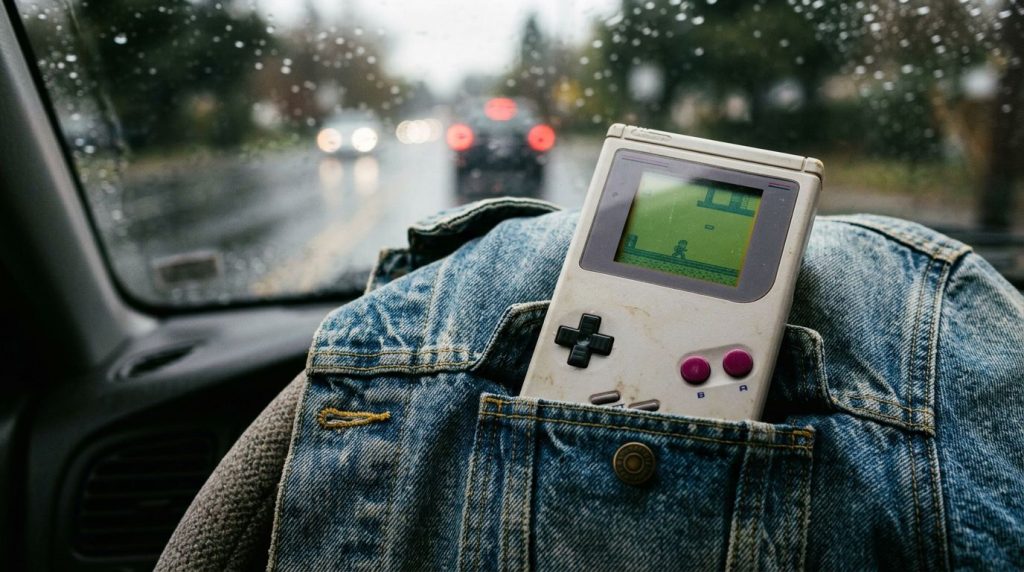
You didn’t need to own a Game Boy to know who had one. You heard it in the back seat, saw it at recess, and spotted that gray rectangle peeking out of a denim jacket pocket like buried treasure.
That was the magic. It wasn’t only a game system. It was freedom in plastic form, a tiny escape hatch for car rides, waiting rooms, sleepovers, and rainy afternoons when the TV was already taken.
So why did this chunky little handheld become the one everybody wanted? A lot of it came down to simple things done right.
The Grey Brick That Changed Everything
When the original Game Boy hit Japan in April 1989 and North America that July, it didn’t look slick or futuristic. The Game Boy release history makes the timeline clear, but the real memory is visual: gray shell, black D-pad, purple buttons, greenish screen. More calculator than spaceship.
And yet, kids wanted it instantly.
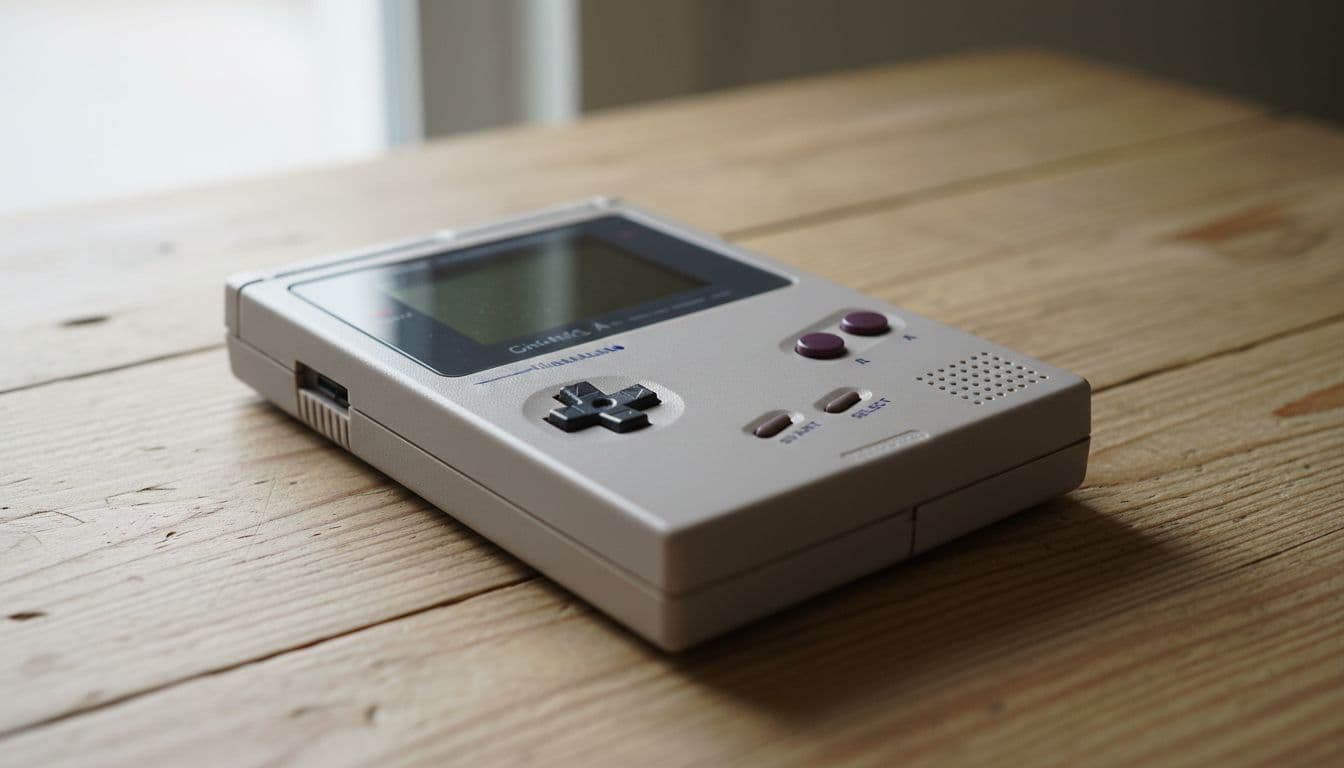
It had a certain no-nonsense charm. The thing looked like it could survive a backpack, a carpeted floor, and one clumsy grab from your little cousin. It wasn’t delicate. It didn’t ask for careful handling. It felt sturdy, owned, lived with.
That mattered more than people sometimes remember.
A home console was a shared event. The Game Boy was personal. Your save file. Your batteries. Your turn. It let kids carry a little piece of their entertainment with them, and that was still a fresh idea in the late 80s.
The Game Boy didn’t need to impress you across the room. It only needed to be in your hands when the day got boring.
It also arrived at the right moment. Nintendo already had trust with families because of the NES. Parents who might have been wary of new gadgets at least knew the name on the box. Kids, of course, didn’t need much convincing. Portable Nintendo? Done. Sold. End of discussion.
The funny part is that the original model wasn’t fancy even by its own era. The screen could blur. It had no backlight. The speaker wasn’t exactly concert quality. None of that killed the appeal. If anything, those quirks became part of the memory. You angled it toward the window. You turned the volume wheel a little too high. You learned the machine.
That bond counts for a lot.
Why Families Said Yes to the Game Boy
Kids wanted the Game Boy because it was fun. Families often said yes because it was practical, or practical enough.
Here’s the short version of what made it easy to love:
| What it offered | Why it mattered in real life |
|---|---|
| Portable play | It went to the car, the couch, grandma’s house, and the dentist’s office |
| Strong battery life | Four AA batteries lasted long enough that parents didn’t feel tricked |
| Tough build | It handled bumps, drops, and everyday kid chaos better than many toys |
| Big game library | One handheld could keep paying off as birthdays and holidays rolled around |
| Shared appeal | Kids played it, siblings borrowed it, and adults got hooked on Tetris |
That table is the whole case, right there.
Portability was the headline feature, but battery life may have been the secret weapon. Flashier handhelds came along, but the Game Boy had stamina. You could toss in batteries and expect a long stretch of play, not a quick burst followed by disappointment. For parents, that meant fewer complaints on long trips. For kids, it meant the system was ready when it mattered.
Then there was durability. The original unit felt solid in a way many toys didn’t. It had weight. It had grip. It had that reassuring “thunk” when you set it down on a table. If you grew up in that era, you probably remember at least one Game Boy with a scratched screen cover, a worn battery door, or a bit of tape holding life together. And it still worked.
That kind of reliability turned desire into loyalty.
The Game Boy also solved a family problem without announcing it. It gave one child something to do without taking over the living room. No fight for the television. No crowd around the console. No whole-house event. It was small, self-contained, and weirdly peaceful.
For a lot of households, that made the purchase feel less like a splurge and more like a smart call.
The Games Made the Hardware Impossible to Ignore
A handheld can be sturdy and portable all day long, but without games, it becomes a fancy paperweight. The Game Boy had the opposite problem. Its library kept giving kids new reasons to obsess over it.
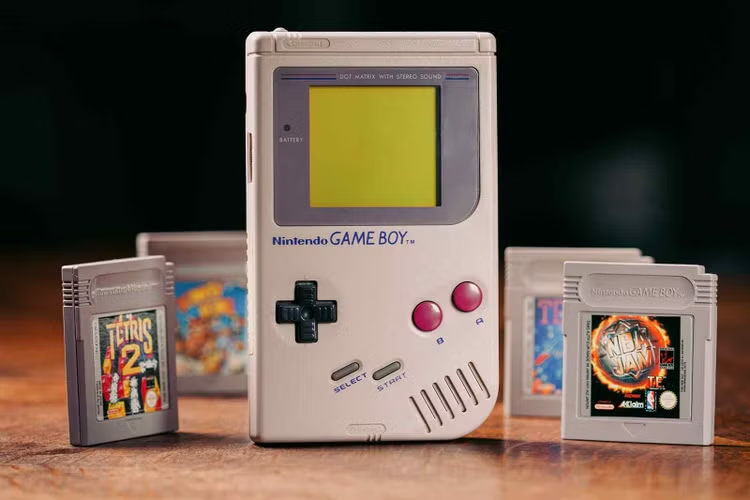
Start with Tetris, the title that turned the system into a cross-generational magnet. In many regions, the Game Boy came bundled with it, and that was a masterstroke. Kids loved it. Parents understood it in five seconds. Older siblings stole turns. Even people who claimed they didn’t care about video games suddenly cared a whole lot about lining up blocks.
Then came Super Mario Land, which felt a little strange, a little speedy, and completely irresistible. It wasn’t just “Mario, but smaller.” It proved Nintendo could put a real platformer in your hands and have it feel like an event.
A few years later, The Legend of Zelda: Link’s Awakening made the Game Boy feel almost improbably rich. This was a full adventure, not a watered-down side item. It had mystery, personality, and that wonderful sense that your tiny screen was somehow holding a huge world.
And then, of course, came Pokemon.
If Tetris made the Game Boy universal, Pokemon made it social in a new way. Now the handheld wasn’t only something you played. It was something you brought with you because someone else might have one too. Trades, battles, rumors, schoolyard myths, whispered tips about where to find rare monsters, it all fed the machine.
That’s a big reason the Game Boy’s run lasted so long. The library had range. It could handle five minutes in a waiting room or a full summer obsession. It had puzzle games, platformers, RPGs, sports titles, oddball experiments, and licensed stuff that filled Christmas wish lists.
The best handhelds don’t only pass time. They create rituals. The Game Boy had those in abundance.
Playground Status in a Plastic Shell
Let’s be honest, part of the appeal was social.
If a kid pulled a Game Boy out at school, on a bus, or during a family gathering, heads turned. Maybe not a whole crowd, but enough. It had presence. You wanted to see what game was in it. You wanted a turn. You wanted to hear the music. You wanted, at minimum, to hold it for a second and feel what all the fuss was about.
That kind of object becomes more than hardware. It becomes currency.
Not money currency, playground currency. The kind built from attention, envy, and bragging rights. Did you beat that level yet? Did you get farther than me? Did you bring the Link Cable? Those questions mattered. They weren’t life-or-death, obviously, but they shaped the small daily drama of being a kid.
The Game Boy also created a perfect little stage for hand-offs. “Here, try this.” “Watch this part.” “Don’t mess up my save.” That social rhythm helped. A handheld sounds solitary on paper. In real life, it was often communal, with one person playing and three more watching from odd angles.
By the time Pokemon hit full force, that social side exploded. Trading and battling turned the Game Boy into a connector. You didn’t only own a system. You belonged to a little network of other kids with systems.
And because it traveled well, it kept showing up. On vacations. In minivans. At cousins’ houses. In malls, food courts, and Little League bleachers. The NES stayed home. The Game Boy came with you.