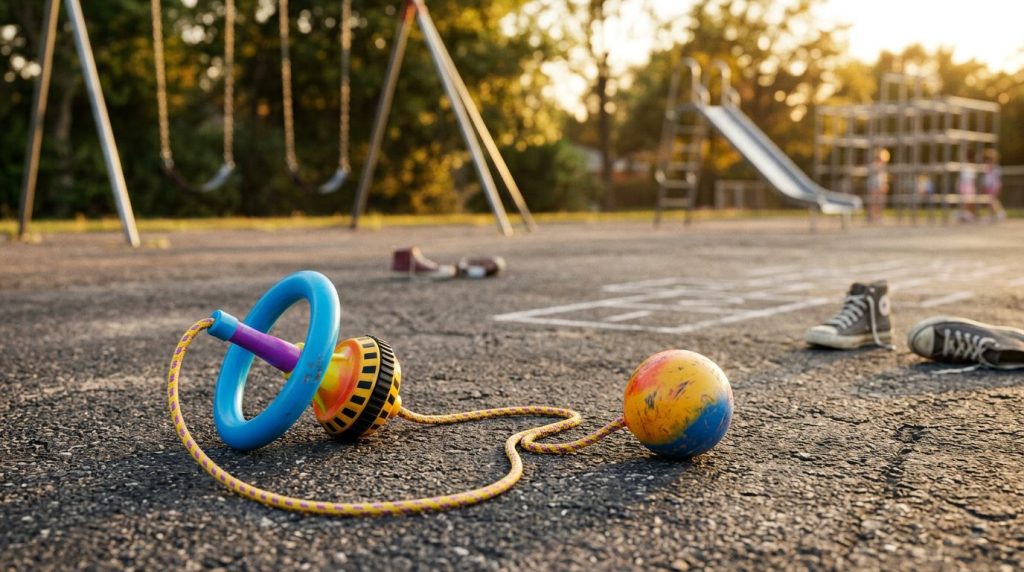
One plastic hoop, one swinging ball, one badly timed jump, and suddenly the whole playground had an audience. The Skip-It toy looked almost too simple to become a sensation, yet this classic toy drew kids in to take a turn, count the clicks, and beat somebody else’s score.
If you grew up around the late 1980s or early 1990s, you remember the sound before you remember anything else, turning the experience into a cherished childhood memory. Clack. Jump. Clack. Jump. It was recess percussion, right alongside jump-rope chants, sneaker squeaks, and outdoor fun that kept everyone moving during the school day.
The Skip-It craze didn’t happen by accident. This little ankle-powered spinner had the right look, the right challenge, and one very clever feature that turned playtime into a personal high-score showdown.
Key Takeaways
- The Skip-It toy combined jump rope, solo play, and a simple score-chasing challenge.
- Its roots go back to ankle ring toys sold in the 1960s and 1970s.
- Tiger Electronics brought the best-known version to kids in the late 1980s.
- The built-in counter made every successful jump feel official.
- This inexpensive, portable, physical retro toy was perfectly built for recess competition.
The Skip-It Toy Had a Brilliantly Simple Hook
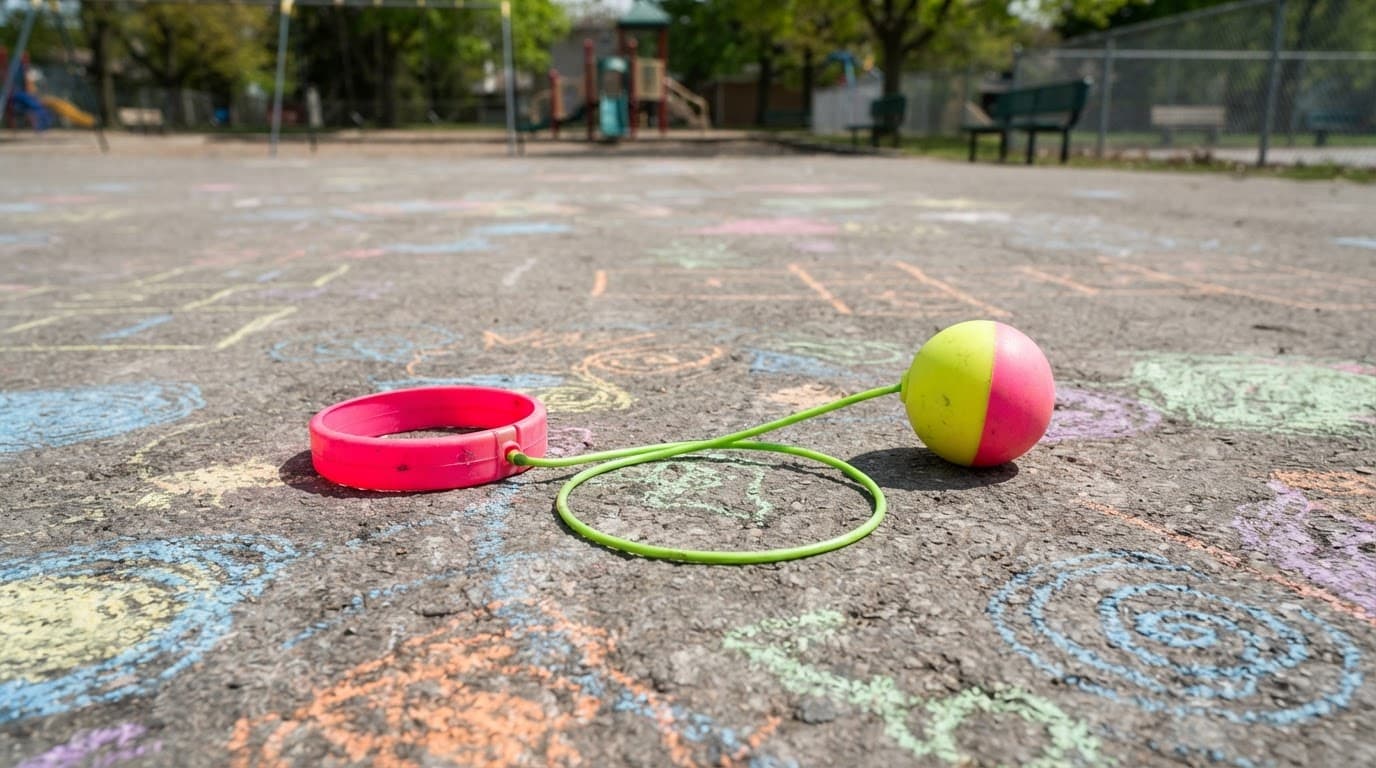
Skip-It didn’t need batteries, a television tie-in, or a complicated rulebook. You slipped the plastic hoop around one ankle, swung the ball in a circle, and hopped over it with the other foot to keep this active game going. That was the whole deal.
Of course, “the whole deal” became a lot more dramatic once you started missing.
A clean rhythm made you feel untouchable. One stumble could send the ball into your shin, tangle the cord, and make you start over while your friends pretended not to enjoy it a little too much. Every kid with a Skip-It had a personal relationship with that plastic ball. It could be your best friend for five minutes, then turn into a tiny neon wrecking ball.
The idea itself wasn’t brand-new. Ankle-skipping toys had been bouncing around playgrounds for decades. Similar products included Jingle Jump in the 1960s, Footsee in Canada, and Chemtoy Corporation’s Lemon Twist in 1975. The history of Skip-It and its earlier cousins is longer than many people realize.
Tiger Electronics acquired the rights in 1988, then helped make the toy feel fresh for a new generation. The familiar version had bold colors, a comfortable ankle ring, a weighted ball, and the feature that changed everything: a mechanical counter.
It wasn’t a toy you watched somebody else use. It was a toy that immediately handed you a challenge.
A Skip-It didn’t ask kids to imagine a score. It clicked the score into place, one jump at a time.
That Tiny Counter Turned Play Into a Big Deal
Before the counter, you could claim you had done 500 jumps. Your friends could raise an eyebrow. End of discussion.
With Skip-It, the toy kept receipts.
The early version featured a mechanical number window, while later 90s iterations sometimes leaned toward a digital counter, ticking upward every time the spinner completed a rotation. It wasn’t an electronic scoreboard with lights and sound effects. It was a humble little number window. But to a kid on blacktop, that number carried serious weight.
Did you get 26? Nice.
Did you get 126? Okay, now we’re talking.
Did you lose your rhythm at 999 because your little brother walked past you? Tragedy. Full daytime-drama tragedy.
That counter turned a physical toy into a game of measurable progress. You could practice alone on the driveway, building a fond childhood memory that stuck with you for decades. You could compare high scores at school. You could set a new personal best without needing teams, equipment, or someone willing to hold one end of a rope.
The patent for a Skip-It rotation counter was issued in 1990 to Avi Arad and Melvin R. Kennedy. Arad later became a major name in Marvel film production, which is one of those gloriously strange pop-culture side roads. The person connected to a plastic playground spinner also had a hand in helping bring superheroes to movie screens. Life is weird. The 1980s were weirder.
The toy also gave kids a rare mix of independence and bragging rights. Jump rope often required a partner. Four Square required a court. Tag required a crowd. Skip-It only required a patch of open ground and enough confidence to risk a shin bonk.
It Was Made for the Recess Economy
Recess had its own rules. You needed a toy that was easy to carry, quick to explain, and exciting enough to pull a crowd, making it the ultimate piece of outdoor fun. Skip-It checked every box.
It was compact. It fit under an arm or in a school bag. There were no tiny game pieces to lose in the grass. No board to flatten. No cards to blow across the playground the second a breeze came through.
Better still, it created a social scene without demanding a group, which is why this recess activity became so popular. One kid jumped. Others watched, called out the count, waited for a turn, or tried to distract the jumper at exactly the wrong moment. Skip-It could be solitary exercise or full-blown playground theater, depending on who was standing nearby.
That made it different from the big-ticket toy crazes of the decade. A Cabbage Patch Kids holiday craze could send adults into a shopping frenzy, while Skip-It was the kind of thing a kid could put to work that same afternoon. No adoption papers. No accessories. No elaborate origin story. Just spin and jump.
The toy’s TV commercials helped, too. Tiger Toys advertised Skip-It during children’s programming, including daytime Nickelodeon. Those ads had a familiar message: this wasn’t exercise, it was fun. And honestly, they weren’t wrong.
Kids weren’t thinking about coordination or cardio. They were thinking, “Can I beat 83?”
Neon Plastic, Big Motion, Zero Boredom
As a quintessential retro toy, the Skip-It looked like it belonged in the period. Bright pinks, electric greens, sunny yellows, and purple accents were not shy colors. The thing had the visual confidence of a Trapper Keeper and the bounce of a Saturday-morning commercial.
That mattered. Toy shelves in the late 1980s were loaded with color and personality. Even toys without faces had to look like they were ready to party.
Skip-It also had motion built into its design. A ball whipping around an ankle is hard to ignore, creating distinct sound effects as it moved through the air. It created noise. It made a visible circle. It invited the question every toy wanted to inspire: “Can I try?”

The danger, such as it was, became part of the legend. Most people who owned one remember getting clipped by the ball at least once. You’d misjudge the timing, catch the spinner with your ankle, and hop around like the playground had suddenly turned into hot lava.
Then you’d reset it and try again.
That little risk made success sweeter. A flawless run felt earned because the Skip-It could expose a sloppy jump instantly. No mercy. No excuses. The counter knew.
Modern nostalgia posts still revisit the toy’s combination of competition, exercise, and occasional ankle drama, including this Skip-It memory reel. Because this nostalgic toy left such a lasting impression, the jokes land easily today since everybody had a score, and everybody had a story about getting whacked.
Why It Crossed From the 80s Into the 90s
Skip-It is often filed under 1990s toys, and that makes sense. Its biggest cultural moment arrived in the early 1990s. But its famous Tiger Electronics version was already on the scene in the late 1980s, which gives it a foot in both decades. Pun fully intended.
That overlap helped it stick. The late 1980s loved toys with a visible trick or built-in mechanism. Think of the secret transformations in M.A.S.K. transforming vehicles, or the storytelling machinery inside Teddy Ruxpin. Skip-It had no secret compartment, but its digital counter had the same irresistible message: this toy does more than it first appears to do.
It also fit the era’s growing love of personal scores. Arcades had high scores to beat on glowing screens. Handheld games had levels to clear. Fitness culture was everywhere, from aerobics classes to neon sweatbands. Skip-It translated that mood into a kid-sized challenge with no screen required.
And it didn’t demand a major purchase. The toy was far more accessible than a game console, a bike, or a giant playset. One Skip-It could become the center of a whole recess because its value wasn’t locked inside the box. The action began when somebody started spinning.
The Toy’s Secret Was That It Let Kids Get Good at Something
A lot of beloved toys are about owning the thing. Skip-It was about improving at the thing.
The first few tries were awkward. You would swing too fast, jump too early, stare at the ball instead of trusting the rhythm. Then something clicked. Your body learned the beat. The ball circled. Your sneaker cleared it. The counter kept climbing.
That learning curve gave the Skip-It toy real staying power. Because it functioned as an active game, it was never solved in ten minutes. You could always aim for a cleaner run, a bigger score, or a more impressive trick. Some kids switched feet. Some sped up. Some tried to keep going long after their legs had politely requested a break.
There was no final boss, but there was always somebody nearby who claimed they had gotten a number you couldn’t touch.
That was enough.
Frequently Asked Questions
What is a Skip-It toy?
A Skip-It is a popular retro playground toy consisting of a plastic ankle ring attached to a long cord with a weighted ball on the end. Players place the ring on one ankle, swing the ball in a circle, and hop over it with the other foot while tracking their rotations on a built-in counter.
Who made the famous Skip-It version?
While earlier ankle-skipping toys existed for decades, Tiger Electronics acquired the rights in 1988 and popularized the iconic version known to 80s and 90s kids. This modern iteration featured bright neon colors, a comfortable ankle ring, and a mechanical rotation counter.
How did the counter work?
The built-in mechanical or digital counter ticked upward automatically every time the spinning ball completed a full rotation around the player’s ankle. This simple feature transformed solo play into a competitive game where kids could track their progress and challenge friends.
Did Skip-It hurt if you messed up?
Yes, getting hit by the swinging ball was a well-known rite of passage for anyone who played with a Skip-It. Missing a jump usually sent the plastic ball straight into your shin or ankle, turning minor miscalculations into a brief, comical playground drama.
Why We Still Remember That Clack-Clack Sound
The Skip-It toy became a recess favorite because it understood what kids wanted before anybody put that idea into marketing language. It was colorful, physical, competitive, slightly chaotic, and easy to turn into a shared event.
Its clever counter gave every jump a number. Its spinning ball gave every mistake a sting. And its simple rhythm made it hard to stop after one more try.
For a few glorious minutes on the playground, a plastic hoop and a clicking ball from this classic toy could make you feel like the reigning champion of recess.