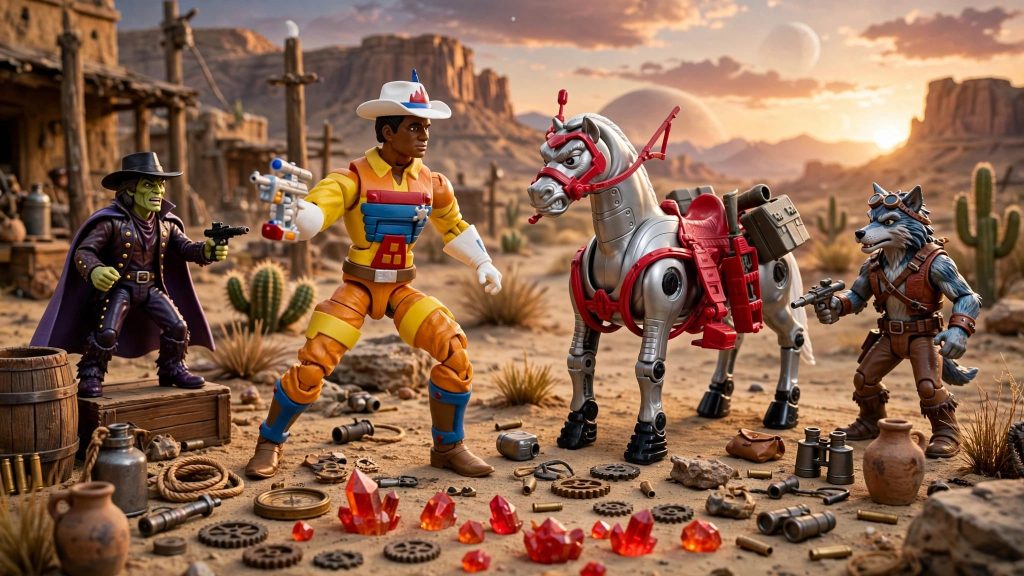
Bravestarr toys gave us a space marshal, a robot horse, and villains ready to rob a bank on another planet. The toy line launched in 1986, a year before Filmation’s cartoon premiered on television.
For collectors, the appeal is still wonderfully specific: oversized figures, electronic shootouts, and a frontier town built around Kerium, a precious mineral. Missing accessories and unreleased characters can make the lineup confusing.
Let’s put BraveStarr’s heroes, outlaws, and tiny plastic nuggets in their proper places.
80s Article Snapshot
•Mattel’s BraveStarr toy line launched in 1986, before the cartoon premiered in September 1987. A December 1986 report said more than $15 million worth of figures and accessories had shipped to stores, but Mattel still had weak sales.
•The standard action-figure roster has eight characters. Thirty/Thirty, the robotic stallion, is generally cataloged separately as a horse or vehicle.
•Figures stood about eight inches tall and came with character-specific accessories. Kerium nuggets, correct equipment, and working electronics all matter when checking completeness.
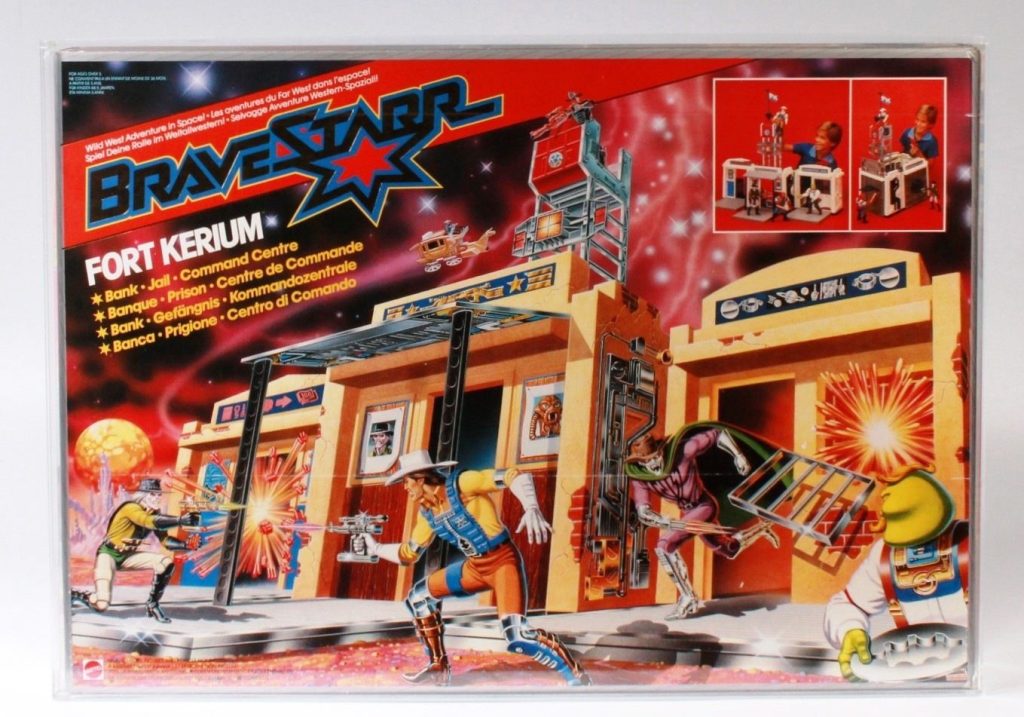
•Fort Kerium was sold as a combined playset and as three separate sections: the Command Center, the Bank, and the Jail. Planned follow-up characters and the Starr Hawk vehicle never reached regular retail.
•Condition and original accessories are more useful buying criteria than a seller’s “rare” label. Check recent sold examples and include shipping, tax, and replacement parts in your total.
The Bravestarr Toys Beat the Cartoon to Town
Filmation conceived BraveStarr, but Mattel’s toys reached stores before Filmation’s television series premiered in September 1987.
That’s quite a head start for a toy line asking kids to fall for unfamiliar characters.
hobbyDB’s BraveStarr toys history dates Mattel’s launch to 1986. A December 1986 Los Angeles Times report said more than $15 million worth of figures and accessories had shipped to stores the previous month.
That figure describes shipments, not purchases by delighted kids. Mattel suffered weak sales despite the ambitious rollout.
The premise deserved attention, though. BraveStarr mixed frontier lawmen, mining-town trouble, robots, and alien technology. The cartoon’s marshal had animal-inspired powers; the toy aisle had an electronic showdown waiting to happen.
And the spelling? BraveStarr is the franchise’s stylized name. “Bravestarr” is the ordinary search-friendly version you’ll encounter in listings. That capitalization difference doesn’t identify a separate release or variant.
The Original Bravestarr Toys Checklist
The standard roster contains eight characters. The marshal’s robotic stallion companion belongs in a collection but is generally cataloged separately as a horse or vehicle.
Here’s the core lineup of action figures, without counting packaging or electronic variations as additional characters.
| Side | Standard action figures |
|---|---|
| Heroes | Marshal BraveStarr, Deputy Fuzz, Colonel Borobot, Handlebar |
| Villains | Tex Hex, Outlaw Scuzz, Thunder Stick, Sand Storm |
| Heroic companion | Thirty/Thirty, the robotic stallion |
The marshal and Tex Hex are the natural starting pair. One brings frontier-hero confidence; the other looks like trouble before he’s moved a single joint.
Deputy Fuzz adds little-guy charm, while the other heroes fill out the lineup. The villains bring outlaw swagger, machinery, and creature-feature personality.
Listings may use “Marshal Bravestarr” for the marshal. The franchise styling is BraveStarr, and the spelling doesn’t indicate a separate variant. Other listings may split Handlebar into two words, spell Scuzz with a k, or combine Thunder Stick into one word. Some references shorten the colonel’s name to Brobot.
The illustrated BraveStarr checklist helps separate naming variations from genuinely different products. A seller’s spelling alone doesn’t make a figure rare.
Big Figures, Little Nuggets, Plenty of Personality
Eight Inches of Toy-Aisle Confidence
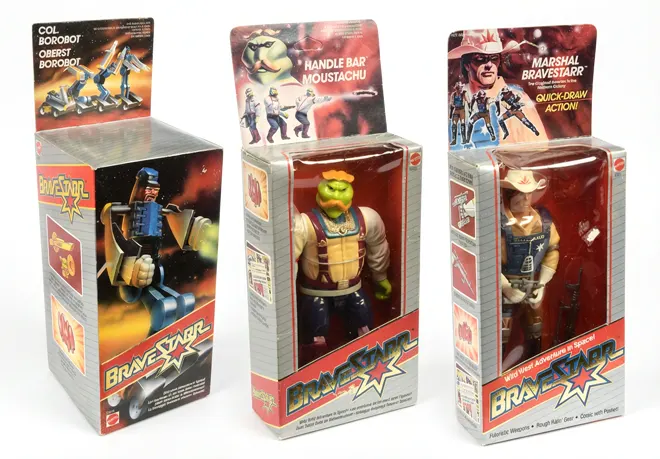
The main action figures stood about eight inches tall, with articulation and individual play features. They were large for their era, particularly beside the smaller figures in the G.I. Joe toy line.
The BraveStarr toys actions figures had presence. Big boots. Big weapons. Enough shelf space to make your other figures reconsider their personal boundaries.
Mattel packaged them in windowed boxes, so collectors now have more to assess than the figure itself. The window, cardboard, inner tray, and printed material all matter when comparing boxed examples.
Kerium Was Part of the Package
Figures came with accessories and, depending on the character, one or more Kerium nuggets, the toy version of New Texas’s valuable mineral. Those little pieces helped tie the figures to the setting.
They also made ideal candidates for disappearing beneath the furniture.
Sand Storm’s water-blasting feature is documented, as are the electronic action features on Laser-Fire versions of BraveStarr and Tex Hex. Accessories varied by character.
A figure standing upright with its gun isn’t automatically complete. Nuggets, character-specific accessories, and the correct equipment belong in that conversation too.
Fort Kerium and the Frontier Vehicles
One Town, Three Separate Sections
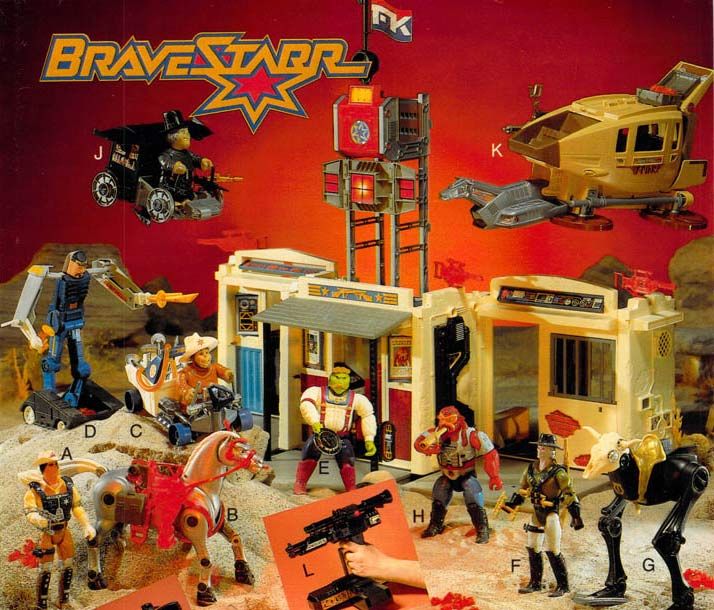
Fort Kerium was the line’s frontier headquarters, with the essentials every space-Western adventure needed: a place to give orders, store valuables, and lock up trouble.
Mattel sold the playset as a combined setup and in three separate sections:
- The Command Center.
- The Bank.
- The Jail.
That modular arrangement matters today. A listing for “Fort Kerium” may describe one section rather than the complete setup.
Compare the buildings and their included components, not just the listing title. Check the doors, attached fittings, stickers, and loose accessories before calling a collection complete.
Stagecoaches and Skeletal Trouble
The vehicle lineup included the Stratocoach, Tex Hex’s Skull Walker, and Thirty/Thirty.
A stagecoach in a science-fiction toy line? Absolutely. That combination was the whole charm.
The Stratocoach brought the frontier theme to the vehicle range. Skull Walker gave Tex Hex a sinister ride, while Thirty/Thirty completed BraveStarr’s team.
For a focused display, the marshal and his robotic partner make the premise clear. Add Tex Hex and a section of the fort for a compact New Texas scene.
Laser-Fire Backpacks and the Toy Guns
The Electronic Showdown
Marshal BraveStarr and Tex Hex had Laser-Fire versions with backpacks that used infrared beams and electronic sound effects. Blue marked the heroes’ equipment; black suited the villains.
Mattel also sold the backpacks separately, so a loose figure and its backpack may have come from different purchases.
The system registered infrared hits with electronic sounds. For an 80s toy, that was a persuasive sales pitch.
When buying now, distinguish “backpack included” from “electronics demonstrated working.” Clean-looking equipment can still have battery corrosion, damaged contacts, or silent circuitry. A photo can’t prove the sound effects work.
Neutra-Laser and the Other Role-Play Sets
The hand-held Neutra-Laser pistols used sounds and infrared beams, with target equipment and compatibility with the Laser-Fire system.
These role-play products were toy guns for kids, unlike the small weapons held by the figures. That distinction matters when a listing casually promises an “original BraveStarr gun.”
Mattel’s other named products included the Tex Hex Sound Pistol ‘N Holster and the Kerium Special Target Game Set.
Keep these products separate on your want list. A sound pistol, a Neutra-Laser set, and a figure-scale accessory aren’t interchangeable purchases, even when listings describe them all as lasers.
The Cancelled Wave and the Wider Merchandise
The Characters That Never Reached Regular Retail
The planned follow-up included Judge J.B. McBride, Long Arm John, Rampage, and Dingo Dan, plus the Starr Hawk vehicle.
They weren’t part of Mattel’s released retail lineup.
The BraveStarr merchandise history links the abandoned continuation to Filmation’s 1989 shutdown. Accounts differ on the exact cancellation timing, so the studio closure might not tell the whole story.
Independent makers have produced bootleg versions of planned pieces. Those can interest fans who want the missing characters, but they aren’t vintage production toys.
An unreleased character appearing online doesn’t mean a forgotten second wave has suddenly surfaced.
Books, Comics, and Computer Screens
BraveStarr also escaped the toy aisle.
Ladybird published four books in 1987: The Phantom Herd, The Tail Drive, The Rodeo, and The Great Kerium Robbery. Blackthorne Publishing’s BraveStarr in 3-D comic began in January 1987.
A 1987 home-computer game appeared for the ZX Spectrum, Amstrad CPC, and Commodore 64. It belongs in the computer-game category, rather than being described as a home-console release.
These extras offer another collecting lane. A book or comic can bring the artwork and atmosphere into a display without requiring another large vehicle.
For some of us, that printed cover art supplies an awfully strong nostalgia hit all by itself.
Buying Vintage BraveStarr Without Buying Trouble
Choose Your Collection Before Your First Bid
Start by choosing a few favorite characters, such as Marshal Bravestarr, a loose-complete lineup, or boxed examples.
Those are different budgets and different hunts.
Original BraveStarr toys remain available through secondary-market sellers. Use the Thirty/Thirty marketplace listing to browse eBay results, but treat asking prices as seller expectations, not completed sales.
Search eBay with both “BraveStarr” and “Bravestarr.” The alternate spelling is a search aid, not a distinct release.
For collectors, compare recent sold examples with matching condition, accessories, and packaging. Include shipping, tax, auction premiums, and replacement parts in your total.
Our guide to buying vintage 80s toys follows the same full-cost approach. A cheap figure can become expensive after you hunt down its missing gear.
Condition Beats a Breathless “Rare” Label
There isn’t a documented rarity ranking that makes any released figure an automatic holy grail. Completeness and condition are more useful buying criteria.
Accessory-heavy examples and working Laser-Fire equipment are harder to find complete than bare figures.
Inspect exposed finishes and mechanical connections, and account for each playset section and fitting. Check joints, cracks, paint, battery compartments, and repaired areas.
Clear photographs should show molded markings, accessories, and every side of a box. Reproduction nuggets, weapons, stickers, or packaging can suit a display, but shouldn’t command original-part prices.
“Complete” should mean the correct original contents for that release, not enough accessories to make the photograph look busy.
A clean, opened favorite can be a happier purchase than a sealed trophy you’re nervous to handle.
Frequently Asked Questions
When were the BraveStarr toys released?
Mattel’s toy line launched in 1986. Filmation’s cartoon premiered in September 1987, after the toys had reached stores.
How many figures are in the standard BraveStarr lineup?
The standard roster contains eight action figures: four heroes and four villains. Thirty/Thirty, the robotic stallion, is generally listed separately as a horse or vehicle.
What are the Laser-Fire toys?
Laser-Fire versions of Marshal BraveStarr and Tex Hex had backpacks that used infrared beams and electronic sound effects. Mattel also sold the backpacks separately, so a loose figure and backpack may not have come together originally.
Were the planned follow-up characters released at retail?
No. Judge J.B. McBride, Long Arm John, Rampage, Dingo Dan, and the Starr Hawk vehicle weren’t part of Mattel’s released retail lineup. Independent makers later produced bootleg versions of some planned pieces, which aren’t vintage production toys.
A Frontier Worth Revisiting
BraveStarr packed big figures, electronic duels, a modular town, and a robotic stallion into a short-lived Wild West sci-fi line.
BraveStarr’s released toys offer documented details, while collectors bring their own memories and preferences.
That mix of space-age adventure and Western style gives Fort Kerium and the line lasting appeal.