Identify original Starriors figures by matching the line’s design, interchangeable parts, molded markings, colors, and equipment together. The signature Wastor robots have wind-up weapons and tiny pilots tucked inside their heads, but those clues don’t authenticate every component on loose figures.
These little machines had chrome, moving weapons, and enough interchangeable limbs to capture the mix-and-match appeal of 80s toys. Forty years later, that appeal can make identification tricky.
Start with the robot’s construction, then give its parts their own inspection.
Key Takeaways
- The line debuted in 1984, with Marvel comics helping bring the robots to life.
- Wastors have interchangeable heads, arms, and legs, plus key-wind weapons and tiny Control Circuit pilots.
- R.A.T.S. recolors and the Radio Shack Galactic Walker can complicate identification.
- Original parts, working mechanisms, condition, and surviving packaging matter when comparing purchases.
Tomy, Marvel, and the Robot-Aisle Showdown
A 1984 Debut With Comic-Book Ambitions
The company developed Starriors as a line of robot action figures with interchangeable parts, introduced in 1984. The Starriors history overview places the line alongside its close relative, Zoids.
The company partnered with a comics publisher, and each toy included a publisher-issued mini-comic. These accompanied the separate four-issue, full-size Starriors series. The mini-comic scans at Retro-Geek offer a look at that pocket-sized storytelling.
Tiny robots. Big backstory. Absolutely appropriate for the decade.
Big Plans, Short Shelf Life
Starriors entered a crowded contest as a toyline, alongside Tonka’s GoBots, introduced in 1983, and Transformers, introduced in 1984.
Despite promises of a major marketing push and an animated series for 1985, Starriors was a commercial failure. Its second wave added a handful of Wastors plus Twinhorn and Windstorm.
That short run matters to this Collector’s Guide. A remembered robot might belong to a different category within Starriors, rather than an entirely different toy line.
How to Identify Original Starriors Figures
Start With the Wastor Construction
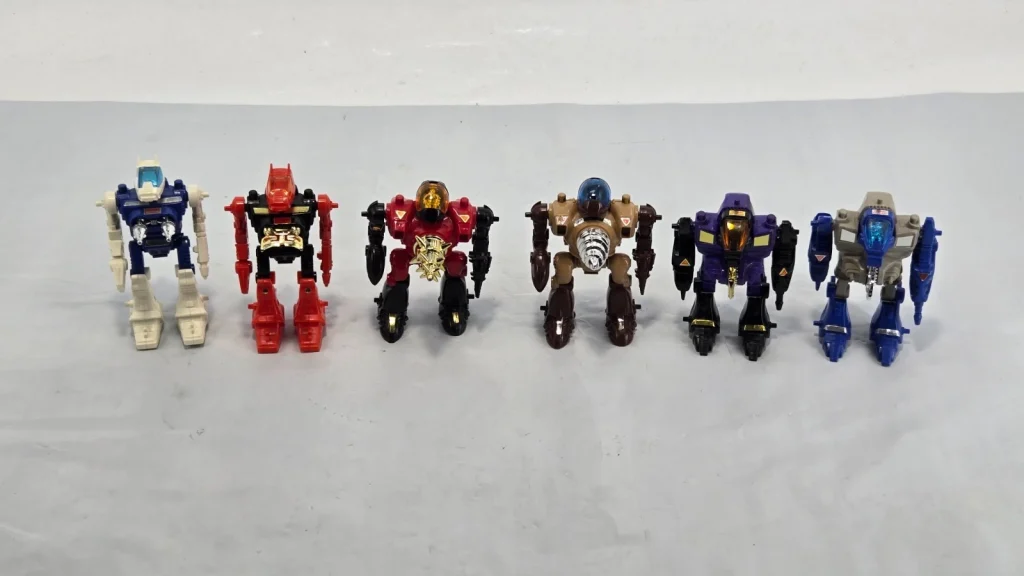
Wastors were the primary humanoid Starriors type. Their arms, legs, and heads were interchangeable, so a genuine vintage body can carry parts that originally belonged elsewhere.
Each had a key-wind motorized chromed weapon. Depending on the figure, the action could involve a spinning saw, reciprocating cannon, or chomping claw.
Inside the head sat a tiny pilot called a Control Circuit. These were based on pilots from Tomy’s related robot line, a family resemblance inherited from Starriors’ origins as an offshoot of that line.
That little passenger is a useful identification clue. It’s also exactly the sort of piece that could disappear into the carpet forever.
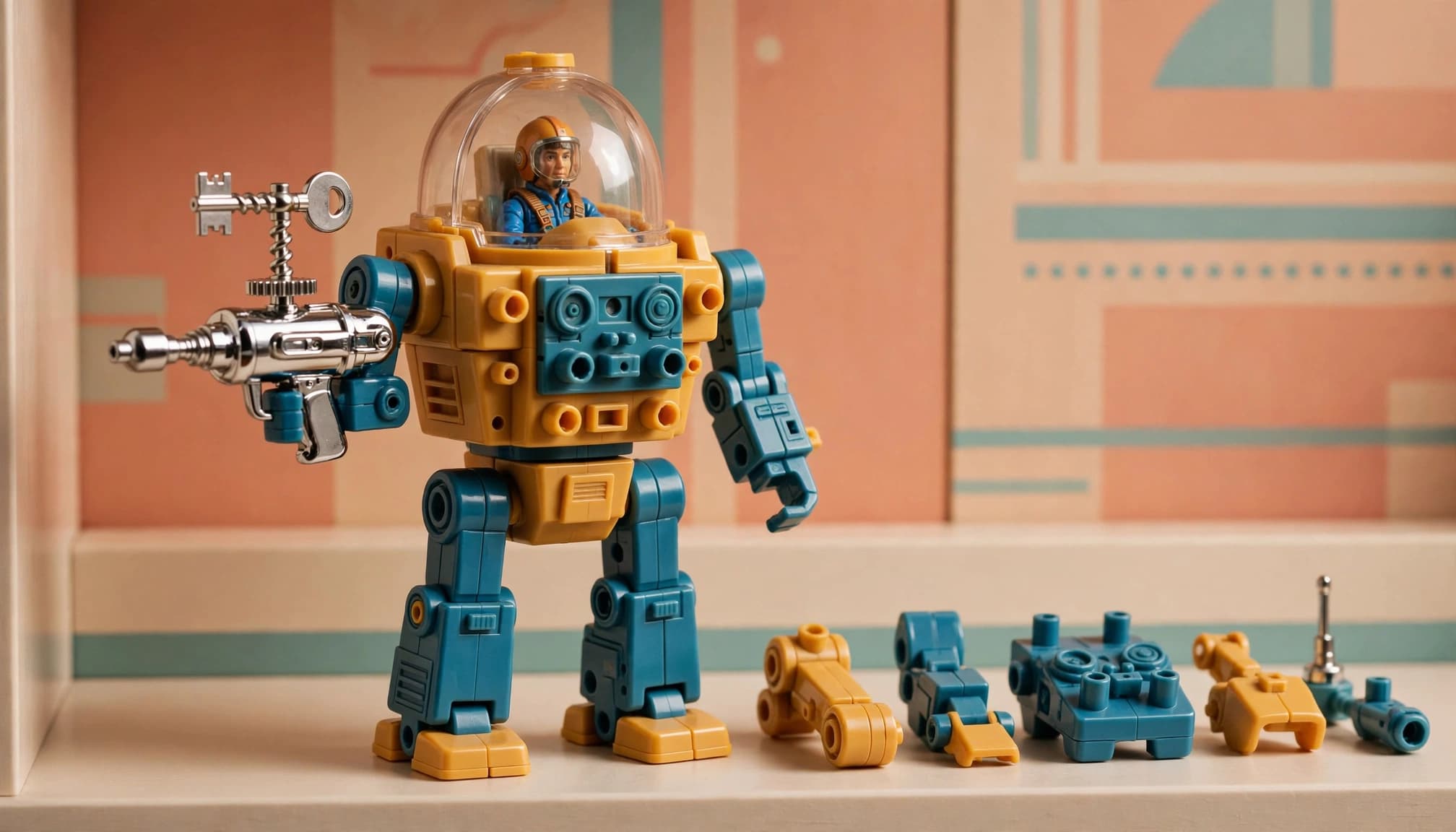
An illustrated tribute to the interchangeable robot toys of the 1980s.
Match the Details, Not One Magic Stamp
Compare the sculpt, materials, construction, plastic colors, paint, accessories, and components with documented examples. Comic artwork can help identify a character, but photographs show the toy’s actual construction.
Use this checklist when examining a candidate:
- Read the molded maker, copyright, and country details. A copyright date concerns the design, not necessarily the toy’s manufacture date.
- Check the plastic and other materials, along with the construction.
- Compare the paint, sculpt, and colors with documented examples.
- Check that the accessories and components match the specific version.
- Compare the packaging and toy with documented originals, reproductions, and later versions.
No single clue, including a material or marking, proves authenticity. Markings support an identification, but they don’t prove every attached component is original, correctly matched, or unaltered.
An original Starriors body can still have mismatched vintage limbs, replacement parts, or later paint.
Starriors Checklist: Wastors and Small Vehicles
Later Wastors and Their Factions
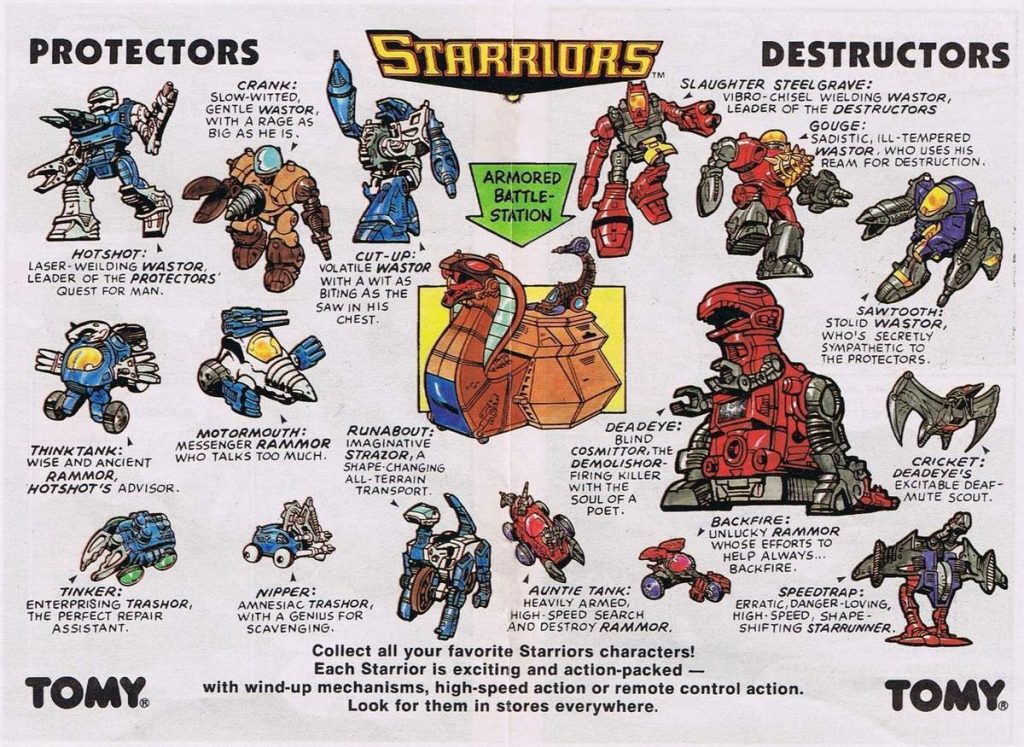
The later Wastor assortment included the Protectors Ripsaw, Flashfist, and Twinblade, alongside the Destructors Clawgut, Slice, and Bolar.
Use those names to narrow a search, then compare each robot’s head, body colors, limbs, and weapon. A figure assembled for maximum childhood destruction may no longer resemble its original configuration.
The Starriors collector’s picture archive is useful for sorting the line’s different toy categories visually.
Rammors and Trashors
The smaller vehicles deserve their own space on the checklist. Rammors used pull-back motors, while Trashors were the even smaller vehicle group.
Here are the named vehicles by faction.
| Type | Protectors | Destructors |
|---|---|---|
| Rammors | ThinkTank, Motormouth | Backfire, AuntieTank |
| Trashors | Tinker, Nipper | Scrapper, Grub |
These are separate toy types, rather than Wastors missing their legs.
Look at the whole chassis, wheels, weapon arrangement, and decoration. A small vehicle found beside a humanoid robot doesn’t automatically belong to it. Toy-box geography was never especially reliable.
The Bigger Robots, Remote Set, and Battlestation
Transforming Machines and Mechanical Mounts
Starriors figures stretched well beyond the familiar humanoids. Some transformed; others were large mechanical creatures that smaller figures could ride.
This category guide separates those larger releases.
| Toy or set | Character association | Identifying feature |
|---|---|---|
| Strazor | Runabout | Dinosaur-to-motorcycle transformation |
| Starrunner | Speedtrap | Ostrich-like creature converts to jet/hovercraft |
| Vultor | Windstorm | Large ridable mechanical creature |
| Stalker | Twinhorn | Large ridable mechanical creature |
| Cosmittor | Deadeye and Cricket | Remote-control set |
The product-type name and character name can both appear in collector descriptions. Knowing both helps explain why two listings for similar-looking toys might use different titles.
Cosmittor’s Cricket controller is described as a one-button, battery-free remote. Don’t assume every robot-era remote set needs a conventional battery-powered handset.
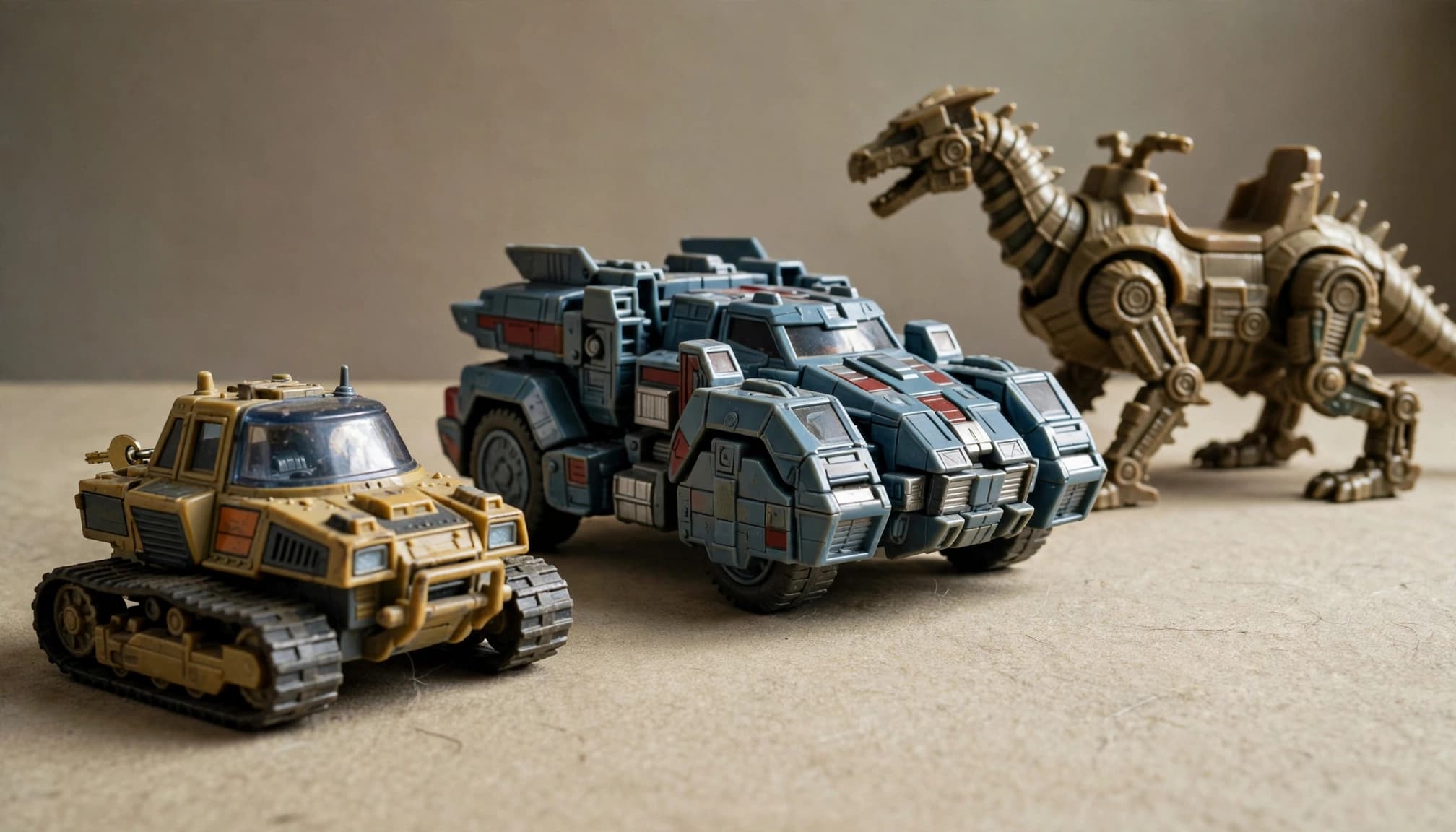
Illustrated robot vehicles and creatures capture the toy aisle’s wonderfully weird side.
The Citadel of Dreams
The Armored Battlestation was the line’s capstone playset. In the storyline, it was the Citadel of Dreams, rumored to be where Man slumbers.
Yes, even the playset had mysterious lore. A plain plastic headquarters apparently wasn’t enough.
When identifying a loose battlestation, compare the structure and its separate components individually. A recognizable main shell doesn’t establish completeness, and an impressive spread of loose pieces doesn’t establish that they all belong.
R.A.T.S. Recolors and the Galactic Walker
Familiar Molds, Different European Identity
Europe received R.A.T.S., short for Robot Anti-Terror Squad, which reused several Starriors toys in new color schemes.
Some reused second-series Wastor molds with different colors or weapons. A familiar body shape therefore doesn’t establish that a toy was sold under the Starriors name.
Treat an unfamiliar color scheme as something to identify through the whole toy and its packaging history. Calling it a rare Starriors variant immediately skips an important possibility.
Color alone is a particularly shaky shortcut with this family.
The Radio Shack Lookalike
Strazor’s Zoids-like design has another complication: the battery-motorized Radio Shack Galactic Walker knockoff.
Collectors can mistake the larger battery-powered toy for Strazor. Compare size, construction, power source, and transformation rather than trusting a dinosaur-shaped silhouette.
The family connections continued in fiction, too. After Tomy merged with Takara to form TakaraTomy, Starriors appeared as a separate universe within modern Transformers continuity. Ask Vector Prime material includes that later fictional connection.
That’s a fun crossover footnote, but it doesn’t make an old Transformers listing an accurate Starriors identification.
Condition, Completeness, and Buying Prices
Give the Moving Parts Some Attention
For loose Wastors, inspect connection points, head components, chrome wear, cracks, and evidence of glue. Ask whether anything has been repaired, repainted, or replaced.
A wind-up weapon’s presence and its working condition are separate questions. Request a short demonstration rather than accepting “looks complete” as proof that the mechanism operates.
Don’t force a resistant winding mechanism or brittle joint. These toys have earned gentler treatment than they received during their first living-room invasion.
For boxed examples, look at every package side, the insert, instructions, included comic, and contents. Original boxes can be difficult to find because so many were discarded.
Pay for the Toy That’s Included
Collectors hunt through eBay and conventions, using searches such as “Tomy Starriors,” “Starriors Wastor,” and individual character names.
Compare several completed sales for the same toy, condition, equipment, and packaging. Keep loose, loose-complete, boxed, and sealed examples in separate comparisons.
A high asking price tells you what a seller wants. It doesn’t establish what buyers are paying.
My rule is to count the whole purchase: price, shipping, tax, fees, and missing components. Our guide to buying vintage toys without overpaying follows that same approach.
A bargain robot becomes less adorable when its missing pieces create a second shopping list.
Frequently Asked Questions
Are Starriors and Zoids the Same Toy Line?
They’re related Tomy lines, but Starriors has its own identity, characters, and Marvel storytelling. Those origins explain the familiar tiny pilots and some mechanical design similarities. Identify the particular toy rather than treating every Tomy robot as interchangeable between brands.
Does a Missing Control Circuit Mean a Wastor Is Fake?
No. A missing pilot makes the figure incomplete; it doesn’t automatically make the remaining toy inauthentic. Judge the body and every surviving component together. Likewise, adding a correct-looking pilot doesn’t prove that the rest of the assembly matches its original release.
What Makes Original Starriors Figures Valuable?
Condition, completeness, functioning mechanisms, demand, and original packaging all affect a purchase comparison. Obscurity alone doesn’t guarantee a premium. A worn loose robot and a complete boxed example belong in different price comparisons, even when they share the same character name.
Bring Home the Right Robot
The strongest Starriors identification comes from details that agree: construction, colors, molded markings, equipment, and release history. Give every detachable piece the same attention as the main figure.
You don’t need a pristine box to enjoy one of these wonderfully odd machines. You do deserve to know whether you’re buying a matching original, a mixed assembly, or a related release.
Find the robot you remember, then pay for the condition and completeness in front of you.