To identify vintage LEGO space sets, match distinctive pieces and minifigures to a catalog inventory, then compare the building instructions. Blue wings and smiling astronauts get you close; the exact combination of parts gives you the answer.
That dusty tub might hold your childhood moon base, three scrambled spaceships, and somebody’s fire station. Glorious chaos.
Start with the pieces that tell the strongest story.
Key Takeaways
- Distinctive canopies, printed bricks, baseplates, and minifigures narrow the search faster than ordinary bricks.
- Genuine LEGO replacements aren’t necessarily original to the set’s production period.
- Packaging, completeness, and condition matter more than a seller’s enthusiastic “RARE!” headline.
Recognize the Classic Space Look
Blue Wings, Gray Bricks, Big Dreams
Classic Space was LEGO’s first full Space theme. Its familiar collecting era runs through 1979 to 1987, although the earliest releases appeared in 1978.
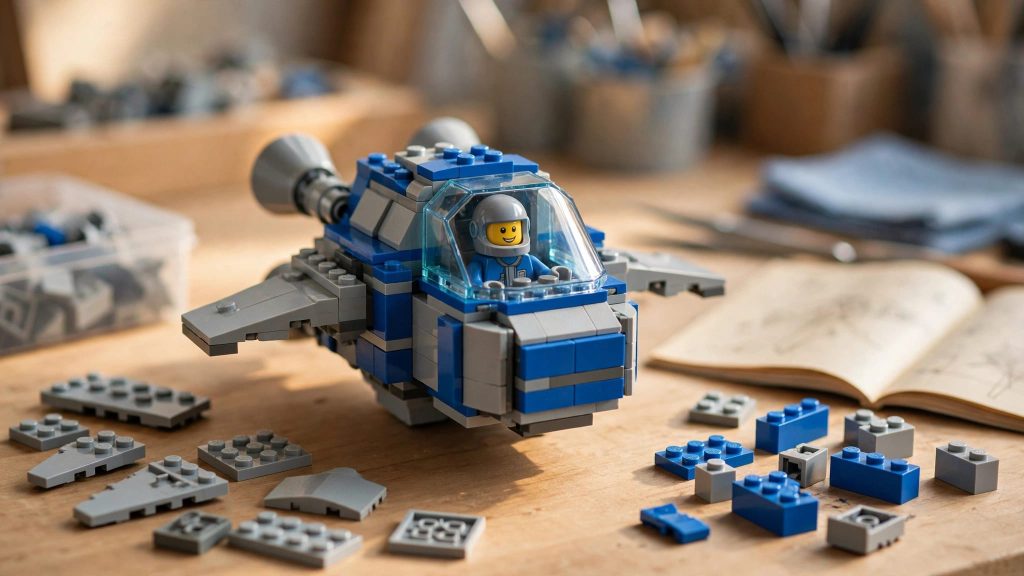
Early models often combine blue spacecraft, gray structures, transparent-yellow windows, and astronauts wearing the planet-and-spaceship emblem. Later Classic Space sets use other colors, so blue isn’t compulsory.
The Classic Space set catalog provides named models for comparison. Read individual release dates carefully, since databases can group later commemorative releases with the originals.
Futuron and Blacktron Change the Uniform
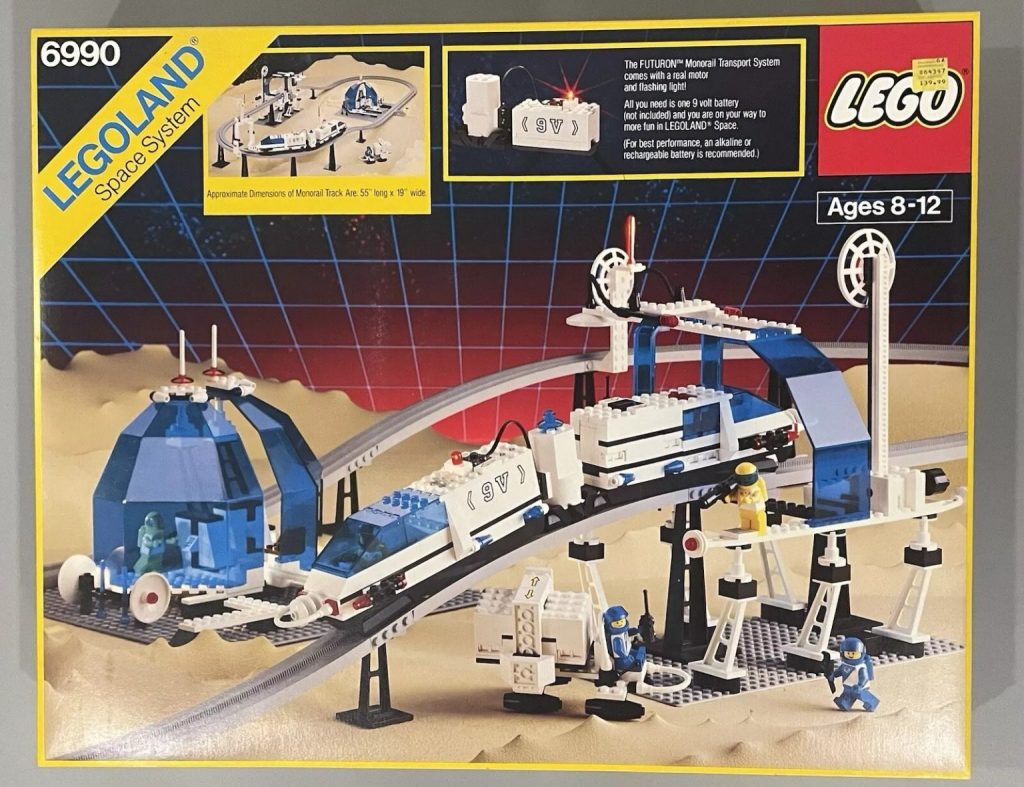
Futuron and Blacktron arrived in 1987. Futuron favors white-and-black builds, transparent-blue canopies, and astronauts with diagonal torso designs.
Original Blacktron brings black-and-yellow vehicles, transparent-yellow windows, and a triangular emblem. Very space-pirate chic.
Those faction details are better dating clues than “it looks old.” A tub containing all three styles probably spans several buying seasons.
Identify a Set From Loose Pieces
Start With the Oddballs
Pull out printed computer slopes, unusual windscreens, large wings, crater baseplates, and specialized wheels. Ordinary gray bricks can belong to hundreds of models. One distinctive canopy is much chattier.
Look underneath pieces for molded design numbers. These identify a part design, not the set itself. BrickLink’s catalog lets you search parts and see which sets contain them.
Narrow candidates using shape, color, and decoration together. A plain slope and a computer-printed version aren’t interchangeable catalog entries.
Match More Than One Clue
Compare the candidate set’s inventory with your pile. Look for several matching features: the correct canopy, wing arrangement, printed controls, and astronaut combination.
Then follow the instructions. The main model’s structure should emerge without inventing connections or borrowing unrelated pieces.
Minifigures help, but they wander. A red astronaut beside a gray rover doesn’t prove they originally shared a box. Kids ran a fairly relaxed interplanetary exchange program.
Photograph sorted groups before rebuilding. It keeps your evidence together when two almost-identical ships start competing for the same wings.
Use Set Numbers to Pin Down the Model
These retired sets provide useful reference points across the decade.
| Set number | Name | Release year | Pieces | Minifigures |
|---|---|---|---|---|
| 497 / 928 | Galaxy Explorer | 1979 | 338 | 4 |
| 6980 | Galaxy Commander | 1983 | 443 | 5 |
| 6990 | Monorail Transport System | 1987 | 731 | 5 |
Galaxy Explorer’s regional numbers explain why references can list the same familiar ship under different entries. Its 1979 release date is another clue. Cross-check the model and market in BrickEconomy, not just the number.
The monorail belongs to Futuron, despite frequent “Classic Space monorail” shorthand. LEGO released three complete motorized monorail systems, plus track accessory packs. Claims that the entire range comprised four sets oversimplify that history.
Separate Original Parts From Later Replacements
Genuine LEGO Doesn’t Automatically Mean Period-Correct
Look for molded LEGO branding where the element normally carries it. Studs, undersides, and minifigure components offer clues, but markings vary by part.
A genuine modern replacement can fit perfectly while differing in mold, finish, or color. LEGO’s older light gray also differs from the later light bluish gray.
Compare hinge geometry, wheel fittings, and cataloged mold variants. An updated hinge might restore movement beautifully without matching the original inventory.
A genuine replacement can complete a build without making it period-correct.
Watch the Fragile and Decorated Pieces
Inspect helmet chin straps, torso sides, hands, antennae, clips, and hinge fingers for cracks. Check astronaut chest printing for wear, especially the gold portion of the emblem.
Modern reproductions, custom printing, and replacement stickers deserve separate disclosure. Bright decoration alone doesn’t prove something is fake, just as yellowing doesn’t prove age.
Without documented ownership history, you usually can’t establish that every loose brick came from one particular original box. “Period-correct” is often the more defensible description.
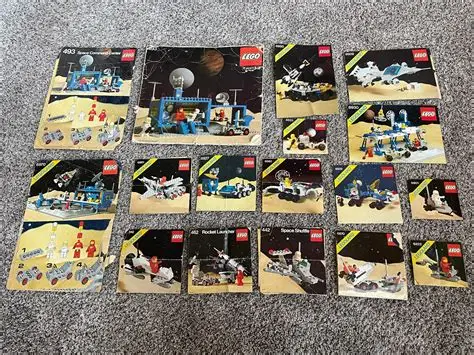
Read Boxes and Instructions Like Evidence
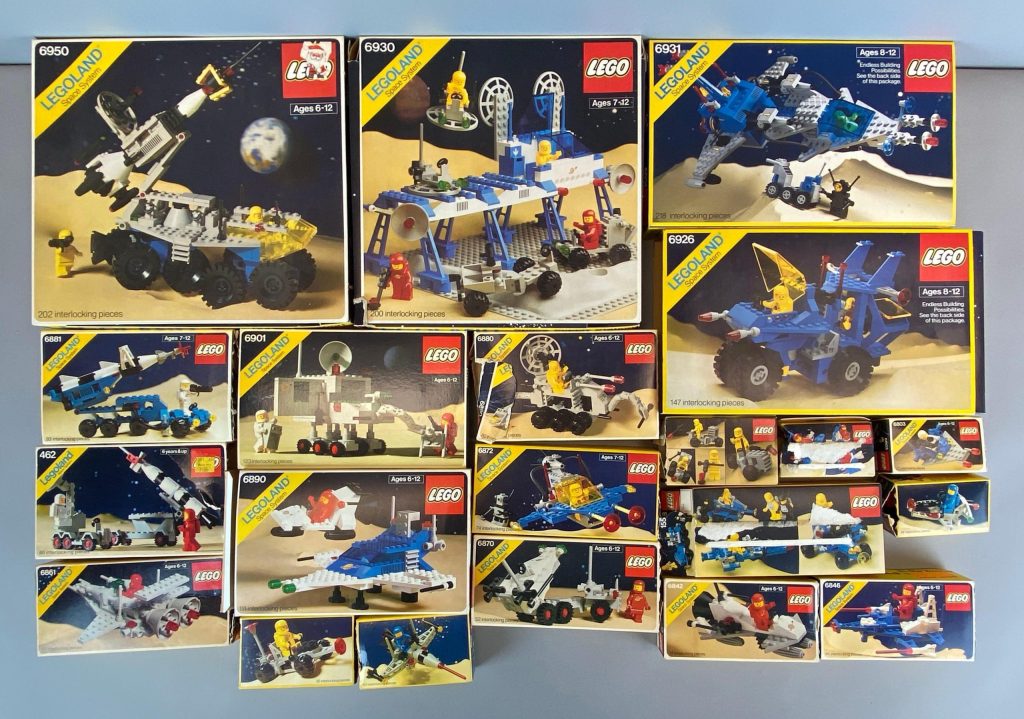
Vintage Space box art could make a handful of bricks look like an entire moon colony. Naturally, we wanted to move in.
That artwork also helps identification. Compare the model, set number, branding, and regional packaging. Boxes weren’t universally labeled with only a set name; names and presentation varied by market.
An instruction booklet gives you a stronger lead than a seller’s remembered title. Match its number and cover model, then compare the build sequence.
For unopened claims, examine every closure and accessible flap. Cut tape, overlapping seals, torn fibers, glue residue, or inconsistent wear can indicate opening or repair. Packaging methods varied, so no single tape pattern authenticates everything.
Boxed doesn’t mean sealed. A rebuilt model placed inside its original carton is an opened, boxed set. A box alone also doesn’t establish that its current contents belong together.
Keep the 1990s Space Cousins Straight
Some treasured “80s space” finds turn out to be younger siblings.
Ice Planet 2002 launched in 1993, despite its futuristic name. Its blue-and-white vehicles and transparent-orange details identify sets such as 6973 Deep Freeze Defender.
Spyrius followed in 1994, with 6889 Recon Robot, 6949 Robo-Guardian, and 6939 Saucer Centurion. Search catalog listings for Recon Robot and Saucer Centurion when a childhood memory is clearer than the surviving model.
Unitron also belongs to the 1990s. Exploriens arrived in 1996 with magnetic play features and decorated tiles; UFO followed in 1997. Both belong to later Space history, rather than the original Classic Space run.
Aquazone launched in 1995 as an underwater theme, so keep Aquazone separate from Space themes. Life on Mars arrived in 2001.
Nostalgia happily mixes decades. Identification needs a slightly stricter filing cabinet.
Don’t Confuse Vintage Space With NASA Models
NASA subjects aren’t proof of an old set. LEGO’s NASA set history documents several much later releases. Use the NASA catalog entry to verify a set number and release date.
Space Shuttle Discovery 10283 has more than 2,000 pieces. The earlier Discovery 7470 was released in July 2003 and discontinued in December 2004. Compare the set numbers: Space Shuttle Discovery 10283 is the later model, not an 1980s release.
Creator Expert NASA Apollo 11 Lunar Lander 10266 arrived in 2019, 50 years after Apollo 11’s moon landing, and retired in 2023. The 10266 number and Apollo 11 name identify the model; NASA’s release record confirms its date.
Ideas NASA Apollo Saturn V 21309 stands about 39 inches (100 cm) tall and separates into three stages. NASA’s listings show the 2019 retirement applies to Apollo Saturn V 21309, while Apollo Saturn V 92176 is its 2020 reissue; the latter retired in 2022.
Ideas NASA Mars Science Laboratory Curiosity Rover 21104, designed by Curiosity engineer Stephen Pakbaz, arrived in 2014 and retired that December.
LEGO.com still provides building instructions for older models, including Space Shuttle Discovery and Apollo 11 Lunar Lander. Those official records are useful when a sleek white spacecraft turns up among older blue wings.
Price the Actual Contents, Not the Childhood Memory
Separate loose incomplete, loose complete, opened boxed, and sealed examples. A surviving box, internal tray, instructions, sticker sheet, and catalog can all affect collector appeal.
The BrickLink Price Guide records sales information. BrickEconomy’s set estimates offer another reference, but an estimate isn’t a guaranteed sale price.
Compare three to ten recent sales where available. Match the set number, completeness, condition, and packaging. Keep sealed examples separate from opened builds.
Our advice on buying vintage 80s toys applies here: calculate the whole purchase, including shipping, taxes, and missing pieces.
Large baseplates, monorail switches, motors, printed elements, and particular wheel fittings can make restoration expensive. Price the exact part variant. A similar-looking substitute may cost less because collectors don’t consider it equivalent.
A bargain spaceship with expensive missing landing gear can develop quite a repair bill.
Rebuild Gently and Save the Paperwork
Rebuilding is rewarding when the main structure survives and missing parts are obtainable. Record substitutions so you can distinguish a display-complete model from a period-correct example later.
Avoid forcing stiff vintage clips and hinges. Separate printed, stickered, and electrical parts before cleaning; ordinary loose bricks can be washed gently in lukewarm water with mild soap. Dry everything thoroughly without direct heat.
Store instructions and flattened boxes in suitable archival sleeves or boxes, away from sunlight and damp. Keep small accessories with the set’s inventory record.
For motorized or Light and Sound sets, inspect battery compartments and remove batteries during long-term storage. Yesterday’s moon mission shouldn’t become tomorrow’s corrosion cleanup.
Frequently Asked Questions
Which Vintage LEGO Space Sets Are Most Valuable?
Sealed early flagships, including Galaxy Explorer and Command Center, can attract substantial premiums. Scarce packaging and exceptional condition matter enormously.
There’s no permanent winner: sealed and incomplete examples occupy different markets, even with matching set numbers. For Spyrius models such as Recon Robot and Saucer Centurion, compare sales by set number, condition, and completeness.
What’s the Best First Set to Collect?
Galaxy Explorer is a strong choice for its unmistakable blue-and-gray look, opening cockpit, and exploration vehicles. For a smaller budget, a modest Classic Space rover or scout ship offers the same cheerful astronauts with fewer expensive parts to replace.
Choose the model you want to rebuild, not merely the one advertised as rarest.
Bring Your Space Fleet Back Together
The strongest identification combines a set number, matching instructions, distinctive parts, and the right minifigures. Packaging and period-correct details add confidence.
You don’t need a pristine museum piece to enjoy the reunion. You do deserve an honest account of what’s original, what’s replaced, and what’s missing.
That little astronaut has waited a long time for another mission.