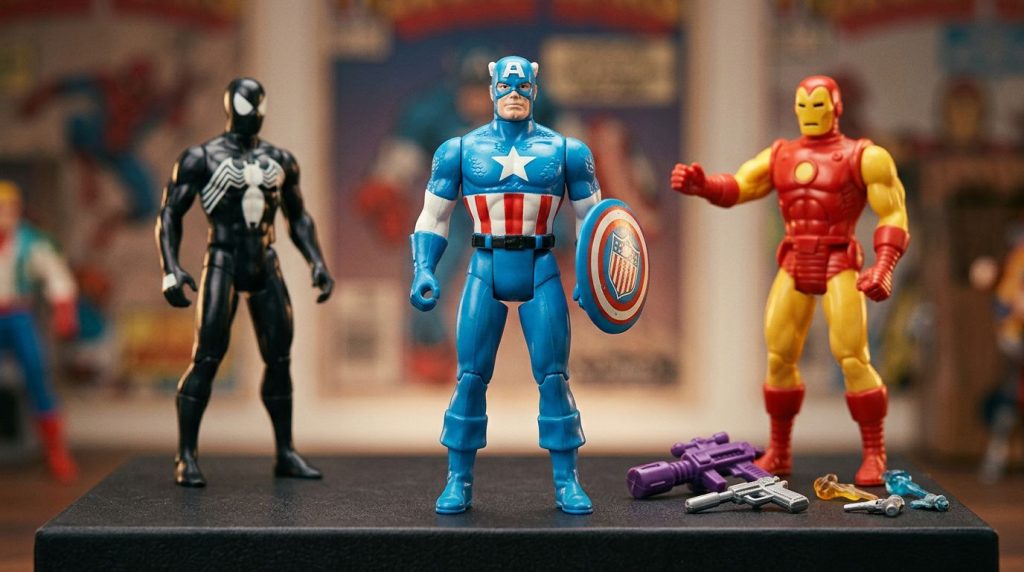
Identify original Secret Wars figures by matching the sculpt, five-point articulation, molded markings, paint, accessories, and packaging together. No single detail proves that everything in the listing belongs to an original 1980s release.
These little Marvel heroes packed an entire comic-book showdown into a bedroom-sized battlefield, and collectors still adore them. Before you pay collector money for a toy-box reunion, start with the figure itself.
80s Article Snapshot
•The line contained 17 figures across three series, with eight multi-packs counted separately.
•An original body can come with replacement accessories, altered paint, or the wrong packaging.
•Compare loose, complete, and sealed examples separately when judging prices.
What Original Secret Wars Figures Should Look Like
The Mattel Secret Wars Archive describes the line’s production history as 1983 to 1986. That’s the broader archival chronology, rather than a manufacturing date you can assign to every loose figure.
The basic construction is wonderfully straightforward: five moving points at the neck, shoulders, and legs. No bending elbows. No bendable knees. These guys fought their battles with limited choreography and enormous confidence.
Match the Sculpt and Molded Markings
For Iron Man, Magneto, and other characters, compare the face, costume details, torso, hands, and boots with documented examples. Judge the entire body, since a familiar mask alone can’t confirm authenticity.
Photograph the molded maker information, copyright wording, and country-of-origin marking wherever they appear. Read them together with the sculpt and construction.
A copyright date can refer to the design rather than the year that particular toy reached a store. Likewise, a matching brand name doesn’t establish that every attached part is original.
Read Paint and Plastic Together
Compare the paint layout as carefully as the colors. Where do the boots end? Which costume details are painted, and which are molded into the plastic?
Production differences and aging can change appearances. The archive records limb discoloration, bleeding colors, and easily scratched painted areas.
Ask whether anything has been repainted, repaired, or replaced. A genuine vintage body can still have later work on it, and an unusual shade alone doesn’t establish a rare variation.
The Three Series and Their Tiny, Vanishing Extras
The official lineup contained 17 figures: eight in series one, six in series two, and three rare European-only figures in series three.
Accessories deserve their own inspection. Childhood toy boxes were enthusiastic about crossovers, so the equipment beside a figure may have arrived there years later.
Series One: Four Heroes, Four Villains
The first assortment split evenly between four heroes, including Iron Man, and four villains, including Magneto.
Most figures included a double-barreled blaster. Heroes received red round shields, while villains received silver square shields. Those shield styles are useful starting clues, but they don’t authenticate the figure or accessory by themselves.
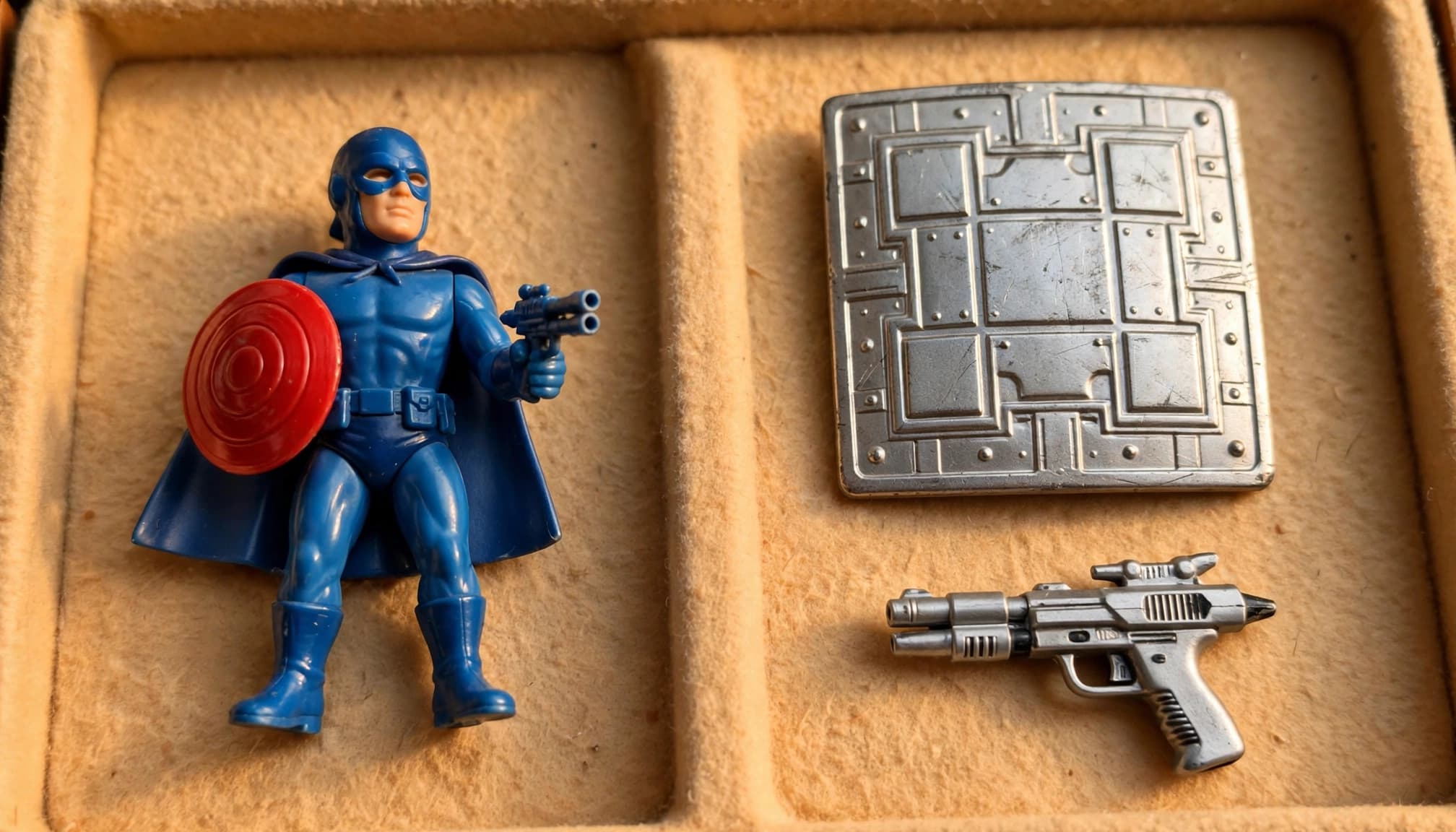
An illustrated retro superhero display.
Compare the equipment with the documented contents of the particular release. A shield that fits a hand doesn’t automatically belong to that package.
Series Two and the European Finale
Series two added six figures and character-specific extras, including Daredevil’s baton, Hobgoblin’s glider, and Falcon’s Redwing.
The third series supplied the final three figures, released only in Europe. They’re the archive’s rare late-series trio.
For any loose purchase, separate three questions: Is the accessory correct? Is it original? Did it accompany this release?
A modern replacement can make a display look terrific. It still shouldn’t be priced as an original accessory.
Cards, Multi-Packs, and Regional Packaging
The archive counts eight multi-packs, including the Captain America vs. Doctor Doom two-pack and first-series blistered three-packs. Check that the set’s figures and packaging match the documented Captain America vs. Doctor Doom pairing.
Those are packaging combinations, not eight additional characters. That distinction keeps the collection count from turning into comic-book mathematics.
Understand the Card Variation Counts
The line used five distinct packaging formats. Series one appeared on all five, while series three appeared only on French- and Spanish-language packaging.
The archive reports 67 carded variations overall, with series subtotals of 40, 20, and six. Those subtotals add to 66; it also identifies the Black Clawed Wolverine error as appearing only on a US card. The relationship between that error and the stated total isn’t explicit.
For identification, printed language and the figure-and-package pairing matter more than the headline count.
Inspect the Package as a Separate Collectible
Request photographs of the front, back, corners, hanging hole, blister, and attachment areas. Include the accessory arrangement and any surviving inserts.
Ask whether the packaging is original and whether it has been opened, repaired, resealed, or replaced.
A recard places a loose figure on newly made or altered packaging. The figure may be genuinely vintage even when its supposed factory-sealed presentation isn’t.
Likewise, a loose figure doesn’t retain a particular card designation simply because a seller associates it with one.
Condition: Battle Damage Still Counts
A scratched superhero can have tremendous charm. That doesn’t make the scratches disappear when somebody writes “excellent vintage condition.”
Secret Wars blisters are infamous for darkening and yellowing. The figures can also show discolored limbs, bleeding paint, and scratched costume details.
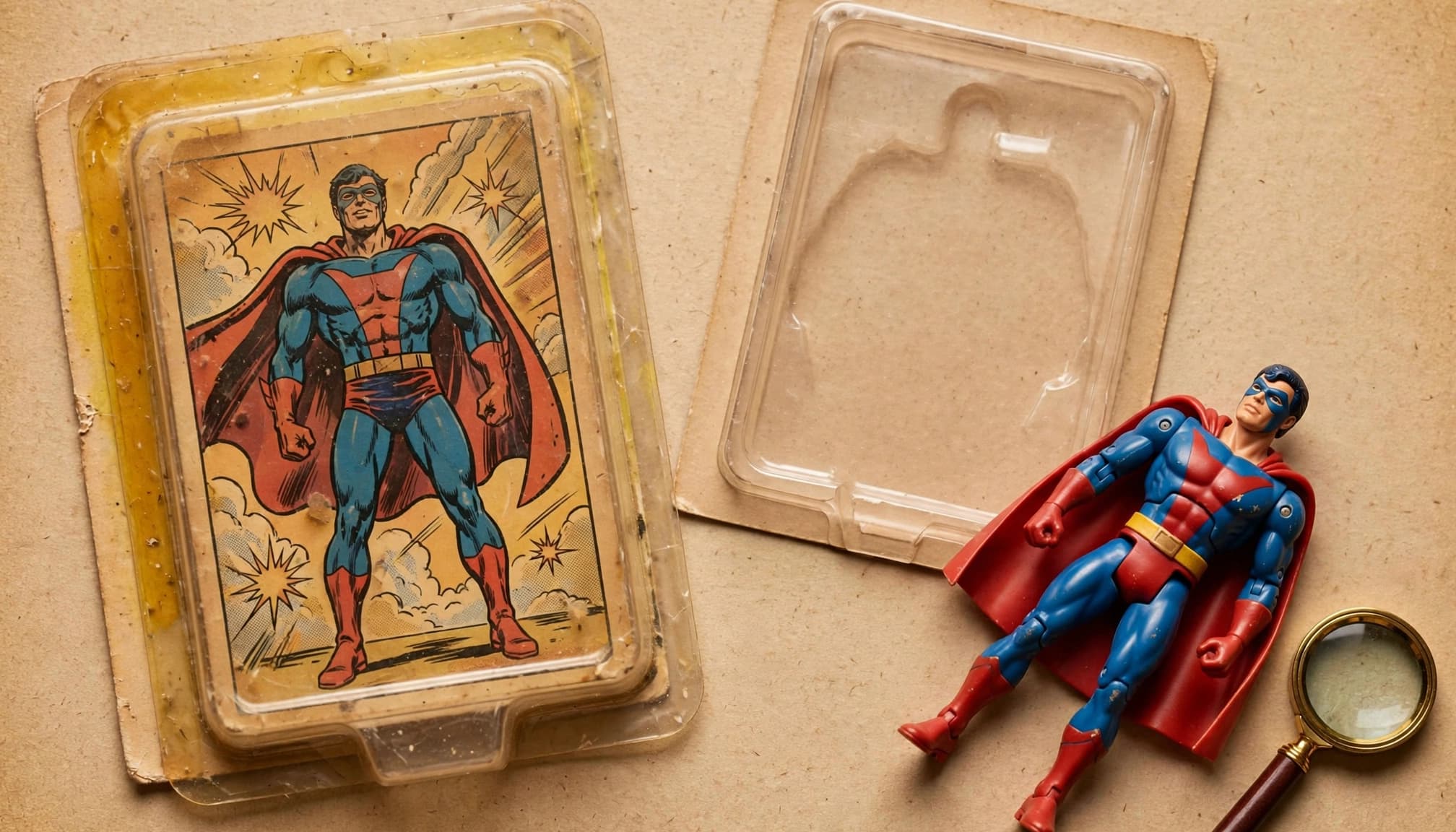
An illustrated packaging inspection.
Ask for clear photographs of the face, hands, boots, back, joints, markings, and every included accessory. For carded examples, distinguish the condition of the figure, blister, and cardboard.
Yellowing is a condition issue, not proof of age. Clear plastic isn’t proof of a reproduction, either.
Describe what survives rather than accepting a flattering adjective. Missing gear, paint loss, cracks, and packaging damage belong in the price comparison.
A played-with original can be a lovely shelf companion. It simply belongs in a different comparison group than a clean, unopened example.
Gulliver’s South American Secret Wars Connection
An unfamiliar release doesn’t automatically mean a fake. Secret Wars had a South American chapter, too.
Licensee Gulliver Brinquedos introduced 10 figures in 1986 under the name “Guerres Secretas.” Another six followed in 1989 as “Super Herois.”
Gulliver also created Future Warriors by combining existing Secret Wars figure designs into new characters. Familiar-looking body parts can therefore belong to a different documented line.
That makes context important. Identify the product line before treating an unusual combination as either a Mattel variation or an aftermarket custom.
A different country marking alone doesn’t establish rarity. The character, construction, decoration, and packaging history need to agree.
The explanation for why Gulliver created Future Warriors isn’t established in the archive’s account.
What Are Vintage Secret Wars Figures Worth?
Treat Action Figure 411’s price guides as market references rather than appraisals of an individual toy.
Its “Secret Wars (Vintage)” summary lists 37 items, total original retail of $251.63, and aggregate market value of $4,557.74. That database includes more than the 17 individual figures, so the totals describe different things.
These are reported guide averages, not condition-matched promises:
| Item | Reported average |
|---|---|
| Hobgoblin | $950.00 |
| Constrictor | $649.99 |
| Star Dart Glider with Spider-Man (Black Suit) | $324.99 |
| Spider-Man | $229.99 |
The Hobgoblin price entry reports a $950 average alongside the original $3.99 retail price. Quite a leap for a little plastic troublemaker.
These figures aren’t a definitive ranking of every character. The guide summary doesn’t supply a common condition grade or reporting date for those averages.
Original retail prices were $3.99 for single figures, $6.99 to $9.99 for vehicles and gift sets, and $19.99 for the Tower of Doom Playset.
For your own purchase, compare several completed sales matching character, release, accessories, packaging, and condition. Keep sealed examples separate from opened ones.
My guide to buying vintage toys without overpaying follows the same full-cost approach: include shipping, tax, fees, and missing pieces.
A low opening price can lose its sparkle once the shopping list for accessories begins.
Modern Marvel Legends Aren’t the Mattel Originals
The Secret Wars name returned on modern Hasbro Marvel Legends figures. Retro packaging makes the connection affectionate, but it doesn’t make the toy an original 1980s release.
The modern Marvel Legends figures discussed here are six-inch collectibles. Their manufacturer, construction, and articulation distinguish them from the vintage five-point figures.
Reported Marvel Legends Retro Secret Wars Wave 2 individual prices are $27.99 to $29.99. CMD Store lists the Wave 2 six-figure set at $167.95.
“Retro,” “vintage-style,” and an old-fashioned package design describe presentation. They don’t establish 1980s manufacture.
Both generations can look fantastic on a shelf. They belong in separate searches, checklists, and price comparisons for Marvel Legends and vintage figures.
Frequently Asked Questions
Does a Copyright Stamp Prove Authenticity?
A stamp is supporting information, not a complete verdict. The sculpt, construction, paint layout, accessories, and packaging must fit the claimed release together. It also doesn’t prove that every component remains original.
Which First-Series Figure Has a Useful Price Benchmark?
Spider-Man has a reported $229.99 average in the guide summary. That number doesn’t establish him as the most valuable first-series figure across every condition and card variation, or price an incomplete example.
Can an Original Figure Have Reproduction Accessories?
Yes. The body’s authenticity and the accessories’ authenticity are separate questions. Ask sellers to identify replacements, repairs, and custom paint, then save that description with the listing. Display appeal and all-original completeness are different purchases.
Bring Home the Hero, Know What You’re Buying
The strongest identification comes from matching evidence: the right body, construction, markings, paint, equipment, and packaging history.
Give original Secret Wars figures that same careful attention whether you’re buying one childhood favorite or building the whole lineup. A few honest scuffs can be part of the charm, as long as the description and price tell the same story.