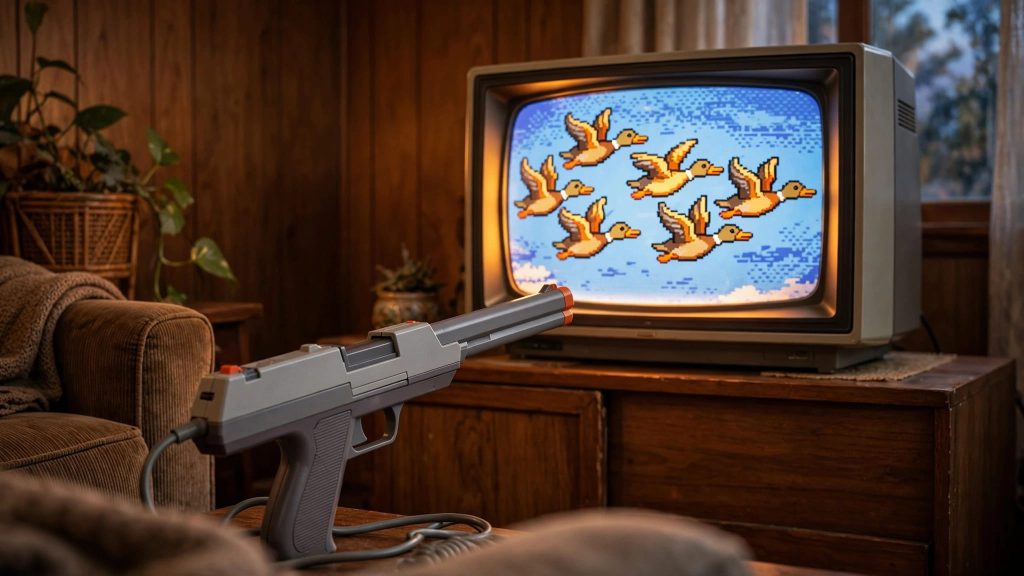
The NES Zapper made the NES feel like an arcade because you aimed at the television instead of steering a character with buttons. You had a target, three shots, and a plastic gun that put your aim on the line.
For an 80s kid, that was a pretty spectacular invitation. The original Zapper needed a CRT television, though, and it won’t work with a modern LCD screen.
That limitation is part of the story, because the television itself helped make the Duck Hunt Zapper’s magic happen.
80s Article Snapshot
•The Zapper detected light coming from the television; it never fired a beam at the ducks.
•The original setup needs a compatible tube television and won’t work with a flat-panel TV or HDMI adapter.
•Used originals usually cost about $15 to $30, with working condition more important than shell color.
Nintendo’s Toy-Aisle Secret Weapon
The Dates Behind the Legend
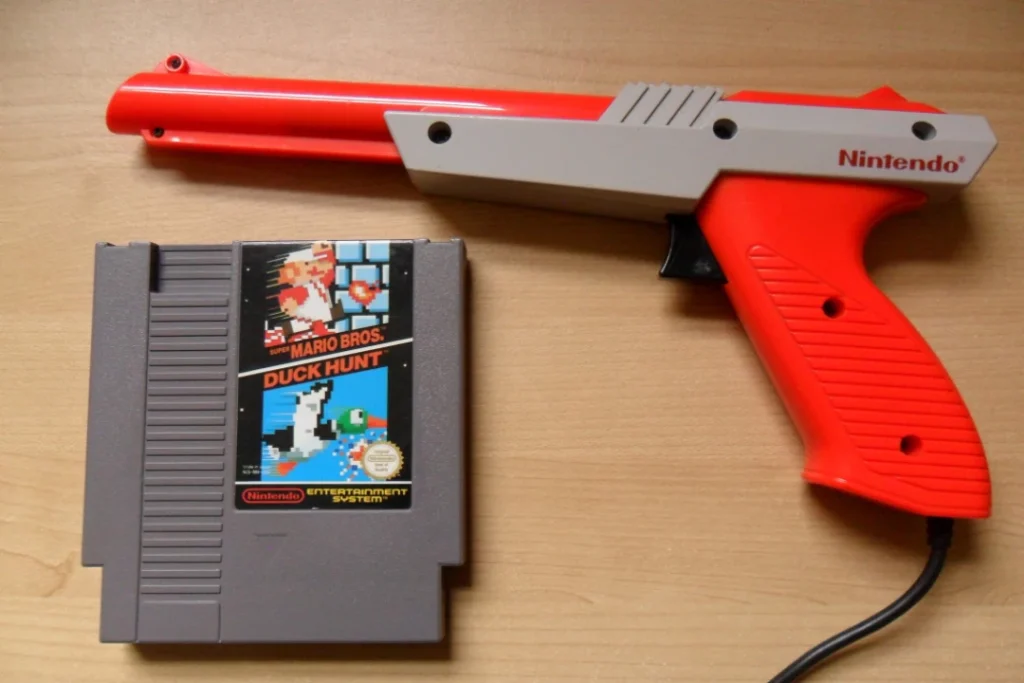
Nintendo released its Famicom light gun in Japan on February 18, 1984, under the Video Shooting Series name. The American redesign arrived with the NES on October 18, 1985, during Nintendo’s New York City test launch.
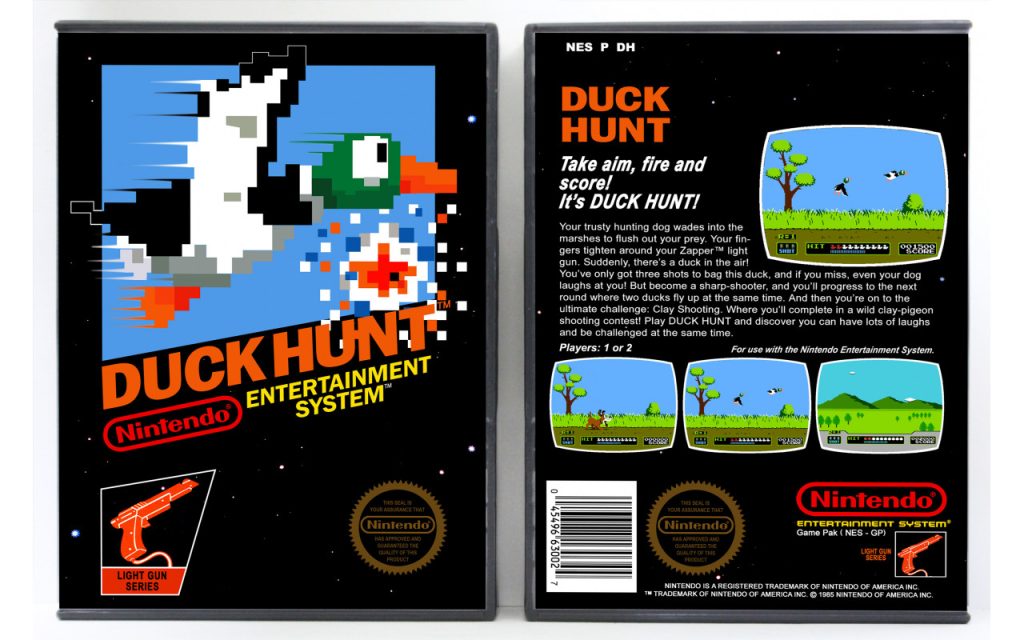
The Zapper was bundled with Duck Hunt in the launch-era Deluxe Set, alongside the console and R.O.B. the robot.
That distinction matters. The familiar package containing Super Mario Bros. and Duck Hunt on one cartridge belonged to the later Action Set. Childhood memories tend to merge those boxes into one glorious Christmas morning.
Why the Gadget Appeal Mattered
After the 1983 video game crash, American retailers weren’t exactly begging for another console. Nintendo pitched the NES through toys, entertainment, and unusual accessories, including R.O.B.
As Mental Floss’s launch history recounts, R.O.B. helped Nintendo get past that retail resistance.
R.O.B. looked futuristic. A light gun gave everybody something they could understand before the sales pitch was finished.
Why Duck Hunt Felt Like a Living-Room Arcade
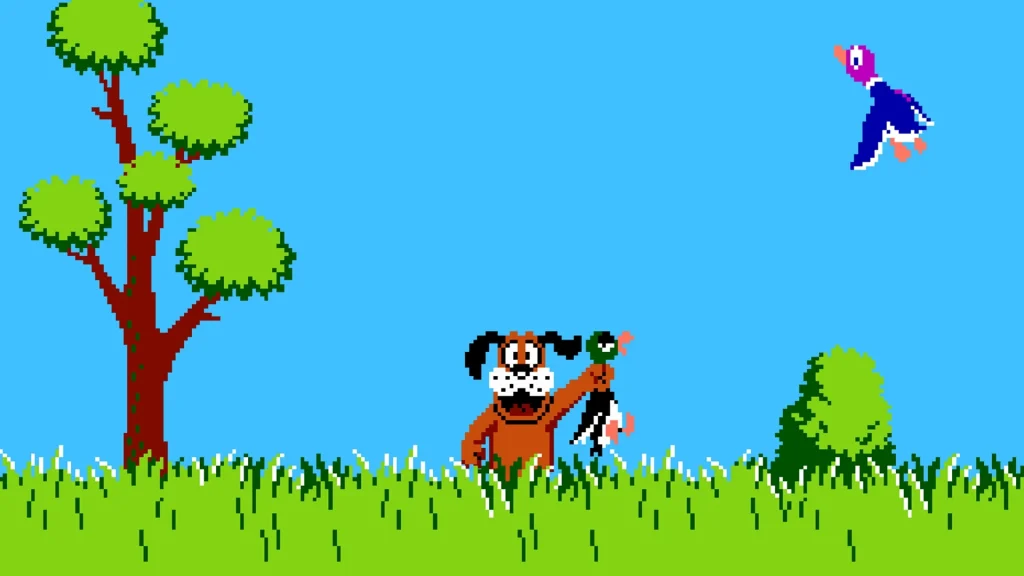
Duck Hunt had the confidence of a good carnival attraction. A duck appeared. You aimed. Everybody watching understood whether you’d succeeded.
The trigger clicked, the screen flashed, and the result arrived immediately. Miss enough times and that dog popped up with a laugh that could test a perfectly reasonable person’s patience.
The arcade feeling came from the physical routine. You raised the gun, lined up the sights, and took your shot. Spectators could follow the action without learning a button combination.
Short rounds and visible scores made taking turns natural. Even someone who couldn’t survive Mario’s first Goomba could have a respectable go at clay shooting.
That’s part of why kids wanted the NES: the accessories promised experiences you could picture yourself having.
The warm family-room glow is nostalgia. The direct aiming, quick feedback, and score-chasing structure are the concrete reasons the comparison holds up.
How the Zapper Detected a Hit
The Gun Was Watching the Television
Despite its space-age shape, the Zapper was a light gun, not a device that fired a laser or invisible bullet at the screen.
An optical sensor inside the barrel detected light from the television. The lens narrowed its view, so aiming at one part of the television mattered.
Pulling the trigger told the NES to begin a brief visual test. The software changed what the television displayed, then read the sensor’s response.
The clever part was the partnership. The gun supplied the light reading; the game supplied a screen pattern that made that reading useful.
Black Frame, White Targets, Instant Verdict
Duck Hunt first flashed the screen black for one frame. It then displayed white target boxes against the dark background.
When multiple ducks were present, the game tested their target areas in sequence. If the sensor detected the expected light during a target’s turn, the game registered a hit.
That’s the famous black-screen and white-box technique. You experienced it as a quick flicker rather than a little interrogation happening inside the television.
The gun didn’t recognize a duck. It recognized the right light at the right moment.
Why the Original Zapper Needs a CRT
Timing Was Part of the Hardware
A conventional CRT television produced its picture with an electron beam scanning a phosphor-coated screen. The Zapper’s detector and the game’s timing were designed around that rapidly changing light.
Modern LCD, LED-backlit LCD, plasma, and OLED displays don’t reproduce that behavior. Display processing adds delay, while their light output differs from a CRT’s pulses.
The white target can therefore appear after the game expects the sensor’s response. Even a beautiful picture can arrive at the wrong moment.
For this accessory, the television was part of the controller system.
What Modern-TV Workarounds Actually Mean
The original NES Zapper and Duck Hunt setup won’t work on a modern flat-panel television. Game Mode doesn’t solve the whole problem, and a standard NES-to-HDMI adapter doesn’t translate the light-gun system.
An adapter can put the NES picture on a new television without making the Zapper compatible with it.
Modern-screen solutions require different hardware, modified software, or an emulator paired with another pointing device. Those approaches can recreate the game, but they’re different setups.
For original play, use a conventional standard-definition tube television. Later digital or HD sets can introduce processing problems too.
When the Ducks Won’t Fall: Testing Your Zapper
Start with the correct setup before declaring the gun a decorative ray pistol.
- With the NES switched off, connect the Zapper to controller port 2. Keep a standard controller in port 1 for menu selection.
- Use a standard-definition tube television and select a shooting mode in Duck Hunt. Start several feet back with an unobstructed view.
- Clean the television glass and the gun’s front lens gently. Keep strong sunlight and glare off the screen.
- Adjust excessive darkness or low contrast, then test again. Change one setting at a time.
- If misses continue, try another compatible television to isolate the faulty part.
A Reddit discussion about Zapper tricks includes memories of bright-light cheating and improved results after brightness or contrast adjustments.
Treat the lightbulb stories as anecdotes, not a dependable diagnostic. The game’s initial dark-screen test helps reject constant light, so aiming at a lamp isn’t a reliable shortcut.
Gray or Orange: Buying an Original Zapper
Same Job, Different Wardrobe
The original North American Zapper was gray. The Federal Toy Gun Law took effect in 1988 and required toy guns to be visibly distinguishable from real firearms.
Nintendo introduced the orange Zapper in 1989 after the Federal Toy Gun Law took effect. The law didn’t mandate Nintendo’s exact orange color scheme.
The Zapper’s hardware history documents the change and the Federal Toy Gun Law behind it.
Both versions perform the same basic job. Orange doesn’t mean better accuracy, and gray doesn’t automatically mean a more valuable collectible.
The early gray shell has launch-era appeal. The orange one practically announces Saturday afternoon. Your display shelf can have an opinion; the ducks won’t.
What an Original Zapper Is Worth
Budget roughly $15 to $30 for a loose original Zapper. Completed eBay sales tracked by PriceCharting’s Zapper price guide include examples around $7.99 to $29, plus an $11 entry dated September 7, 2026.
Condition matters more than a hopeful asking price. A tested unit, intact cable, clean lens, and responsive trigger are stronger buying points than color alone.
Original NES units carry Nintendo identification and model number NES-005. Markings help, but labels alone don’t prove authenticity.
Look for consistent molding, an original-style connector, and clear photographs. Reproductions, repaired examples, and untested originals deserve different expectations. Our vintage toy buying advice follows the same principle: pay for condition, not somebody else’s nostalgia surcharge.
Beyond Ducks: Games, Oddballs, and Successors
Duck Hunt owned the spotlight, but the Zapper had other places to show off.
These games gave the accessory different personalities:
| Game | What You Did |
|---|---|
| Duck Hunt | Shot flying ducks or clay targets |
| Wild Gunman | Reacted to quick-draw opponents |
| Hogan’s Alley | Picked out criminals among innocent bystanders |
| Gumshoe | Shot beneath Mr. Stevenson to keep him moving |
Operation Wolf also supported the Zapper, with standard-controller play available. Compatibility depended on the game; pointing the gun at Super Mario Bros. wouldn’t give Mario any useful new abilities.
The wider light gun family got wonderfully peculiar. It included Konami’s LaserScope headset, Nexoft’s wireless ProBeam, Camerica’s Video Blaster, and Bandai’s Hyper Shot for the Famicom. The LaserScope fired when players said “fire,” while the ProBeam was wireless. These accessories didn’t share identical game support.
The Zapper was discontinued in 1994. Nintendo’s next-generation gun-style accessory was the SNES Super Scope, a shoulder-mounted contraption with considerably more science-fiction swagger.
The later Wii Zapper took a different approach from the LaserScope and NES Zapper. Unlike either design, the Wii Zapper was a plastic housing for a Wii Remote and Nunchuk, not an NES-style optical light gun.
Splatoon’s N-ZAP weapons carried the old design into another generation. Apparently, that silhouette still had places to be.
A Small Gun With a Big Saturday-Afternoon Personality
The Zapper made Duck Hunt feel special because aiming was the game, and everyone in the room could understand the stakes.
Its clever light detection needed the right television. Its appeal needed a target, a trigger, and somebody ready to take the next turn.
That’s the piece worth remembering: an arcade-style experience could fit in your hand, even if the television required two people to move.
Frequently Asked Questions
Do You Need a Zapper to Play Duck Hunt?
Yes, the original NES game’s shooting modes require a light gun. A standard controller handles menu input and can let a second player influence the duck in the single-duck mode, but it doesn’t replace the shooter’s gun.
Is an orange Zapper Worth More Than a Gray One?
Neither color has an automatic premium. Working condition, original packaging, cosmetic wear, and the particular sale matter more. Both are commonly available loose, so paying extra for orange alone doesn’t buy better gameplay.