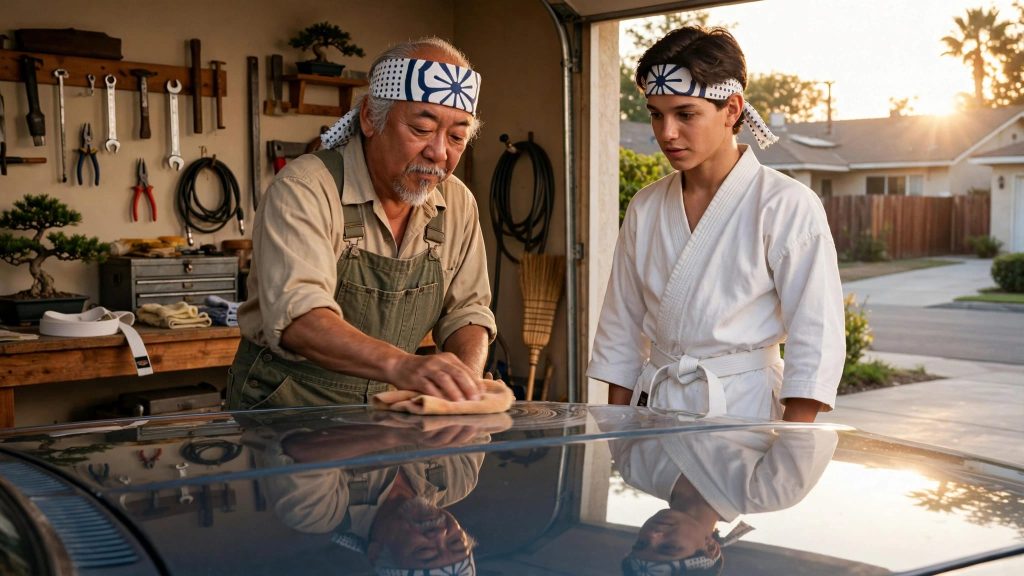
Some movie lines are fun for a summer. Others move into your brain, rent-free, and stay there for decades. The Karate Kid gave us one of the all-timers.
It’s a memorable martial arts movie built around a simple instruction from an old handyman to a frustrated kid: “wax on, wax off.” Then the 1984 film pulls the rug out, reveals what those circles really mean, and makes every car hood feel like martial-arts equipment.
Key Takeaways
- The Karate Kid turns a familiar underdog story into a memorable coming-of-age film through Daniel LaRusso’s move to Reseda, his rivalry with Johnny Lawrence, and his bond with Mr. Miyagi.
- The “wax on, wax off” lesson works because ordinary chores secretly build Daniel’s defensive skills, showing how repetition can create ability before the student understands it.
- Mr. Miyagi’s defensive philosophy directly contrasts with Cobra Kai’s “No mercy” approach, giving the film emotional depth beyond its tournament fights.
- The All-Valley tournament, the crane kick, and Johnny’s final acknowledgment of Daniel deliver a satisfying victory without pretending that one match erases the harm Daniel endured.
- The 1984 original remains the heart of the franchise because of its warm performances, sunlit California setting, memorable training scenes, and lasting message about patience and perseverance.
Why The Karate Kid 1984 Still Feels Like Summer
Released by Columbia Pictures on June 22, 1984, The Karate Kid had the kind of premise that sounds small on paper. A teenager moves from New Jersey to Reseda, a neighborhood in Los Angeles. He gets picked on by bullies. He meets a mentor. He enters a tournament.
But John G. Avildsen knew how to make an underdog story hit you right in the ribs. He had already directed Rocky, earning an Academy Award for his work on it.
John G. Avildsen’s direction here shows the same instinct; his AFI catalog entry for The Karate Kid identifies the film’s writer and credits Jerry Weintraub as producer.
A New Kid With Nowhere To Hide
Daniel LaRusso, played by Ralph Macchio, is a teenager from New Jersey who lands in Reseda with his mom, Lucille. California sunshine is supposed to be the dream, right? Not when you’re the new kid in an apartment complex and the local blond karate champ wants you wrecked.
Daniel catches the eye of Ali Mills, played by Elisabeth Shue. He also catches the fury of her ex-boyfriend, Johnny Lawrence, played with icy confidence by William Zabka.
The ex-boyfriend isn’t some cartoon brute. He’s a proud, angry kid trained to see mercy as weakness. That makes the trouble feel uncomfortably real. The social triangle around Daniel LaRusso and Ali Mills gives Elisabeth Shue room to play more than a love interest.
The Script Came From A Bruise, Not A Formula
Robert Mark Kamen didn’t pull the idea out of thin air. In an interview about the screenplay, he discusses the personal experiences and martial arts influences behind the story.
That personal edge is why Daniel’s humiliation matters. He doesn’t want to become a tough guy for applause. He wants to stop feeling hunted.
And wow, did audiences show up for him. Made on an $8 million budget, the film became a major hit at the box office. Gross tallies differ between archives, but IMDb lists more than $91 million in worldwide grosses, a remarkable box office result for Columbia Pictures, especially for a modest drama film.
Daniel Meets Mr. Miyagi
The movie changes gear the moment Daniel LaRusso first meets Mr. Miyagi. Pat Morita walks into the role with gentle humor, clipped sentences, and eyes that suggest he has carried plenty.
Mr. Miyagi is the apartment handyman. He trims bonsai trees. He fixes faucets. He seems like the last person who’d know how to dismantle students from the original film’s Cobra Kai dojo in about eight seconds.
Then Johnny and his friends corner Daniel at a Halloween dance.
Mr. Miyagi steps in.
No speech. No grand entrance. Just fast, controlled defense rooted in martial arts. That meeting becomes The Karate Kid’s true turning point.
Pat Morita Made Every Pause Count
Pat Morita gives Mr. Miyagi a light touch without turning him into a joke. His little laughs are warm. His silences land even harder.
The character’s history surfaces during a quiet scene about Miyagi’s late wife and child. Suddenly, the wise neighbor has a whole life behind those patient eyes. It’s one of the film’s most tender moments.
At the 57th Academy Awards, Pat Morita received a Best Supporting Actor nomination. That Academy Award recognition mattered for a summer crowd-pleaser, and it still makes sense on a rewatch.
Ralph Macchio Sells The Fear
Ralph Macchio was older than Daniel, but he had the wide-eyed energy the part needed. Daniel can be mouthy, and Elisabeth Shue’s Ali Mills gives him a personal stake beyond the fighting. He can also be scared out of his mind. The movie lets him be both.
That matters because Ralph Macchio makes the kid’s eventual win feel earned. The kid who wins at the end isn’t a born champion. He’s a kid who got knocked down, complained loudly, trained anyway, and found a little steel in himself.
Why “Wax On, Wax Off” Became Famous
Daniel LaRusso thinks Mr. Miyagi is taking advantage of him. First, he must wash and wax several cars. Then comes sanding the floor, painting the fence, and painting the house.
The instructions are maddeningly exact:
- Wax on, wax off.
- Sand the floor.
- Paint the fence.
- Paint the house.
Daniel spends days repeating the movements. Circular motions. Side-to-side strokes. Up-and-down brushwork. He has no clue that his arms are learning blocks. The Karate Kid turns these chores into its clearest training lesson.

The Reveal Is The Whole Magic Trick
When Daniel finally blows up, Mr. Miyagi tells him to show the motions. Then he fires punches at him.
Daniel blocks them.
The phrase “wax on, wax off” becomes a defensive circular block. Paint the fence becomes an outward block. Sand the floor becomes a low block. Ordinary chores have encoded defensive movements from martial arts. In one sharp scene, all those chores snap into focus.
The lesson isn’t a trick for avoiding hard work. It’s the movie’s promise that repetition can build skill before you even know you have it.
That reveal is why the phrase stuck. Everybody has had a “Why am I doing this?” moment. Piano scales. Basketball drills. Flash cards. Mowing the lawn for the tenth Saturday in a row.
Miyagi’s lesson says the boring part might be the part that counts.
It Was A Catchphrase With Heart
Lots of 1980s catchphrases were tossed around because they sounded cool. This one lasted because it carries a whole scene with it.
Say it, and you can picture Daniel’s sore arms. You can hear Miyagi’s calm voice. You can feel that glorious second when Daniel realizes he wasn’t being played after all.
It’s comedy, discipline, surprise, and comfort packed into four words. Not bad for car wax.
Cobra Kai Is The Darker Mirror Of The Karate Kid
The dojo is all sharp black uniforms, aggressive stances, and John Kreese barking “No mercy.” Martin Kove makes John Kreese frightening because he never seems to think he’s wrong.
To John Kreese, Cobra Kai is domination. Strike first. Strike hard. Strike before anyone can hurt you.
Mr. Miyagi teaches the opposite. Karate is for defense. A fight avoided is better than a fight won.
Johnny Isn’t Just A Punching Bag
William Zabka gives Johnny Lawrence real swagger, but he also lets you see the pressure underneath it. Johnny Lawrence is Kreese’s prize student. His Cobra Kai training has taught him that kindness looks like losing.
That makes his final moment with Daniel matter. After the championship match, Johnny Lawrence gives Daniel the trophy and says, “You’re all right, LaRusso.”
It doesn’t erase the harm he caused as one of the bullies. It does show that Johnny can see past the dojo’s script, even if only for a second.
The Cobra Kai philosophy clashes with Mr. Miyagi’s approach. That contrast gives The Karate Kid more bite than a standard teen sports movie. One man teaches control through martial arts; the other teaches fear.
The All-Valley Tournament Brings The Fire
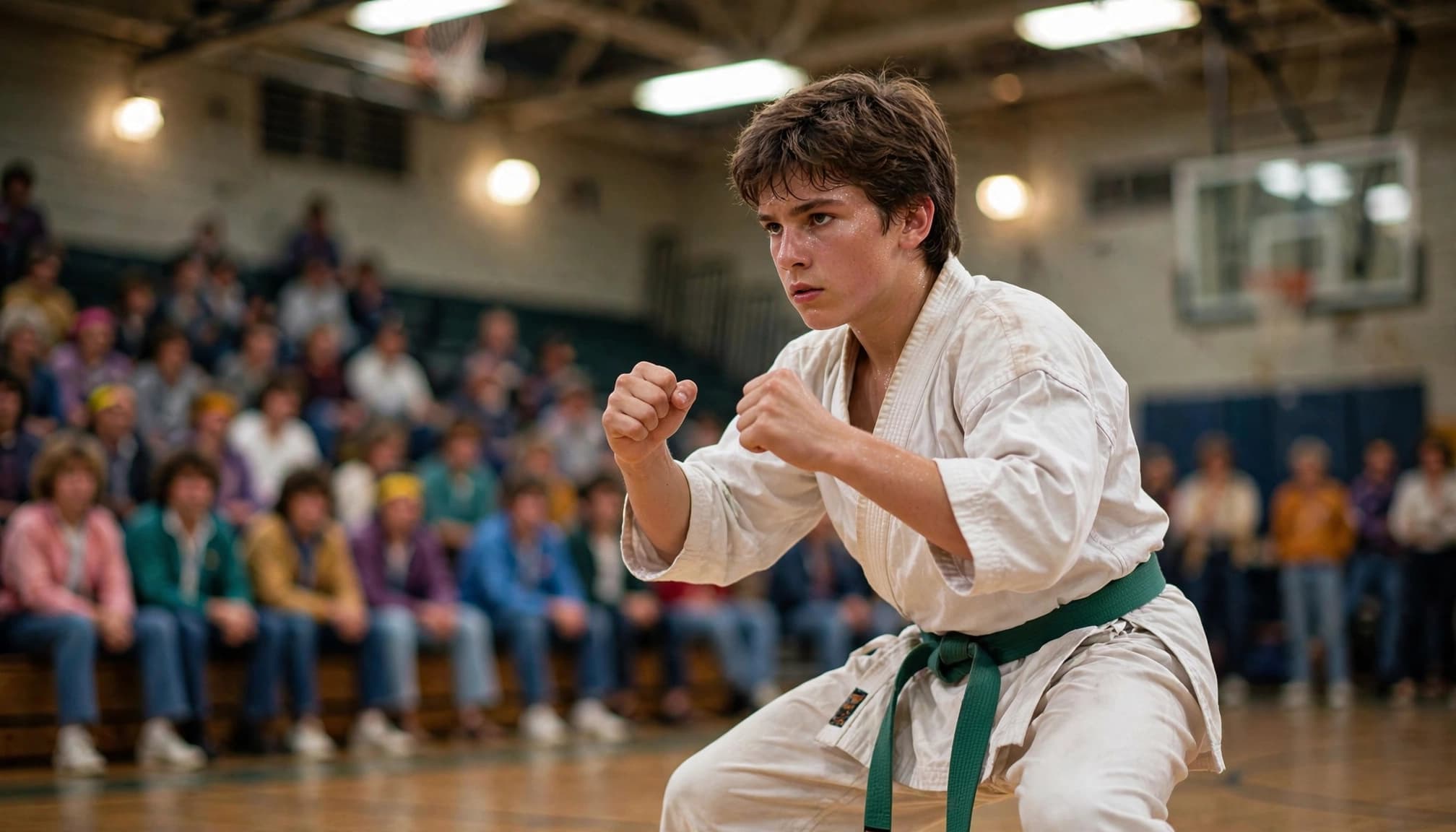
The All-Valley Karate Championships is where The Karate Kid cashes every emotional check it wrote. Daniel LaRusso has worked for this. He has endured the bullies, trusted his teacher, and learned that martial arts aren’t about showing off.
Then Joe Esposito’s “You’re the Best” kicks in during the tournament montage, and the soundtrack makes every 80s kid feel capable of conquering a mountain before dinner.
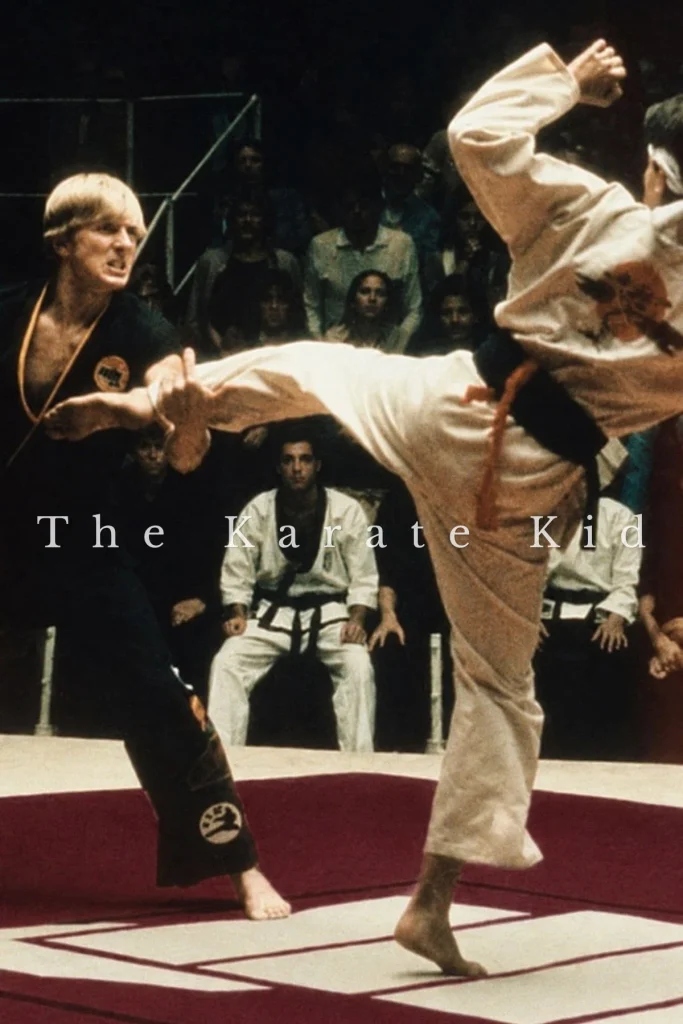
Daniel advances through the tournament bracket at the All-Valley Karate Championships. Cobra Kai students fight dirty. Cobra Kai’s sensei orders Bobby Brown to injure Daniel’s leg, and Daniel nearly has to quit.
The Crane Kick Is Still A Pop-Culture Thunderclap
By the tournament final, Daniel faces Johnny Lawrence on one good leg. Mr. Miyagi gives him the look. Daniel balances, raises his arms, and launches the move.
The shot freezes on Ralph Macchio’s airborne silhouette before the crane kick lands. Johnny drops. Daniel wins. The crowd explodes. Miyagi smiles like the proudest dad in the Valley.
Inside The Karate Kid, though, the moment works because it isn’t about whether the move is technically realistic. It’s Daniel’s last desperate answer after his opponents tried to take his chance away.
A Franchise, But Never the Same Movie Twice
The 1984 original, The Karate Kid, found box office success and launched two sequels. The Karate Kid Part II arrived in 1986, followed by Part III in 1989.
Those sequels keep Daniel LaRusso and Mr. Miyagi at the center, with Ralph Macchio and Pat Morita returning. Their stories move from California to Okinawa and back.
The Next Karate Kid arrived in 1994, with Hilary Swank as a new student of Miyagi. Set largely in Boston, it gives the franchise a different student and setting.
The 2010 remake starred Jaden Smith and Jackie Chan. Set in China, it follows kung fu rather than Japanese karate, even though it kept the familiar title.
Then came Cobra Kai, the television continuation that brought Daniel and Johnny back as adults. Cobra Kai isn’t part of the original film’s 1984 plot. William Zabka plays Johnny Lawrence with more bruises, jokes, and history.
The Original Still Has Its Own Flavor
Later chapters expand the story, but the 1984 film, The Karate Kid, is its own sunlit, compact little miracle. It carries Reseda streets, Los Angeles sunlight, the apartment pool, and the yellow motorcycle. There are also bonsai trees, denim, headbands, and a mom who has no idea how wild her son’s after-school activities have become.
It also belongs beside the era’s other kid-centered favorites. If you miss that scrappy, big-hearted movie energy, The Goonies’ unforgettable treasure hunt is waiting nearby.
The original never needed a giant universe to work. It had Daniel, Miyagi, one scary dojo, and a trophy that felt like the Holy Grail.
Frequently Asked Questions
What does “wax on, wax off” mean?
“Wax on, wax off” describes the circular motions Daniel uses while waxing Mr. Miyagi’s cars. Those chores secretly train him to block punches and show that repetition can build skill before the student understands the lesson.
Who plays Mr. Miyagi in The Karate Kid?
Pat Morita plays Mr. Miyagi, Daniel LaRusso’s patient mentor and apartment handyman. His gentle humor and quiet emotional depth earned him a Best Supporting Actor nomination at the 57th Academy Awards.
Who is the main villain in The Karate Kid?
John Kreese, played by Martin Kove, is the ruthless sensei who teaches Cobra Kai’s “No mercy” philosophy. Johnny Lawrence is Daniel’s main teenage rival, but Kreese’s teachings help drive the conflict.
What happens at the end of The Karate Kid?
Daniel faces Johnny Lawrence in the All-Valley tournament final while fighting on an injured leg. He wins with the crane kick, and Johnny gives him the trophy while acknowledging, “You’re all right, LaRusso.”
The Lesson We Still Carry
The Karate Kid survives because the 1984 film never treats improvement as magic. Daniel LaRusso earns his confidence one sore shoulder, one hard lesson, and one brave choice at a time.
The cars get polished. The fence gets painted. The scared new kid finds his footing.
And somewhere, every time the phrase is repeated, The Karate Kid reminds us that Mr. Miyagi’s lesson still lands.