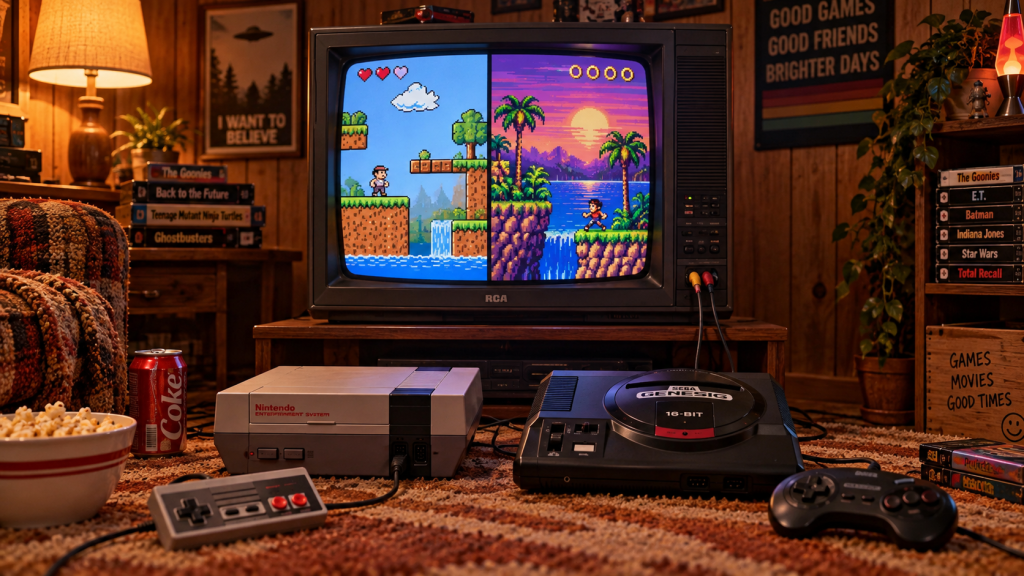
The old question isn’t really about which plastic box is “better.” NES vs Sega Genesis comes down to game libraries, controller feel, and the kind of Saturday-morning magic you want plugged into your TV.
The NES is Nintendo’s 8-bit system, the gray rectangle that made Mario, Zelda, and Mega Man feel like household names. The Sega Genesis, called the Mega Drive outside North America, arrived later with a 16-bit look, bigger action, and enough attitude to make a hedgehog seem like a rock star.
If you’re new to retro games, here’s the friendly truth: both original systems are worth your time. Authentic hardware feels different from later mini consoles, especially in the controllers. The trick is knowing which library and nostalgia fit you best.
Key Takeaways
- The NES is an 8-bit classic built around Nintendo’s foundational games, simple controls, bright chiptunes, and timeless nostalgia.
- The Sega Genesis, also known as the Mega Drive, brings 16-bit speed, bigger sprites, arcade energy, sports games, and distinctive FM-synth sound.
- Game libraries matter more than raw specifications: choose NES for Mario, Zelda, Mega Man, and tight platforming, or Genesis for Sonic, Streets of Rage, sports, and louder action.
- Games released on both systems can differ significantly in graphics, difficulty, levels, sound, and controls, as Battletoads demonstrates.
- Original hardware delivers the full retro ritual, while mini consoles, collections, and modern re-releases offer an easier starting point.
These Consoles Came From Different Moments
The NES and Genesis sat under plenty of the same TVs, but they came from different generations. Nintendo’s machine established the rules. Sega arrived later, during the 16-bit era, and tried to turn the volume way, way up.
The NES: The 8-Bit Living-Room Legend
Nintendo launched the Family Computer in Japan in 1983, then brought its redesigned Nintendo Entertainment System to North America in 1985. It arrived after the North American game business had crashed hard, and it made home consoles feel exciting again.
The NES is an 8-bit machine. That means its games use simpler graphics and sound than later consoles. Don’t mistake simple for boring, though. The best NES games are pure design. You jump, dodge, memorize, try again, and suddenly two hours have vanished.
Nintendo reports lifetime worldwide sales of 61.91 million NES and Famicom systems in its official hardware sales data. That total shows broad reach, but worldwide unit sales don’t fully capture cultural impact or current desirability. That’s an awful lot of couch cushions hiding cartridges.
Want the full nostalgia hit? Take a side trip into why kids wanted the NES. The machine was more than a game system. It was a birthday wish, a rental-store mission, and a full-blown playground status symbol.
The Sega Genesis: The Mega Drive Goes Global
Sega released the Mega Drive in Japan in 1988, then introduced the Sega Genesis in North America in 1989. Other regions kept the Mega Drive name, so buyer guides may show the same hardware under two names. That regional split is why the Mega Drive and Genesis can appear as separate entries, despite sharing core hardware.
The Sega Genesis is a 16-bit console. In plain English, it had more room to push larger, more colorful action across the screen. Those hardware specifications set up the technical differences explored next.
Sega’s famous campaign line, “Genesis does what Nintendon’t,” framed the Sega Genesis as cheeky, loud, and impossible to ignore. By then, the console war was mainly against the Super Nintendo, not the older NES.
It also looked different in the bedroom. The NES felt dependable. The Genesis looked like it should be sitting beside a cassette deck and a stack of Bon Jovi tapes.
NES vs Sega Genesis: The Hardware Difference
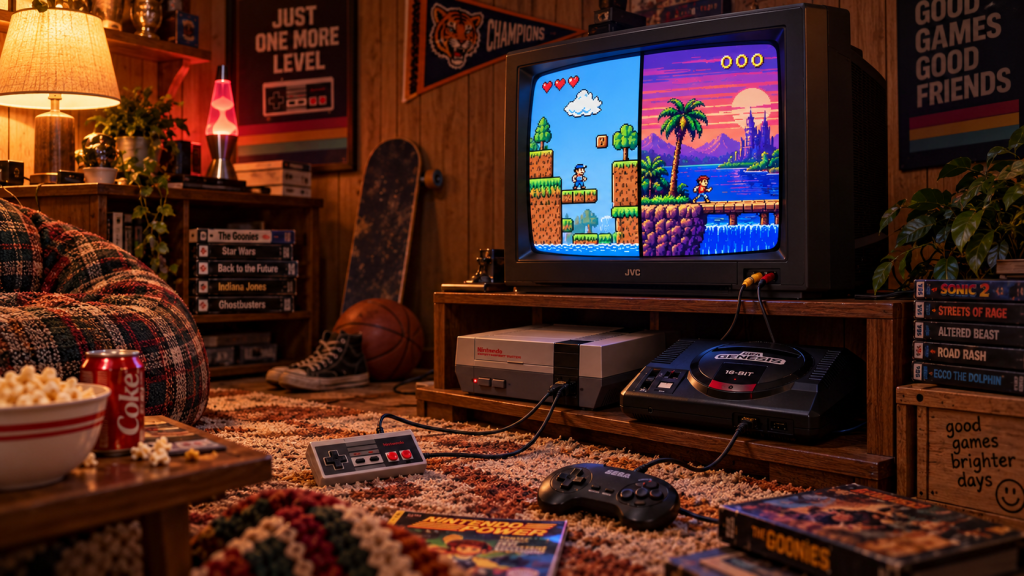
You don’t need an electrical-engineering degree to enjoy either system. Still, a few specs explain why the Genesis looked and sounded like a step into a new decade. The table below is a practical summary of the hardware specifications, not an exhaustive technical benchmark.
| Feature | Nintendo Entertainment System | Sega Genesis / Mega Drive |
|---|---|---|
| Gaming generation | 8-bit | 16-bit |
| North American debut | 1985 | 1989 |
| Controls | D-pad, Start, Select, A and B | D-pad, Start, three face buttons |
| Visual feel | Crisp, compact, colorful sprites | Bigger characters, richer colors, more movement |
| Sound personality | Chiptune bleeps, buzzes, and catchy melodies | FM synth tones, punchier bass, arcade flavor |
| Backward compatibility | Doesn’t play Genesis games | Doesn’t play NES games |
Neither box can play the other machine’s original cartridges, though modern mini consoles and collections may include games from both libraries. The Sega Genesis and Mega Drive could play many Sega Master System games with the original Power Base Converter accessory, but that was a separate earlier Sega system, not Nintendo magic.
Speed and Screen Action
The Sega Genesis, also listed as the Mega Drive in many regional guides, used a Motorola 68000 processor. That processor ran at about 7.67 MHz, with a Zilog Z80 chip helping manage sound. A detailed Genesis hardware history explains how that processing speed supported quick-moving arcade-style games and covers the system’s models.
That processing speed is why Sonic racing through Green Hill Zone felt like such a flex. The Genesis could move scenery and characters with a sense of speed that the older NES wasn’t built to match.
That doesn’t make NES action weak. Ninja Gaiden, Contra, Kirby’s Adventure, and Punch-Out!! still snap along beautifully. The difference is in scale and spectacle.
Graphics and That Famous Sega Sound
The Genesis could draw from a palette of 512 colors, with up to 61 colors shown at once in normal modes. Common display modes included 320 by 224 pixels. Those numbers sound dry, but they helped create bolder graphics, larger sprites, and a more arcade-like look. The Mega Drive technical breakdown gets into the nuts and bolts.
Sound may be the bigger personality test. NES music has a bright, clean, beep-and-buzz charm, with sound effects that can be instantly recognizable. Think Super Mario Bros. or The Legend of Zelda. Genesis music uses FM synthesis, which creates sharper, more metallic instrument sounds. Sometimes that FM synthesis is gloriously funky. Sometimes it can sound like a robot arguing with a trumpet.
The Genesis often feels faster and louder. The NES often feels tighter and more melodic. Your ears may make the choice before your brain does.
The Game Libraries Tell the Real Story
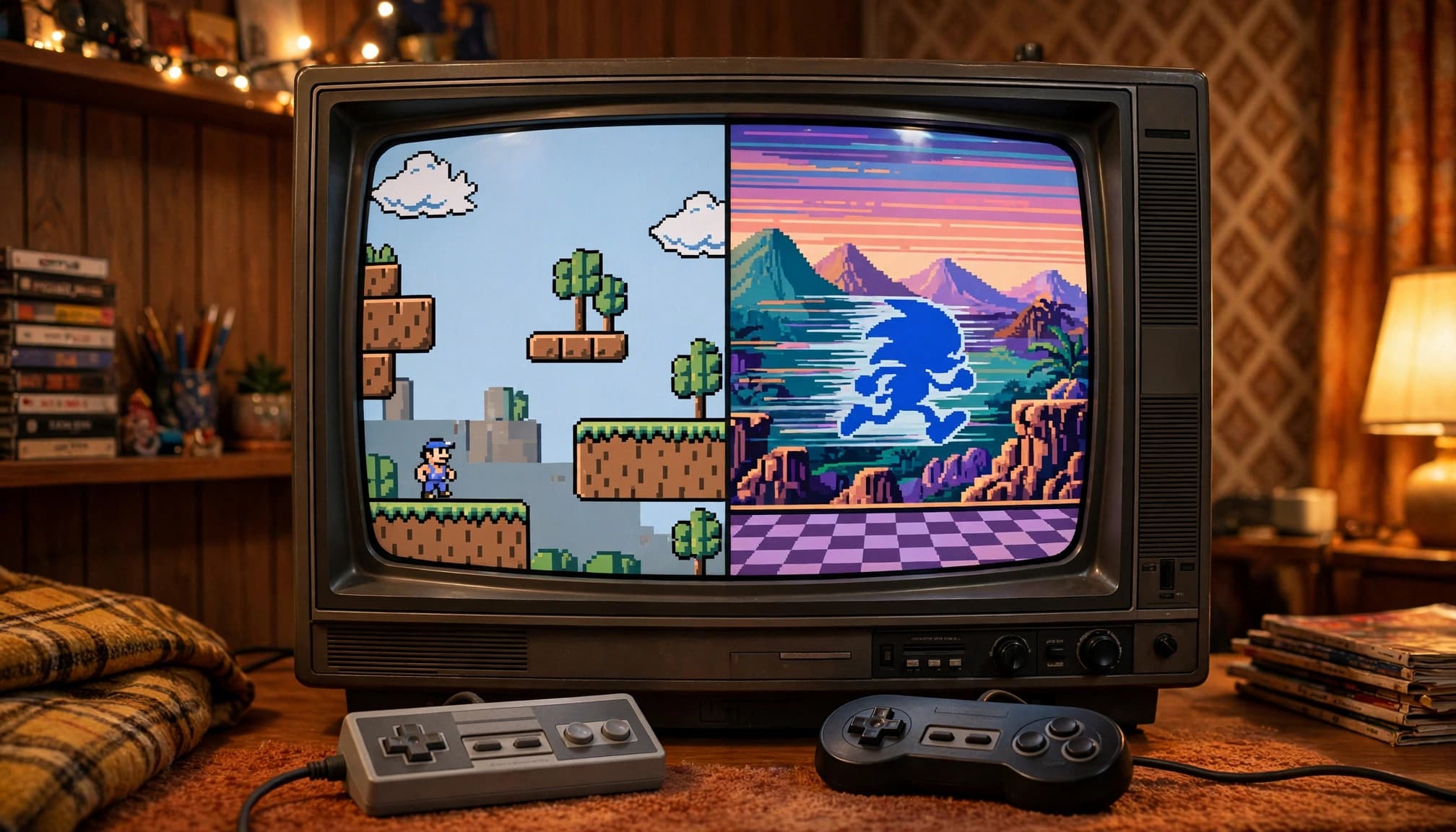
Specs are fun for about five minutes. The gaming library is where the love affair happens.
Pick NES for Nintendo’s Early Classics Over Sega Genesis
The NES gaming library is packed with classic games that became permanent pieces of pop culture. Super Mario Bros. still offers near-perfect platforming gameplay. The Legend of Zelda invites you to explore. Metroid feels eerie and lonely in the best way. Mega Man makes its bosses feel like a personal insult until you finally win.
There are also great approachable games that don’t require lightning reflexes:
- Kirby’s Adventure is colorful, inventive, and more forgiving than many NES favorites.
- DuckTales has bouncy music, memorable levels, and a pogo-stick move that never stops being fun.
- Dr. Mario is a terrific puzzle game for quick sessions.
- Tetris is Tetris. It doesn’t need a sales pitch.
The NES library has lots of tough games, no question, and some have a steeper difficulty curve. It also has clear rules. A controller with two face buttons keeps the controls simple, and that simplicity feels wonderful.
Pick Sega Genesis for Sports and Arcade Energy on the Mega Drive
Sonic the Hedgeog is the Genesis calling card. Its speed makes every loop feel grin-inducing. The first Sonic the Hedgehog feels lean and focused, while Sonic 2 adds Tails and ramps up the fun.
Unlike its true 16-bit rival, the Super Nintendo, the Genesis has a louder arcade spirit. It delivers classic games across beat-’em-ups, sports, shooters, and arcade classics, where speed feels exciting without guaranteeing better design. Streets of Rage brings moody city brawling and an unforgettable soundtrack, while NHL ’94 remains a legendary local multiplayer machine.
For newcomers, the Sega Genesis may feel more natural with later gamepads. In some regions, it’s called the Mega Drive. The original three-button pad has A, B, and C, while later six-button controllers add more options for fighting games.
The Sega Genesis 16-bit upgrade captures why the system felt so fresh after years of NES adventures. Sega wasn’t trying to replace Nintendo’s cozy charm. It wanted to look cooler doing something different.
Cross-Platform Games Can Surprise You
A game with the same title on two systems isn’t always the same game, and ports helped define the broader 8-bit and 16-bit console war. Different hardware, cartridge sizes, schedules, and design choices could give those ports different code, level layouts, audio, controls, or omissions.
Battletoads Is the Big Lesson
Battletoads began on the NES in 1991 and became famous for two things: wild cartoon attitude and soul-crushing challenge.
In Battletoads, the Turbo Tunnel became infamous for its fast stages, leaving players staring into the middle distance decades later.
The Sega Genesis version arrived later with richer graphics, but some regions called it the Mega Drive. It isn’t a straight 16-bit duplicate: it eases the difficulty, zooms the view in, and cuts several levels from the ending. A close Battletoads version comparison shows why the NES original remains the version many fans remember most fiercely.
Battletoads’ soundtrack also lands differently. NES tunes have a crunchy, direct punch. Genesis FM sound gives the same material a rougher, more electronic texture. Neither is wrong. They’re different flavors of glorious 1990s chaos.
For beginners, Battletoads on Genesis may offer gentler gameplay. For bragging rights, Battletoads on the NES is the one that says, “Oh, you think you’re ready?”
Zombies Ate My Neighbors Is a Different Fight
Zombies Ate My Neighbors is not an NES game, but it is a handy reminder that the 16-bit battle was never simple. It launched on Super Nintendo in North America in September 1993, then on the Sega Genesis in November 1993, according to its release history.
Both versions, listed regionally as Super Nintendo or Mega Drive, send you through suburban levels with water pistols, bazookas, and B-movie nonsense. Yet players still debate which version looks, sounds, or feels better.
That is retro gaming in a nutshell. A version isn’t only a scorecard for hardware. It is its own little time capsule.
What About the Nintendo and Sega Console War?
The NES established Nintendo’s position, but it wasn’t Sega’s main 16-bit rival. The major 16-bit era console war was between the Sega Genesis and Super Nintendo. Calling it an NES-versus-Genesis console war is a useful generational shortcut, not the full history.
Nintendo’s NES had already won its generation in worldwide sales. The Sega Genesis, called the Mega Drive in many regions, sold about 30.75 million units. The Super Nintendo reached 49.10 million, giving Nintendo the larger market share in unit sales. That console war gave Sega a major attitude win. The Mega Drive made Nintendo feel it had to answer back.
The Super Nintendo also used special chips in certain cartridge-based games. The Super FX chip, for example, gave games such as Star Fox extra power for polygon graphics. It wasn’t built into every SNES. The chip lived inside particular games, like a tiny bonus engine for the Super Nintendo.
So yes, the Super Nintendo won more sales battles, but market share doesn’t fully explain fan loyalty. Sega won hearts among kids seeking something faster, louder, and less polite; the Super Nintendo still led in sales.
How to Choose Your First Retro Console
Start with the retro games you want to play. Compare their controls and gameplay, then choose hardware that suits your patience and budget.
Original Hardware Has the Full Vibe
An original NES or an original Sega console paired with a CRT television feels right. The picture is soft, the controllers have long cords, and you may need to blow dust away from a cartridge before the game starts. That ritual is part of the package and the nostalgia.
Modern flat-screen TVs can make old consoles look rough without extra equipment. HDMI adapters and upscalers can help, but cheap ones may add input lag. That tiny delay matters when you are jumping over a pit or escaping the Battletoads Turbo Tunnel.
Both systems are used-market purchases, so condition matters. Used listings may use either regional name, calling the console Mega Drive or Genesis depending on where it was sold. Search Mega Drive listings too. Inspect each Mega Drive listing for model differences, missing cables, and controller replacement costs.
An original cartridge needs a little care and authenticity checks. Clean the cartridge contacts gently, avoid forcing it into the slot, and buy from sellers who show clear photos of labels and pins.
Original controllers may need replacement, and third-party pads can feel different. Check that feel before planning local multiplayer.
Modern Options Make Starting Easier
Licensed mini consoles, retro collections, modern re-releases, and emulation can be easier ways in. Licensed mini consoles are separate products with fixed libraries, not genuine original hardware.
A Super Nintendo mini system makes that distinction clear, while Super Nintendo collections offer another modern route. Modern re-releases and collections are often the easiest options currently available.
These options save space, often include save states, and don’t demand a working 30-year-old power supply. Save states can make punishing difficulty easier to manage.
If you want the classic feel without the repair project, that is a perfectly good choice. Play the games. Have fun. Nobody earns extra points for wrestling with a temperamental RF switch.
You don’t need to settle the old console war. Choose what you’ll actually play.
For the cleanest NES vs Sega Genesis decision, use this quick gut check:
- Choose the NES if Mario, Zelda, Mega Man, straightforward buttons, and bright chiptunes sound like your happy place.
- Choose the Sega Genesis if Sonic, sports games, beat-’em-ups, arcade action, and rowdy FM music make your heart do a little fist pump.
- Choose both if you can. This is the most honest answer, and probably the most dangerous for your shelf space.
Frequently Asked Questions
Is the NES better than the Sega Genesis?
Neither console is simply better. The NES is a stronger choice for Nintendo classics and straightforward gameplay, while the Genesis suits players who prefer speed, arcade action, sports, and a louder 16-bit style.
Can NES games play on a Sega Genesis?
No. Original NES cartridges do not work on a Sega Genesis, and Genesis cartridges do not work on an NES. Modern collections and mini consoles can include games from both libraries, but they are separate products.
What is the difference between the Sega Genesis and Mega Drive?
The Sega Genesis and Mega Drive are regional names for the same core 16-bit console. North America used the Genesis name, while many other regions used Mega Drive, so used listings may show either name.
Which console has better games?
That depends on the games you want to play. Choose the NES for Mario, Zelda, Mega Man, Metroid, and classic puzzle games; choose the Genesis for Sonic, Streets of Rage, NHL ’94, shooters, and arcade-style action.
Should I buy original hardware or a modern collection?
Original hardware offers the most authentic controllers, cartridges, and CRT television experience, but it may need repairs or extra display equipment. Modern re-releases, collections, and licensed mini consoles are easier to use and often include save states.
The Better Console Is the One You’ll Play
The NES is the warm, sturdy 8-bit time machine, with compact controls and Nintendo’s foundational gaming library. The Genesis is the louder 16-bit jukebox with sneakers on, bringing colorful arcade action, a distinct controller feel, and a memorable soundtrack. That 16-bit energy invites comparison with the Super Nintendo.
Choose the NES for classic games, nostalgia, and Nintendo’s roots; choose Genesis for speed, arcade action, and its distinct controller feel. Modern re-releases make either route convenient; listings may use Mega Drive, and regional collections may also use Mega Drive. The Super Nintendo comparison can’t settle the NES vs Sega Genesis debate or end the console war; choose by the games you’ll actually play, not specs or brand loyalty.