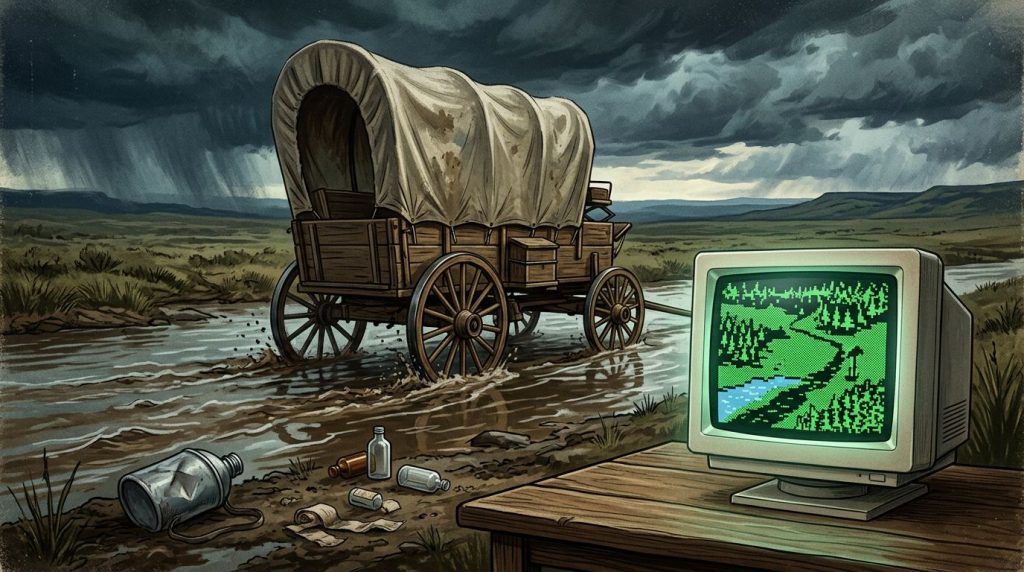
The old classroom computer ran a computer game, an educational video game meant to teach history. Instead, it taught an entire generation one cold, weirdly adult sentence: dysentery could wipe out a member of your tiny pixel family before lunch.
You picked names, bought supplies, crossed your fingers at every river, then watched somebody get sick. The famous death message became an 80s playground punchline, but its roots were rougher than any floppy disk could show.
Behind the joke sits a real illness, a real migration route, and a historical experience the game made painfully personal. Its choices made the game a strategy video game. This article explains both the illness and the game’s historical context along the Oregon Trail.
Key Takeaways
- Dysentery was a serious intestinal illness that could cause severe diarrhea, dehydration, fever, and death without reliable medical care.
- Contaminated water, food, hands, and crowded camps made infectious diseases a constant threat along the real Oregon Trail.
- The Oregon Trail game turned illness, hunger, river crossings, supplies, and exhaustion into strategy mechanics that captured the pressure of westward migration.
- The message “You Have Died of Dysentery” became an 80s classic because its blunt, ordinary wording made a frightening historical reality unexpectedly memorable.
- Behind the joke is a lasting public health lesson: clean water, sanitation, medical access, and disease prevention can determine who survives.
Why Dysentery on the Oregon Trail Wasn’t Just a Joke
Dysentery isn’t a catchall word for “feeling lousy.” It’s a serious intestinal illness, marked by severe diarrhea, stomach pain, fever, and sometimes blood or mucus in the stool. The danger is dehydration. A person can lose fluids and strength fast, turning one patient’s illness into a public health threat.
For families traveling toward the Willamette Valley on the Oregon Trail, illness didn’t arrive with a warning bell. It could begin after drinking bad water, eating contaminated food, or handling supplies with unwashed hands. Typhoid fever was a different illness and another serious threat. Without nearby doctors, the public health burden could leave travelers too weak to walk beside the wagon, help with camp, or recover before the party moved on.
In a strategy video game, illness is one abrupt line. On the trail, it could mean days of dehydration, exhaustion, and no safe place to recover.
That gives the familiar message its strange staying power. Kids laughed because the wording was so blunt. Adults laughed because they remembered the dread. The word dysentery became memorable because it made a complicated medical crisis sound startlingly simple. But nobody in 1850 treated it like a goofy game setback.
Different versions of the game handled illness and death differently. Some gave a simple notice that a party member was sick or had died. Others made the cause of death more memorable. The famous death notice remains part of cultural memory, even if not every player saw that exact wording on every machine.
Why Dysentery Spread Along the Real Oregon Trail
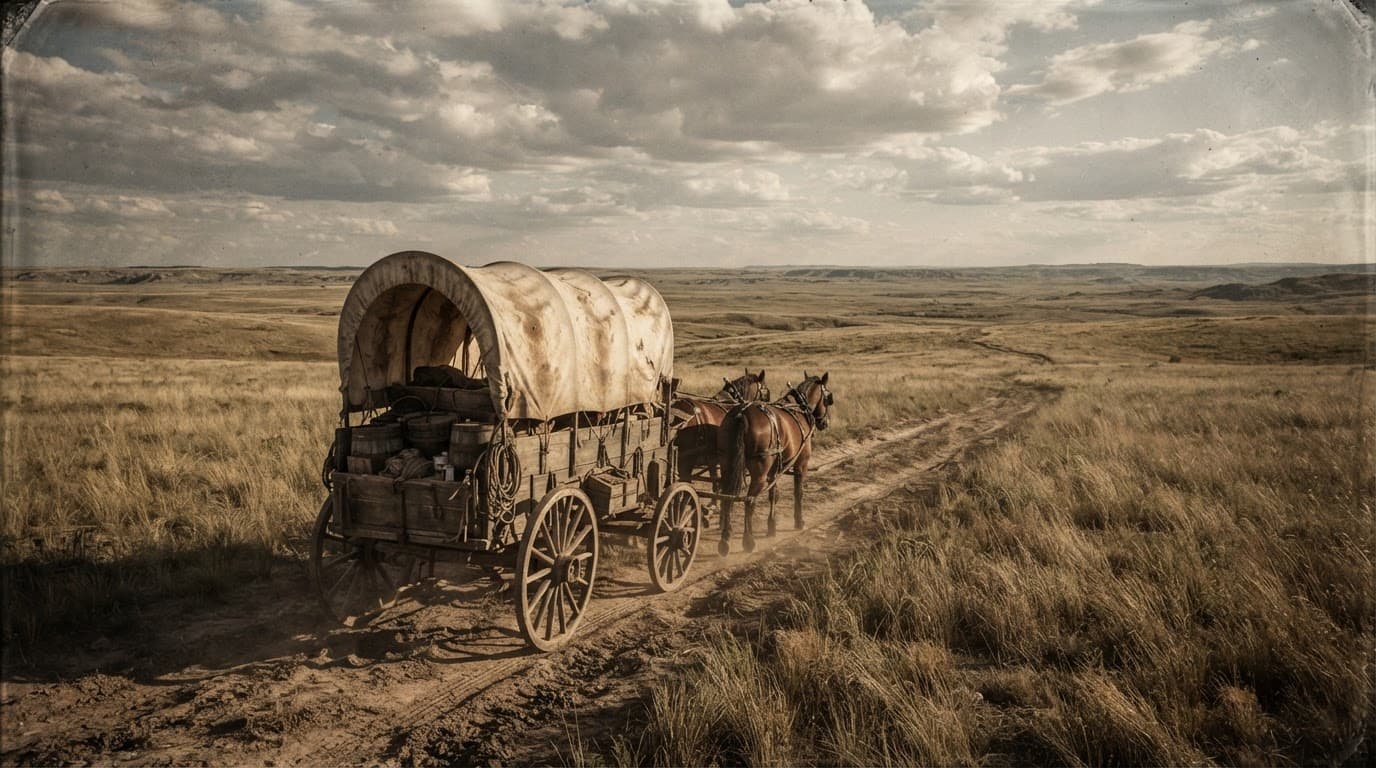
The Oregon Trail was not one neat road with clean wells and tidy rest stops. It was a long, crowded route to the Willamette Valley. Emigrants traveled among horses, oxen, and mules, sometimes in a covered wagon or wagon train. A promising creek could become a problem fast.
People needed water for drinking, cooking, and laundry, while livestock needed huge amounts. Campsites were often reused, and a wagon train might draw from the same source repeatedly. Human waste and animal feces could wash into surface water, especially after rain. Clear-looking creeks could still carry pathogens that cause waterborne diseases, including typhoid fever. That contamination could turn one group’s water source into another group’s medical disaster and a serious public health problem.
The problem was not that pioneers were careless or foolish. They traveled through vast country with limited supplies, limited fuel, and no organized public health measures. There were no modern sanitation systems, portable water-treatment kits, refrigeration, or antibiotics. No reliable test showed whether a creek was safe.
A public health account of diseases on the route uses historical data to describe diphtheria and other infectious diseases emigrants faced. Disease shared the trail with broken axles, drowning, lightning, injuries, and plain old exhaustion. What a vacation brochure.
One Creek, Too Many Uses
Dysentery commonly spreads through the fecal-oral route. That unpleasant phrase means germs from fecal matter get into food, water, or hands, then enter another person’s mouth. It sounds basic because it is. It was also brutally hard to avoid on a crowded overland journey.
A water source might look clear and still carry pathogens that cause waterborne diseases, including typhoid fever. Travelers lacked a practical framework for avoiding contamination, with germ theory still absent from everyday travel advice. Germ theory was gaining ground during the nineteenth century, but it had not become a useful guide for a family camped beside a muddy riverbank.
Boiling water could help, but it took time, fuel, containers, and the knowledge to do it consistently. A tired family with restless children, hungry animals, and miles left before nightfall did not always have ideal choices.
Period health guides show how much sickness shadowed the journey. A BLM Oregon and Washington discussion of an 1852 emigrant almanac mentions entries for dyspepsia, bowel trouble, and other ailments that emigrants feared.
The Germs Behind the Grim Names
Different pathogens caused different illnesses and symptoms. Shigella causes a bacterial infection that inflames the intestine and spreads easily where sanitation breaks down.
Other dangerous infections haunted emigrants too. Crowded camps and contaminated water could raise the risk of a cholera outbreak:
- Vibrio cholerae causes cholera, which can bring sudden, severe fluid loss through diarrhea and vomiting.
- Salmonella Typhi causes typhoid fever, an infection spread through contaminated food or water.
- Entamoeba histolytica, a parasite rather than a bacterium, can also cause amoebic dysentery.
The names sound like a science-class pop quiz. Their effects were anything but academic. A person weakened by diarrhea and fever could not easily ride, walk, cook, care for children, or keep warm through a cold night. The next section shows how these realities became simplified mechanics in a strategy video game.
How the Oregon Trail Game Turned Sickness Into Strategy
The original Oregon Trail began as a classroom strategy video game, not an Apple II icon. In 1971, student teachers Don Rawitsch, Bill Heinemann, and Paul Dillenberger created an early simulation that brought digital education into an eighth-grade lesson on westward migration. Players made choices through a teletype terminal, choosing supplies and responding to bad luck.
When Rawitsch joined the Minnesota Educational Computing Consortium, better known as MECC, the project moved into schools. It became a widely distributed MECC video game, with the westward objective pointing players toward the Willamette Valley.
Then came the version that burned itself into the brains of 80s kids. MECC’s 1985 graphical version reached classrooms on an Apple II computer and became a memorable computer game.
R. Philip Bouchard led the design of that 1985 edition, turning the earlier text-heavy simulation into something more visual, more immediate, and far more likely to make a kid yell at a glowing green-and-black screen.

You bought bullets. You hunted. You chose rations. You decided whether to ford a river or pay for a ferry. Every choice felt like it mattered because, in the game, it usually did.
R. Philip Bouchard’s visual design made those tradeoffs feel immediate. The wagon, supplies, and hazards were simple pixels, but they gave every decision a memorable consequence.
The Survival Choices That Echoed Real Hardships
The game could not model every ugly detail of a nineteenth-century public health crisis. Instead, it used survival mechanics to turn complexity into manageable variables. Those systems captured the pressure of a pioneer journey better than a worksheet ever could.
| In-Game Choice | Real Trail Problem Behind It |
|---|---|
| Setting a fast pace | A rushed party risked exhaustion, injury, and illness across people and animals. |
| Choosing food rations | Smaller meals saved supplies but weakened the entire party under strain. |
| Buying supplies | Limited money had to cover food, clothing, tools, and medicine for everyone. |
| Resting at a fort | Recovery could help the whole party, but delays consumed time and supplies. |
| Attempting a river crossing | The whole party risked drowning, damaged wagons, lost supplies, and delays. |
As a strategy video game, it turned those systems into tradeoffs affecting the whole party. Rest, pace, rations, money, and crossings could help one goal while hurting another.
The hunting minigame made survival look like a quick burst of arcade action, compressing food acquisition into a few fast decisions. Real hunting was harder, slower, and uncertain. You could not fire a few shots, haul back an absurd pile of meat, and call it a day. Yet the hunting minigame got one big thing right: food, timing, weather, health, and money were always tangled together.
A sick party member was not merely one less name on the screen. On the actual trail, illness could change the labor of an entire family. Somebody had to drive the wagon. Somebody had to tend the fire. Somebody had to care for the sick person. The game reduced that reality to numbers, yet the tension stayed.
Why “You Have Died of Dysentery” Became an 80s Classic
For anyone who remembers it, Oregon Trail game dysentery was a phrase with instant comic timing. The player might have named a friend, a sibling, or the kid sitting beside them in computer class. Then, bam, the message appeared.
The line also landed because, as a strategy video game, its low-tech presentation made ordinary hazards sound wonderfully unglamorous. No dragon. No laser blast. No final boss. Just a serious illness with a weird name. The joke came from the mundane wording and serious consequences, not from treating the disease as harmless.
That contrast made the meme durable. R. Philip Bouchard’s visual design gave the timing a plainspoken rhythm, turning history’s worst travel brochure into a shared childhood ritual: name the party, buy supplies, try the hunting minigame, lose an axle, pray at the river, and hope to reach the Willamette Valley.
It also became a historical landmark of school computing, right up there with the 80s games that ruled computer class. Okay, that last part is a little dangerous. One minute you are learning history. The next minute you are emotionally attached to a pixelated wagon party.
Frequently Asked Questions
What is dysentery?
Dysentery is a serious intestinal illness that can cause severe diarrhea, stomach pain, fever, and blood or mucus in the stool. The greatest immediate danger is often dehydration and the rapid loss of strength and fluids.
How did dysentery spread along the Oregon Trail?
Contaminated water, food, hands, and supplies could spread dysentery through the fecal-oral route. Crowded camps, reused water sources, livestock, and limited sanitation made contamination difficult to avoid.
Was dysentery the only disease travelers faced?
No. Emigrants also faced typhoid fever, cholera, diphtheria, and other infections, as well as injuries, exhaustion, drowning, and exposure. Different pathogens caused different illnesses, even when the game reduced them to a simple sickness message.
When was the Oregon Trail game created?
The first version was created in 1971 by Don Rawitsch, Bill Heinemann, and Paul Dillenberger as a classroom simulation. MECC’s 1985 graphical version brought the game to Apple II computers and helped make the dysentery message part of school-computer culture.
Why did “You Have Died of Dysentery” become so memorable?
The message used plain, startling language to announce a serious consequence. Players had named their party members and managed their supplies, so losing someone to an unglamorous illness felt both personal and absurd.
The Lasting Lesson Behind the Laugh
The Oregon Trail game made dysentery famous, but the real illness was never funny. The strategy video game reduced migration toward the Willamette Valley to choices about water, food, and risk.
Its hunting minigame simplified the labor and uncertainty of finding enough food. Emigrants also faced typhoid fever and limited nineteenth-century treatment, without the medical advancements that now support prevention and care.
The game’s message became funny and memorable. Its deeper lesson is one of public health. Clean water, sanitation, less crowding, and medical access can determine who survives.
The illness was not a random game-over screen, but a real threat faced by people trying to reach the West alive.