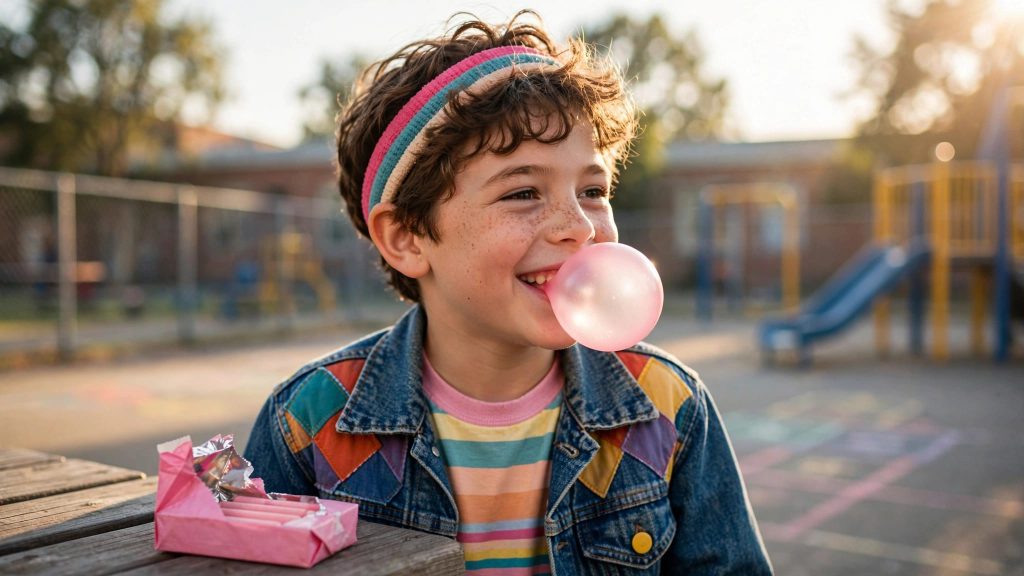
Before selfies, there was the schoolyard bubble test. Could you blow one big enough to cover your nose, hold it for a second, then pop it without wearing the evidence?
Hubba Bubba arrived at exactly the right moment. It was soft, colorful, sweet, and made for that tiny act of playground showmanship. You didn’t need a scoreboard. The bubble was the scoreboard.
For 80s kids, a pack of gum became part of 1980s bubble gum culture, turning a bus stop, mall bench, or backyard into center stage. It was the kind of 80s candy that made childhood feel like a performance.
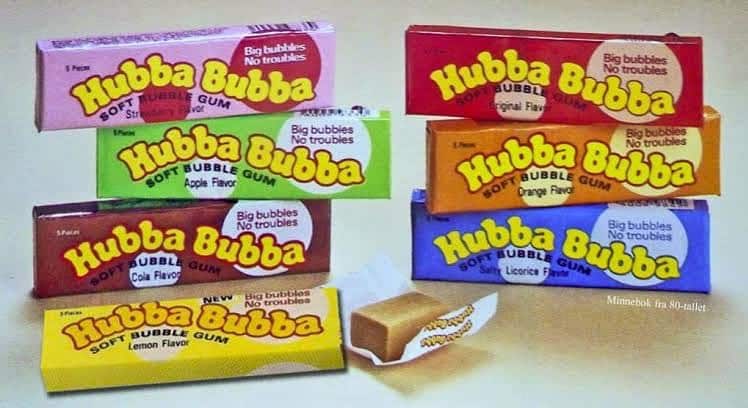
Hubba Bubba Gum Hit the United States in 1979
The brand launched in the United States in 1979, right before the 1980s turned bright packaging, loud advertising, and snack-time gimmick culture into a full-blown lifestyle.
The Wrigley Company introduced the product in the United States in 1979, selling it in a five-piece bubble gum chunk format. The Wrigley Company is now part of Mars, Incorporated, so the brand sits under the Mars Wrigley family today.
A name with World War II roots
Documented brand-history sources connect the name to “Hubba Hubba,” a phrase some U.S. military personnel used during World War II to show approval. It had bounce. It had pep. It sounded like something you’d yell after seeing a giant pink bubble sail across the cafeteria.
The brand’s own Hubba Bubba history confirms the 1979 launch and original chunky format. No complicated backstory was needed on the wrapper. The name already sounded like fun.
The project called Stagecoach
Early development accounts often repeat an internal-development anecdote about the code name “Stagecoach” at a Wrigley plant in Santa Cruz, California. It’s a great bit of brand lore, though the official brand timeline doesn’t confirm it.
That code name also fits the early Wild West feel of the advertising. Somewhere between the lab bench and the TV screen, a simple chewing gum got a whole personality.
The Big Sell: A Less-Sticky Formula
Bubble blowing is a risky hobby when you’re eight. A bubble pops, and suddenly you’ve got pink glue on your lips, cheek, hair, or the sleeve of your prized neon sweatshirt.
According to this look back at Hubba Bubba’s early history, the product’s calling card was a formula marketed as less sticky than ordinary sticky bubble gum. The pitch was plain and smart: blow a bubble, let it burst, and peel it away more easily.
Why that mattered to kids
Taste got you to buy a pack. A bubble that didn’t turn your face into a sticky crime scene got you to buy another.
Candy history accounts describe the less-sticky positioning as a key point of difference. The company used that promise to join the gum battle. The linked source is a secondary account, not official brand documentation. The idea wasn’t glamorous. It was practical, and in kid logic, that made it genius.
A good bubble was only half the mission. The other half was getting away clean after it popped.
Nobody believed gum could be completely mess-free. But “less sticky” was a mighty appealing phrase when your mom was within arm’s reach.
The 80s Bubble-Blowing Craze Had Plenty of Players
Hubba Bubba didn’t invent kids blowing bubbles. Bubble gum had been a fixture long before the 80s. What the decade did was turn ordinary treats into colorful accessories, little props for a loud and playful childhood.
You had gum in pockets, purses, pencil cases, and jacket compartments. You chewed it while reading comics, waiting for the arcade, walking home from school, or flipping through a fresh stack of cassette tapes.
The schoolyard rules nobody wrote down
Every playground had its own unofficial bubble etiquette. The basic moves were universal:
- Blow too small, and your friends might offer coaching.
- Blow too big, and somebody would call it luck.
- Let it explode across your face, and you’d hear the laugh before you found a napkin.
- Try again anyway, because quitting after one pop was never the move.
The joy was in the attempt. Kids weren’t chasing perfection. They were chasing that glorious second when the bubble went round, pale pink, and improbably huge.

Bubblicious was the aisle rival
Bubblicious was a notable 1980s competitor. Both offered soft, sweet gum in bold varieties, and both understood the assignment: kids wanted bubbles, not a serious chewing experience.
That rivalry made the candy shelf more fun. You chose by flavor, texture, package art, or whatever your best friend swore could blow the biggest bubble. There was no need for brand loyalty carved in stone. A pocket full of change could take you anywhere.
Chunks, Tape, and Gum That Felt Like a Toy
The original chunks had a straightforward appeal. Unwrap a piece, toss it in, chew until it softened, and see what happened. That was enough for plenty of fans.
Then the late 80s added one of Hubba Bubba’s great novelty ideas: Bubble Tape. The brand’s official history dates its arrival to 1988. It came in a round plastic case with a long roll of bubble gum tape inside. The experience was part snack, part gadget.
Bubble Tape changed the ritual
Bubble Tape made portioning feel deliciously rebellious. You could pull off a little strip, a longer strip, or the amount your confidence demanded.
The tape format turned gum into a conversation piece. It also fit the same snack culture that made bright plastic packaging and interactive treats irresistible. If that hits a familiar nerve, revisit the click-up Push Pop lollipop, another counter classic that felt a little like a toy.
Other shapes came and went
Over the years, Hubba Bubba’s documented range extended beyond chunks and tape. It included gumballs, shredded pieces, and special varieties across the brand’s long trip through gum aisles.
The exact flavors and formats depend on country and era. The official history recalls flavors such as Cola Party, Groovy Watermelon, and Gushing Grape, without suggesting they were sold everywhere at once. That’s the magic of retro gum memory, too, but an old package or memory isn’t proof of one current original flavor. Someone will swear the blue package was best. Someone else will defend grape until recess ends.
Commercials Gave the Gum a Wild-West Streak
80s ads didn’t always settle for showing a product. They built tiny worlds around it. Cereal had mascots. Raisins sang. Candy chews got zany. Gum could have a cowboy.
Meet the Gumfighter
Early Hubba Bubba ads used Wild West scenes and a character known as the Gumfighter. Those commercials leaned into broad visual humor for kids watching cartoons on Saturday morning with a bowl of cereal nearby.
That kind of advertising DNA belongs in the same scrapbook as the California Raisins’ pop-star rise. In the 80s, a 30-second ad could be a mini show, complete with a character you remembered long after the product disappeared from your lunchbox.
The later stop-motion connection
Some secondary advertising histories and archived campaign records link a 2004 United States campaign to Aardman animation, the stop-motion studio behind Wallace & Gromit. The brand’s commercials moved through different looks and eras, but the playful tone stayed put.
For a quick overview of those product and ad-history threads, the Hubba Bubba reference entry collects many of the best-known details. The bigger point is simple: the gum was never sold as a grown-up chew. It was sold as a little burst of mischief.
Finding Hubba Bubba Today
The brand is still active, though availability varies by store, region, and online seller. Mars, Incorporated is behind the Mars Wrigley business, and the tape format still triggers instant 80s recognition years later.
Don’t count on every remembered version of the gum showing up at your local checkout lane. Store lineups shift, seasonal stock comes and goes, and international products don’t always reach nearby shelves.
Check the package, not your memory
If ingredients matter to you, read the package in your hand. Recipes and labeling can change, and different formats may have different nutrition information.
The same rule goes for product names. A nostalgic online listing can be a time capsule, not proof that the item is currently made. The hunt is part of the fun, but the wrapper gets the final word.
Key Takeaways
- Hubba Bubba first reached U.S. stores in 1979 in its original chunk format, introduced by the Wrigley Company.
- Mars, Incorporated now owns the brand, whose name came from the approving slang phrase “Hubba Hubba.”
- Its less-sticky positioning appealed to bubble blowers tired of face-level messes.
- Bubblicious was a major 80s rival, while Bubble Tape added a fresh novelty hook in 1988.
- The brand reflected a broader decade of playful products and kid-sized moments that demanded a little performance.
Why That Pink Bubble Still Pops
The brand wasn’t the only gum in the 80s, and it didn’t create the bubble-blowing craze by itself. It earned a place in it by understanding what kids wanted from bubble gum: a soft chew, big bubbles, loud colors, and fewer sticky consequences.
One popped bubble can bring back the whole scene, can’t it? The bike rack. The mall candy counter. The crinkle of a wrapper. That tiny burst of pink mischief still knows the way home.
FAQ
When was Hubba Bubba first introduced in the United States?
It first launched in 1979. The original format was a pack of five chunky pieces of gum.
What is the reported origin of the name?
A commonly reported origin links the name to a World War II expression associated with military personnel. The attribution is widely repeated, but available evidence doesn’t confirm it as the definitive source.
Who owns the gum now?
It’s a Wrigley brand under Mars, Incorporated. Wrigley created and introduced it, while Mars Wrigley handles the brand today.
Why was it marketed as less sticky?
The product was promoted as easier to peel away after a bubble burst. That selling point helped kids enjoy huge bubbles without as much bubble gum stuck to their faces.
When did Bubble Tape come out?
Bubble Tape arrived in 1988. Its long strip of gum in a round plastic case made it one of the most memorable formats of the late 80s.
Did Aardman make the commercials?
Secondary advertising histories credit Aardman with stop-motion ads used for a reported 2004 U.S. campaign. That attribution doesn’t include the earlier 1980s advertising.