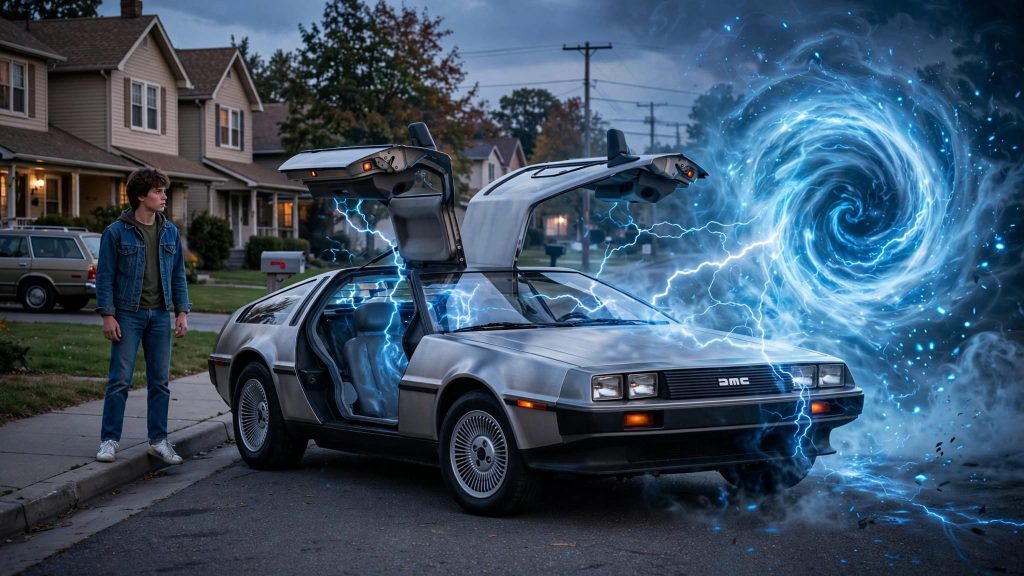
Universal Pictures’ 1985 theatrical release gave moviegoers a stainless-steel sports car, a wild-haired inventor, and one unforgettable warning: don’t mess with your parents’ first date.
1985 time travel movies weren’t a giant pile of identical films released at once. They marked a smaller, stranger moment. One enormous theatrical blockbuster made impossible journeys feel like the most fun you could have in a parking lot, while television projects and cult-oriented science fiction offered darker, sweeter, and far weirder versions of the future.
Fire up the flux capacitor. We’re heading back to the year when yesterday suddenly looked like the hottest place to be.
Key Takeaways
- Back to the Future turned time travel into a funny, fast-moving family adventure, with Michael J. Fox’s Marty McFly traveling from 1985 to 1955 in a DeLorean.
- The film’s success came from its personal stakes: Marty must repair his parents’ first meeting, protect his own future, and return home before history erases him.
- The 1985 time travel moment extended beyond theaters, with Disney Channel’s The Blue Yonder offering a gentler story about family, memory, and meeting a grandfather in the past.
- The wider 1985 science fiction landscape had remarkable range, from Cocoon and Explorers to Brazil, The Quiet Earth, and Enemy Mine.
- Practical effects, physical machinery, and the famous lightning-strike finale gave 1985 science fiction a tangible sense of danger and wonder.
Back to the Future Made Time Travel Pop
Released by Universal Pictures on July 3, 1985, Back to the Future turned a brainy science fiction film premise into a full-speed summer adventure. Robert Zemeckis directed it, Bob Gale co-wrote the original screenplay, and Steven Spielberg executive-produced it for Universal Pictures.
Marty McFly is a regular teen with a skateboard, a guitar, family problems, and terrible timing. Doc Brown, played by Christopher Lloyd, is the brilliant neighborhood oddball who builds a time travel machine inside a DeLorean. One bad night sends Marty from 1985 to 1955 in the DeLorean time machine, where he has to repair history before he disappears.
The original theatrical release brought in about $381.1 million worldwide. It became a box office success and the year’s biggest hit for Universal Pictures. The American Film Institute’s production record captures just how much work Universal Pictures put into getting the movie on screen.
A Time-Travel Story With Sneakers On
Earlier time-travel stories could be grand, gloomy, or full of physics homework. For Marty McFly, Back to the Future made the idea personal.
What if you met your parents as teenagers? What if your mom had a crush on you? What if your dad needed a push to become brave?
Those questions came from Bob Gale’s story and gave the movie its heart, while Christopher Lloyd makes Doc Brown human. The ticking-clock suspense mattered, but Bob Gale’s original screenplay made George McFly’s stand against Biff matter too. You weren’t only waiting for the DeLorean to hit 88 mph. You were waiting for a family to get its future back.
The DeLorean Was the Whole Deal
Early discussions considered a refrigerator as the time machine. Thank heaven, that idea stayed on the drawing board.
The DeLorean looked futuristic before it did anything. Its brushed stainless-steel body and gullwing doors made it feel like an exotic machine that had fallen into suburban Hill Valley by mistake. It was part sports car, part science project, and part rolling piece of 1980s wish fulfillment, before the story turned it into a DeLorean time machine.
As visual commentary, the DeLorean’s design reflects Bob Gale’s visual storytelling and Steven Spielberg’s production instincts:
The DeLorean time machine didn’t need an explanation before it became iconic. One look told you that this thing could do something spectacular.
The Movie That Nearly Had a Different Marty
Here’s the part that still makes fans blink. Back to the Future nearly had a different Marty McFly. Michael J. Fox wasn’t the first actor filmed in the role.
Eric Stoltz was originally cast, and significant scenes were filmed before the filmmakers changed course. Bob Gale’s original screenplay gave Marty an ordinary teenager’s perspective, making the lead’s tone especially important.
According to the AFI record, Eric Stoltz was replaced after five weeks, and Michael J. Fox then took over. The change happened during principal photography, while the production was still underway.
For Universal Pictures, the switch meant expensive reshoots, a new lead, and a production already racing against the calendar. Eric Stoltz’s replacement became one of the clearest pivots in the film’s production history.
Fox Brought the Missing Spark
Michael J. Fox brought the loose, alert energy the role needed. Robert Zemeckis directed the tonal balance Bob Gale gave Marty, an ordinary teenager facing time travel demands. He could look terrified, sarcastic, and weirdly confident within the same beat. Eric Stoltz’s filmed material reflected a different interpretation, but the public record doesn’t reduce the decision to one simple motive.
The new Marty could look terrified, sarcastic, and weirdly confident within the same beat. Marty McFly never feels like a chosen hero. He feels like the kid who got swept into the craziest night of his life.
Christopher Lloyd met him perfectly as Doc Brown, playing Doc with huge eyes, huge hair, and total conviction. Eric Stoltz’s filmed scenes reflected another approach. Christopher Lloyd’s commitment kept Doc Brown’s “1.21 gigawatts!” from becoming pure cartoon noise. Instead, it became a line every 80s kid can still hear at maximum volume.
The finished film has a quicksilver comic rhythm. Michael J. Fox bounced off Christopher Lloyd, Lea Thompson, Crispin Glover, and Thomas F. Wilson like a pinball. Christopher Lloyd’s chemistry with the cast gave Doc a human center. That rhythm is the movie’s secret weapon.
That production history isn’t proof that chaos is glamorous; it shows that filmmakers sometimes know when a character hasn’t clicked yet. Eric Stoltz had already spent weeks in the production, making the reshoots an enormous risk. Steven Spielberg’s producing role helped steady a production already under pressure. They took that risk and got the version of Marty McFly that audiences wanted to follow anywhere, including 1955.
Why 1985 Movies Felt So Fresh
The 1985 time travel movies that stuck weren’t obsessed with distant centuries and chrome cities. They focused on memory, family, and everyday locations, asking what happens when a kid sees the old neighborhood before it became old.
Back to the Future made that premise personal, connecting memory to family stories and familiar streets. That fit the decade beautifully. The 1980s loved gadgets, malls, music videos, consumer sparkle, and bold little machines with blinking lights. The decade’s science fiction also looked backward, especially toward the clean-cut pop mythology of the 1950s.
History Became Teen Territory
Marty McFly’s trip to 1955 isn’t a classroom lecture. Michael J. Fox makes the past feel immediate, not museum-like. It’s a teen comedy in new clothes, with a soda shop, school dance, a bully, and a guitar solo. His parents are suddenly his own age.
That setup let the film wink at the past without treating it like a museum. The 1950s are cute, awkward, and full of danger. Biff is still Biff. Parents are still embarrassing. The difference is that Marty sees where their stories began.
Technology Felt Tactile
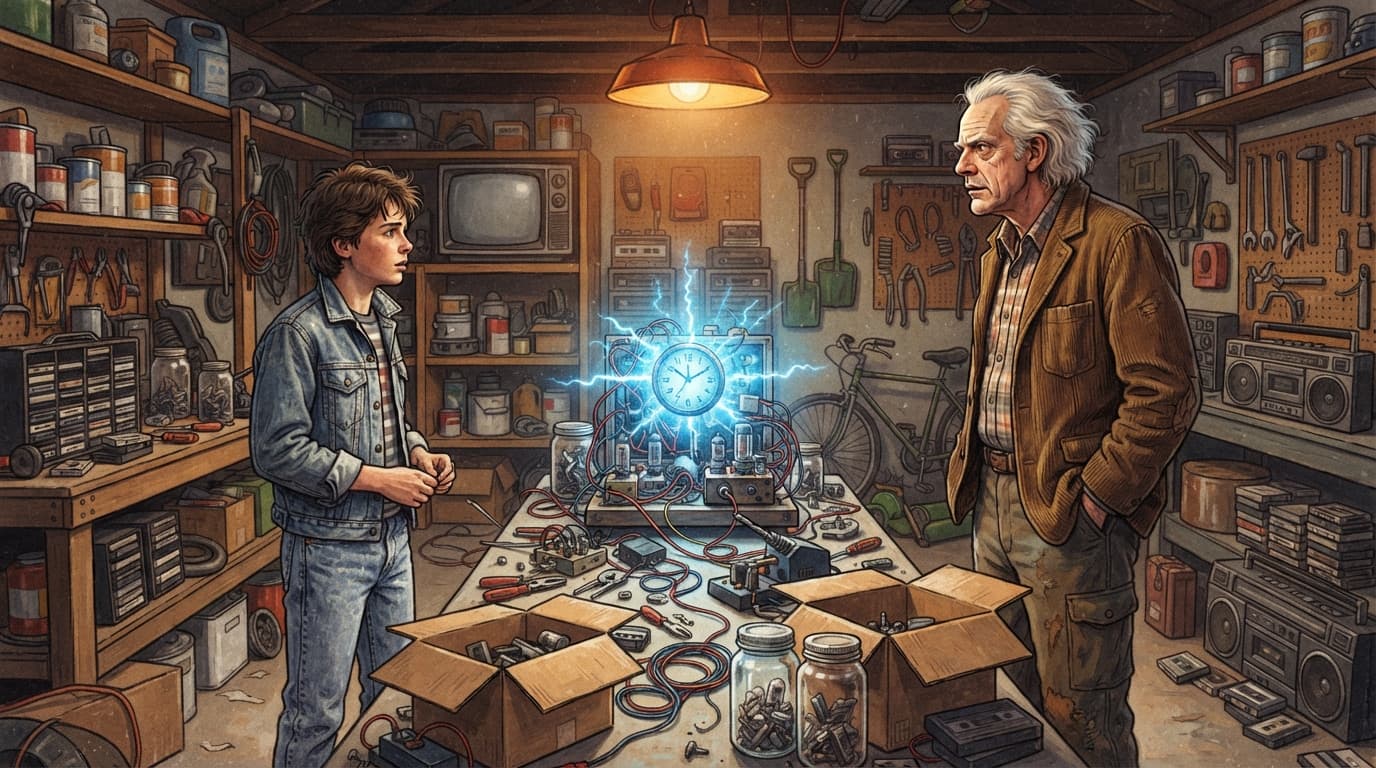
In 1985, the future had buttons. It drew on cassette tapes, digital watches, TV sets with knobs, and bulky home computers. Even the flux capacitor has a wonderfully homemade feel.
The DeLorean time machine needs plutonium, cables, a lightning strike, and a precise speed. You can almost smell the smoke from the garage. The special effects use physical materials, giving the technology weight even when the plot does backflips through time. The visual effects rely on optical techniques, not modern digital imagery, so the machine feels tangible.
The Blue Yonder Took Time Travel to Television
The craze wasn’t confined to multiplexes. Disney Channel viewers got a family story about time travel later that year, first airing on November 17, 1985.
The television story has a softer, more family-friendly premise than Marty’s high-stakes adventure in Back to the Future. A young boy travels into the past to meet his grandfather, a pioneer aviator. Disney’s own archive entry for The Blue Yonder confirms both the story and its original Disney Channel broadcast.
A Smaller Story, a Different Kind of Wonder
The Blue Yonder uses time travel for connection rather than a race against erasure. The past is a place to understand family, courage, and a relative who exists in stories before he exists in your memory.
That’s an important distinction. Not every 1985 science fiction project had to blow out the clock tower. Some used the same impossible idea to bring generations face-to-face.
It Wasn’t One Giant Wave of Copies
Calling it a craze doesn’t mean every studio released a DeLorean knockoff in July. The comparison is between a theatrical science fiction film and a Disney Channel movie, each with its own audience and expectations.
What connected them was the era’s appetite for a trip backward. The Blue Yonder offered a gentler version of that journey. It shows that the past isn’t flat, but full of people making choices, taking risks, and becoming the adults kids thought they already knew.
The Rest of 1985 Sci-Fi Had Range
Time travel was only one flavor on the 1985 genre menu. The year’s science fiction film lineup also delivered alien visitors, dystopian paperwork, lonely survivors, kids building spaceships, and enemies forced to become family.
That variety is why the year’s sci-fi shelf still feels so rich. Some titles packed theaters. Others found their audiences later through late-night television and video rentals. That path gave some films cult success and connected them with fans of cult sci-fi movies.
Wonder, Aliens, and Kids With Big Ideas
Ron Howard’s Cocoon gave viewers warmth, older characters, and extraterrestrial mystery. Joe Dante’s Explorers put young dreamers at the center of a homemade path to space. It starred Ethan Hawke and River Phoenix before either became a familiar face.
That kid-centered energy sat right beside the year’s other youth adventures. Steven Spielberg also produced The Goonies, another 1985 jolt of bikes, friendship, treasure maps, and “we can handle this” confidence. The Goonies’ pirate-map adventure had no time machine, but it shared Marty’s all-in spirit.
The Strange Stuff Had Teeth
Then there was Terry Gilliam’s Brazil, a nightmare vision of a dystopian future shaped by bureaucracy, machines, and dreams that don’t stay obedient. Its horror-adjacent atmosphere recalls sci-fi horror, though the film remains a bureaucratic satire. The film’s synopsis and cast listing puts Jonathan Pryce’s trapped bureaucrat at its center.
New Zealand’s The Quiet Earth imagined a near-empty world after a mysterious event. Enemy Mine sent Dennis Quaid’s human pilot into an uneasy bond with an alien enemy. These weren’t time-travel stories, but they show how 1985 science fiction could get lonely, political, and unsettling. Some even carried a sci-fi horror edge after the popcorn went cold.
Practical Effects Made the Impossible Feel Close
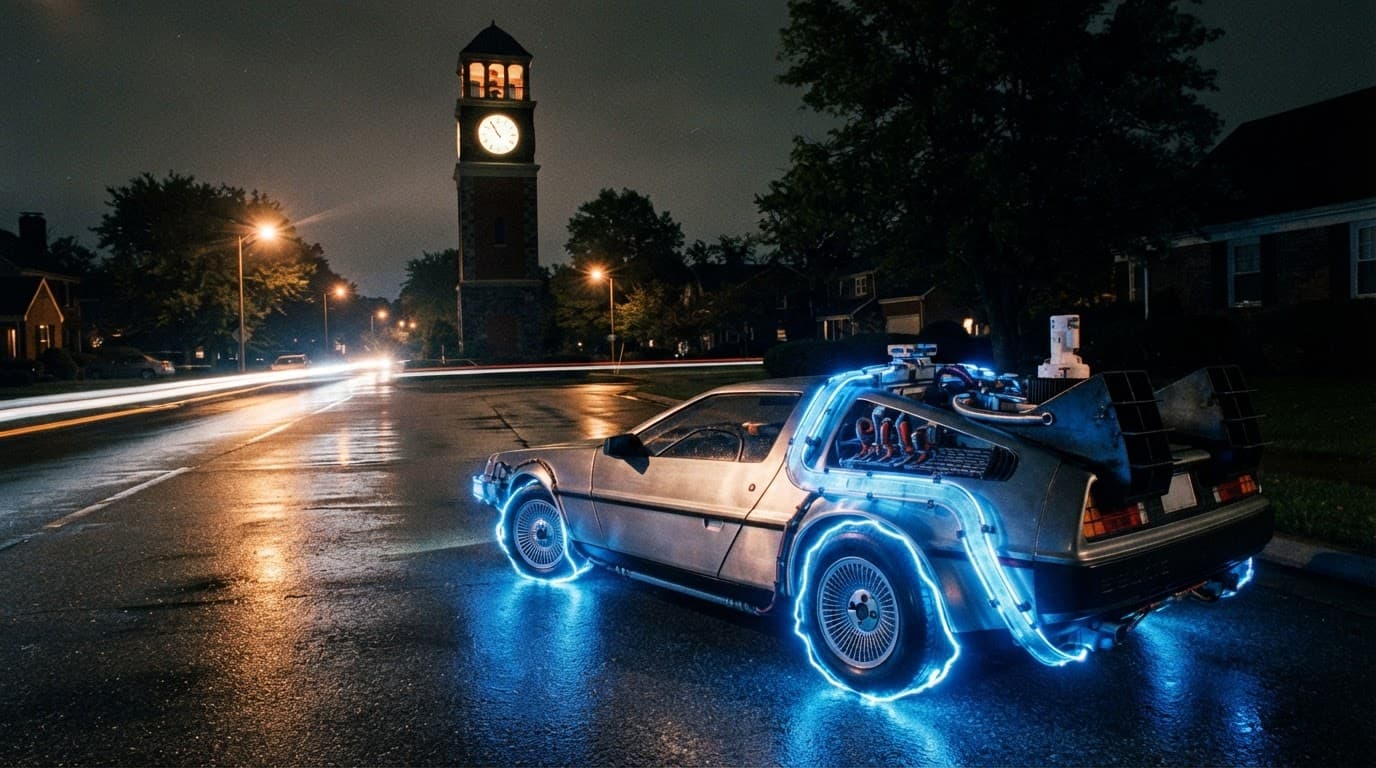
No 1985 audience expected a spotless computer-generated universe. The clock tower sequence feels physical because its impossible time travel machinery occupies real space.
A real car, miniature work, optical work, sparks, smoke, and performers reacting to physical objects give the spectacle a scrappy texture. Special effects supply physical danger, while visual effects join those elements on screen. The lab looks built, wired, and ready to collapse if someone opens the wrong cabinet.
The Lightning Strike Still Hits
The finale is a beautiful mess of cables, weather, timing, and panic. Marty needs the DeLorean time machine in exactly the right place when lightning hits the clock tower. Doc Brown needs everything to work by one deadline, and Christopher Lloyd makes every reaction feel genuinely panicked. The audience needs a paper bag.
The special effects are spectacular, sure. The sequence is also a clean piece of storytelling. Every prop has been introduced. Every problem has a deadline. When the car vanishes in a flash, the movie earns the roar.
The Future Had Personality
Modern effects can make anything glide. The 1985 approach made machinery sputter, flash, and feel slightly dangerous. That was part of the fun.
The best films of the period made technology seem approachable enough to dream about, but unstable enough to fear. A teenager might borrow a time machine. He probably shouldn’t. But he might.
Frequently Asked Questions
What was the biggest time travel movie of 1985?
Back to the Future was the year’s major theatrical time travel hit. Released by Universal Pictures on July 3, 1985, it became a worldwide box office success and the studio’s biggest hit of the year.
What is Back to the Future about?
The film follows Marty McFly, a teenager who travels from 1985 to 1955 in Doc Brown’s DeLorean time machine. Marty must bring his parents together, protect his future, and get back home before his changes to history erase him.
Was Michael J. Fox always the original Marty McFly?
No. Eric Stoltz was originally cast as Marty, and significant scenes were filmed before Michael J. Fox took over the role. According to the AFI record, Stoltz was replaced after five weeks, leading to extensive reshoots.
Was The Blue Yonder a time travel movie from 1985?
Yes. The Disney Channel television story followed a young boy who traveled into the past to meet his grandfather, a pioneer aviator. Unlike Back to the Future, it used time travel for family connection and understanding rather than a race against erasure.
Why do 1985 time travel movies still feel distinctive?
They made impossible technology feel physical through cars, cables, sparks, smoke, optical effects, and practical machinery. Their stories also focused on familiar places, family history, memory, and the emotional consequences of seeing the past up close.
Why We Still Want to Go Back
Back to the Future works because it never treats nostalgia as a free pass. Marty McFly sees the good, the goofy, and the uncomfortable parts of his parents’ teen years. He returns home with a little more empathy, which Michael J. Fox makes feel genuine.
That is a pretty sweet trick for a movie with a DeLorean time machine, Christopher Lloyd as Doc Brown, and a guy shouting about gigawatts.
Universal Pictures’ theatrical release gave this science fiction film a legacy that still feels unusually warm. Bob Gale’s original screenplay gives its family premise real staying power, and Bob Gale’s story design makes each revelation feel earned. Michael J. Fox makes that empathy land, while Christopher Lloyd balances comic energy with emotional weight. Steven Spielberg’s guidance and the recasting that replaced Eric Stoltz remain revealing footnotes to its making.
The broader 1985 genre had range, too. It gave us one enormous classic, one overlooked Disney memory, and a shelf of imaginative experiments. Great time travel stories don’t only ask where you’d go. They ask what you’d finally understand when you got there.