Five kids walk into Saturday detention carrying labels they didn’t choose. By the final bell, those labels look flimsy, painful, and a little ridiculous.
As a 1985 film, The Breakfast Club made high school feel less like a backdrop for pranks and promposals, more like a pressure cooker with lockers. John Hughes made it a coming-of-age story about being understood, with funny, defensive, messy teens scared of being seen. Simple Minds later carried that emotional realism into a musical afterlife beyond its 1980s style.
Key Takeaways
- The Breakfast Club turned a simple Saturday detention into a pressure cooker for exploring teenage identity, social labels, and the fear of being misunderstood.
- John Hughes’s dialogue-driven film relied on a small setting, strong performances, and five sharply drawn archetypes that gradually become more complicated people.
- The film’s treatment of class, family pressure, cruelty, and Allison’s makeover remains emotionally powerful but also invites important criticism.
- Simple Minds’ “Don’t You (Forget About Me)” helped transform the ending into one of the most lasting musical moments in 1980s cinema.
- Its selection for the National Film Registry and continued cultural reach show why the film still belongs to every generation.
Why The Breakfast Club Hit So Hard in 1985
A tiny production with no place to hide
When Universal Pictures released The Breakfast Club in February 1985, its premise sounded almost too small for a hit. Five students. One Saturday detention. One school. No car chases, no fantasy hook, no giant set piece waiting around the corner.
John Hughes wrote and directed the film on an estimated $1 million budget. Universal Pictures chose to back a dialogue-driven teen film built around conversation. The gamble became a box office success, earning a reported worldwide total of $51.5 million.
John Hughes had already struck a nerve with Sixteen Candles, but this film sharpened his approach into a focused coming-of-age story. The comedy is there, sure. So are the big hair, the plaid, the sneers, and the killer soundtrack. Paul Gleason plays Richard Vernon, giving the adult authority figure a face and a temper.
These kids talk because there is nowhere left to run. That pressure helped the small premise reach beyond its setting, while the soundtrack gave it a larger cultural identity. Simple Minds supplied “Don’t You (Forget About Me),” the eventual closing song that helped carry the film beyond its conversations.
Saturday Detention at Shermer High School
One room turns into a pressure cooker
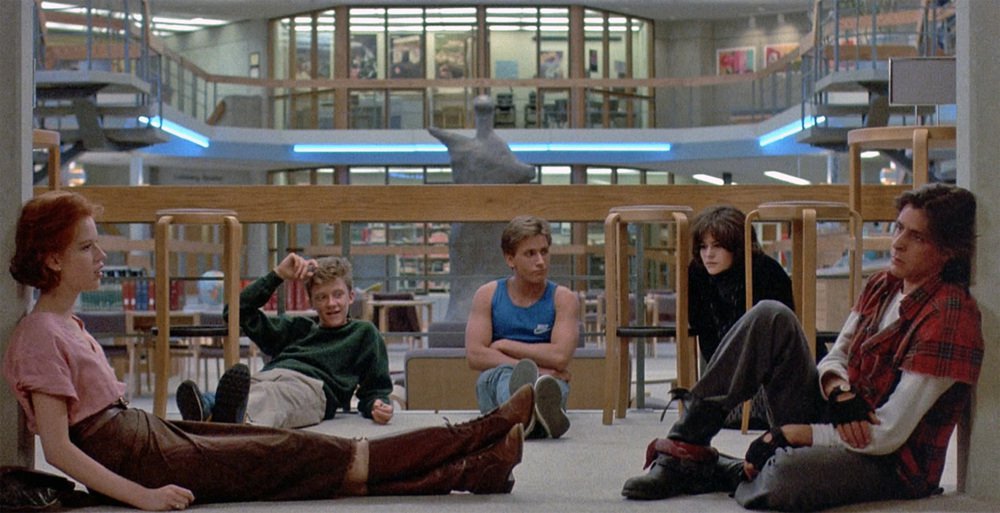
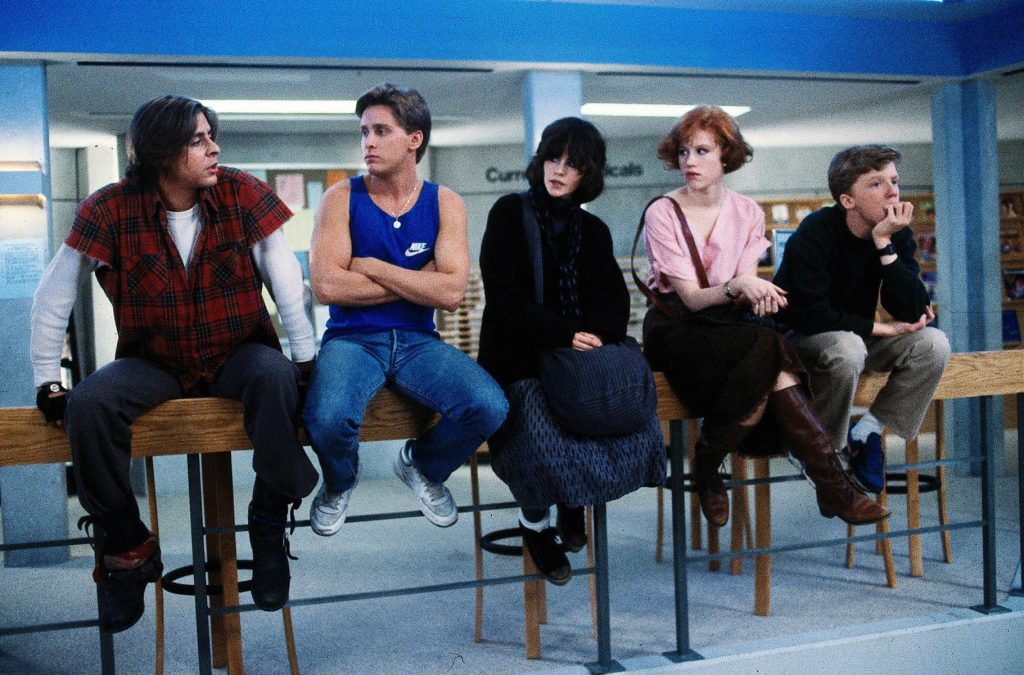
At fictional Shermer High School, Assistant Principal Richard Vernon, played by Paul Gleason, expects a long, dull day of discipline. Instead, in The Breakfast Club, Saturday detention becomes a pressure cooker exposing five students beneath their public identities.
The students must write an essay explaining who they think they are. The detention assignment sounds simple until you’re 16, stuck with people you’d normally avoid, and protecting your reputation.
Judd Nelson’s John Bender needles everyone, while Emilio Estevez’s Andrew Clark pushes back. Molly Ringwald’s Claire Standish tries to keep control, and Anthony Michael Hall’s Brian Johnson wants the rules to work. Ally Sheedy’s Allison Reynolds watches from the edges, tossing out stories that may or may not be true.
The school itself becomes part of the drama, and the rules of detention make each ordinary space feel charged. Hallways feel enormous when you’re alone. A library feels like a courtroom. Even a vending machine becomes a social event.
The fictional school was filmed at Maine North High School, giving its imagined halls a real-world presence.
The five archetypes get names and faces
The opening setup gives us five brutally tidy categories, with Richard Vernon enforcing those labels from above, hiding behind authority. Brian is the brain, Andrew is the athlete, Allison is the “basket case,” Claire is the princess, and Bender is the criminal.
Those names are not flattering, and that’s the point. John Hughes shows how high school cliques reduce teenagers to a look, a rumor, a lunch table, or one terrible decision.
Brian Johnson’s nervous, eager energy turns heartbreaking when his fear of failure breaks through. Academic pressure makes the brain label feel like a trap.
Andrew Clark is more than a varsity jacket. Beneath the muscle and confidence is a kid desperate for his father’s approval.
Allison Reynolds keeps a wary stillness that makes her stories hard to trust. Her distance looks like indifference, but it also protects her.
Claire Standish combines softness with steel. Her polished control can’t hide how much she fears losing status.
John Bender stays magnetic, funny, cruel, and impossible to ignore. His criminal label becomes a shield for anger and hurt.
Far from a complete map of teenage life, the group is still a smart dramatic device. In The Breakfast Club, each person is forced to see the others as people, not hallway shorthand.
John Hughes Lets the Actors Carry the Movie
A real Illinois school, enlarged for the camera
The building is as memorable as any cast member. Production centered on Maine North High School in Des Plaines, Illinois, a school that closed in 1981. The real library was too small for Hughes’s needs, so the larger library set went up inside the gym at Maine North High School.
That oversized room gives The Breakfast Club its odd, dreamlike scale. Five teenagers can look tiny in it one minute, then own the whole place the next. The IMDb filming details still list Maine North High School as the key location.
John Hughes understood suburban Chicago schools because he knew their rhythms: the authority figures, the parking lots, the social borders, and the long walk to nowhere after the final bell.
Performances that never feel like cardboard cutouts
The script gives everyone a big turn, but the cast keeps those moments from becoming pure speech-class theater. The restrained soundtrack leaves room for the actors, while a reserved Simple Minds track supplies its payoff without competing with them.
Judd Nelson can go from a deadpan joke to a raw confession in seconds. Molly Ringwald lets her character’s polish crack without losing her pride.
Emilio Estevez makes Andrew Clark’s anger look learned rather than innate. Anthony Michael Hall gives the movie its most vulnerable jolt. Ally Sheedy has the trickiest role, because her character often hides behind silence, sarcasm, and absurd stories. She makes that distance feel deliberate.
One longtime bit of fan trivia claims Molly Ringwald first read for a different role. It’s a fun thought, but reliable production records don’t settle it. The cast’s later Brat Pack label adds context, but the part she played became indelible anyway.
Class, Identity, and the Parts That Still Sting

Nobody gets the same set of rules
The Breakfast Club is a coming-of-age examination of unequal burdens. Every student has a social role, but those burdens aren’t interchangeable. High school cliques define the order that Saturday detention briefly interrupts. Claire’s status rests on money, appearance, and popularity. Brian feels crushed by academic expectations. Andrew performs toughness for a demanding father.
Bender describes violence and humiliation at home. Allison protects herself through withdrawal and misdirection. Their stories are heightened for a movie, but the feelings remain plain: fear of disappointing parents, fear of isolation, and fear that one bad day will define you forever.
The detention setting creates a temporary truce.
The truce matters because the film never promises it will survive the Monday cafeteria.
That uncertainty hangs over the story. Can a single honest day beat the social order waiting outside the library door? The film wants hope, but it doesn’t pretend high school hierarchies vanish with one group hug.
Allison’s makeover deserves a second look
Loving an 80s favorite doesn’t mean giving it a hall pass. John Hughes’s choice to frame Allison Reynolds’s makeover as a revelation remains the film’s most debated turn, and for good reason. Once Claire Standish changes Allison’s hair and makeup, the boys suddenly see her differently.
The scene suggests that Allison becomes more acceptable when she looks conventionally pretty. That is a tough message, even though the performance gives her stubborn individuality.
Claire and Bender’s ending feels complicated now because real chemistry can’t erase Bender’s earlier cruelty and harassment. The Simple Minds song Don’t You (Forget About Me) makes the ending persuasive, while the soundtrack romanticizes the kiss. Letting teenagers be contradictory strengthens the film; treating a makeover or kiss as a fix weakens it.
The Hit, the Fist, and Simple Minds
Critics noticed the emotional punch
The Breakfast Club was well received on release, and its soundtrack helped the emotional shifts land, though reactions weren’t identical. Some viewers saw a funny, open-hearted teen comedy, while others found its speeches broad or resolutions too tidy.
Still, audiences showed up, and a movie made for about $1 million became a major box office success. That box office result gave John Hughes permission to make a dialogue-heavy teen story without talking down to teenagers.
The Breakfast Club’s early reach eventually led to recognition in the National Film Registry, though its fuller legacy came later.
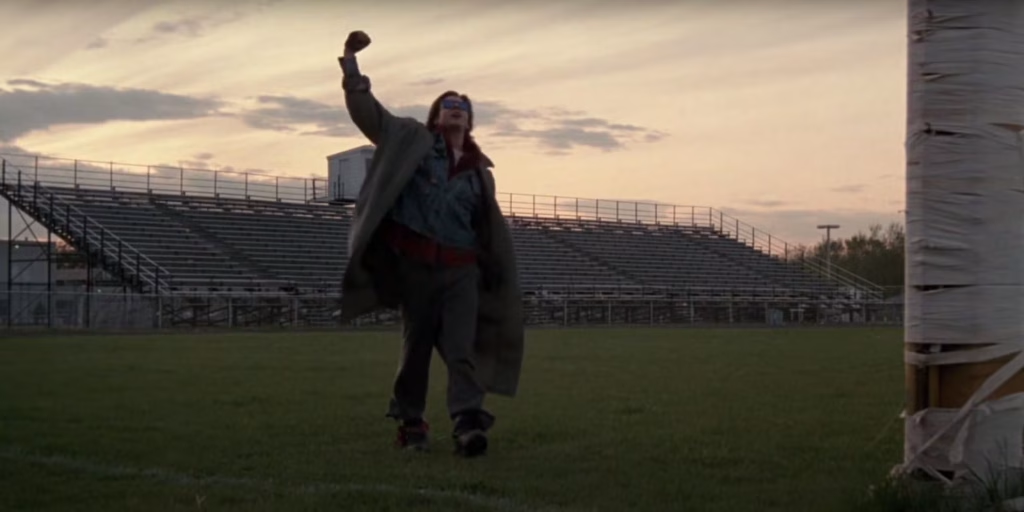
The final image of Bender striding across the football field, fist in the air, became pure 80s iconography. Simple Minds’ “Don’t You (Forget About Me)” carries that gesture beyond the frame. One kid, one gesture, one huge feeling, left behind by the soundtrack.
“Don’t You (Forget About Me)” gets the last word
Simple Minds’ recording isn’t background decoration; its arrangement gives the soundtrack an emotional aftershock. In “Don’t You (Forget About Me)”, the vocal asks for memory without offering easy reassurance.
The chorus of “Don’t You (Forget About Me)” turns the ending into a promise and a plea. Simple Minds make its question sound urgent, but never fully certain. The soundtrack keeps asking whether these kids will remember each other.
A lesser song might have made the ending feel sugary. Simple Minds leave a little ache in “Don’t You (Forget About Me)”, and the soundtrack lets its promise linger across generations. Perfect.
Why The Breakfast Club Still Belongs to Every Generation
Its legacy is bigger than the Brat Pack label
Teen film history stretches beyond 1985, but The Breakfast Club gave high school cliques unusual interior depth. John Hughes made adolescent interior life the whole show, building on the empathy of Sixteen Candles. The 1985 film gave coming-of-age stories room for uncomfortable truths. The popular girl could be unhappy, the rebel frightened, the brain in crisis, and the athlete tired of his role. Its soundtrack carried Simple Minds and “Don’t You (Forget About Me)” beyond the screen. That honesty outlasted the Brat Pack label.
In 2016, the Library of Congress selected the film for the National Film Registry, placing it among movies considered culturally, historically, or aesthetically significant. That National Film Registry honor fits, but the movie’s hold is easier to understand in simpler terms: people still recognize themselves in it. Its soundtrack helped Simple Minds give “Don’t You (Forget About Me)” a lasting emotional afterlife. The National Film Registry also confirms why that soundtrack still matters to new viewers.
The five principal cast members reunited at Chicago’s C2E2 in April 2025 for the film’s 40th anniversary. Molly Ringwald, Judd Nelson, Anthony Michael Hall, Emilio Estevez, and Ally Sheedy brought the whole strange little Saturday back into view. The reunion also recalled Paul Gleason, whose stern adult presence remains part of the film’s cultural memory. The Breakfast Club reunion renewed interest in the soundtrack. Simple Minds’ version of “Don’t You (Forget About Me)” also made the gathering feel connected to 1985.
Claire also helped make Molly Ringwald a permanent fixture of the decade. Her 1980s teen movie legacy goes far beyond one pearl earring and one detention slip. The song remains a soundtrack to adolescent uncertainty, even for listeners who never saw the film. Simple Minds still benefits from that connection, while “Don’t You (Forget About Me)” continues to sound like a farewell to adolescence.
Frequently Asked Questions
What is The Breakfast Club about?
The Breakfast Club follows five high school students from different social groups during Saturday detention at Shermer High School. As the day unfolds, they challenge the labels that separate them and reveal the pressures beneath their public identities.
Who directed The Breakfast Club?
John Hughes wrote and directed the film, which was released by Universal Pictures in February 1985. His dialogue-driven approach made the students’ conversations and performances the main event.
What song plays at the end of The Breakfast Club?
Simple Minds performs “Don’t You (Forget About Me),” the film’s famous closing song. Its urgent, slightly aching sound gives Bender’s final gesture emotional weight and helped carry the movie beyond 1985.
Why is The Breakfast Club still important?
The film remains important because it treats teenagers as complicated people rather than simple stereotypes. Its discussion of social status, family pressure, isolation, and the need to be understood continues to connect with new audiences, even as some of its romantic and makeover choices invite criticism.
The Bell Still Hasn’t Rung
The Breakfast Club lasts because it understands a fact most people learn the hard way: nobody is only the version of themselves you see in public. Its place in the National Film Registry confirms that its cultural reach extends beyond nostalgia.
Its fashion, music, and one-liners are pure 1985. Simple Minds carries that memory forward through “Don’t You (Forget About Me).” Its need to be understood is timeless.