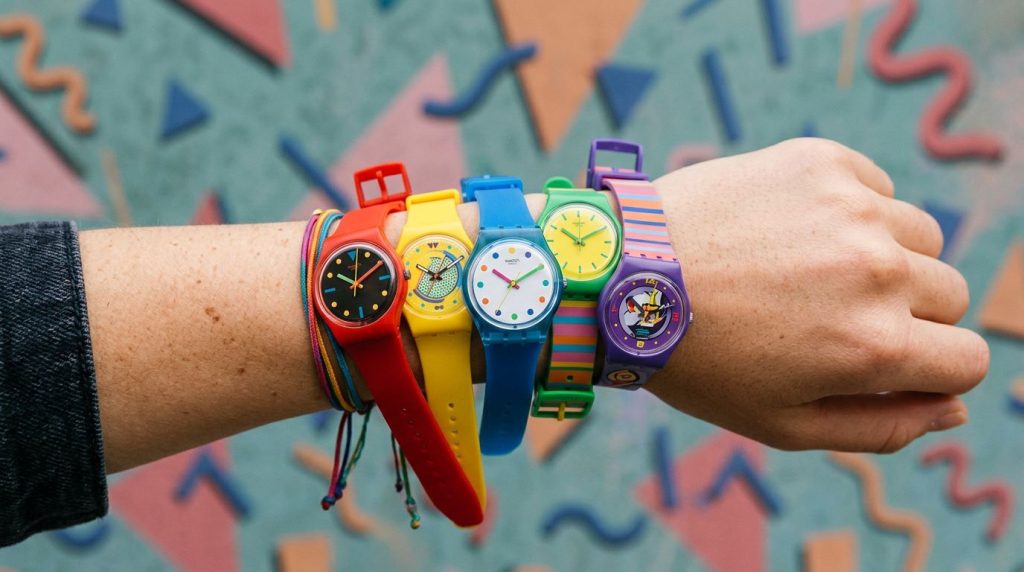
Before phones took over our pockets and our attention, your wrist could do a lot of talking.
If you grew up anywhere near the 1980s or 1990s, you probably remember the pull of Swatch watches. They weren’t only for telling time. They were bright, plastic little declarations, part fashion flex, part collectible treasure, part “look what I got at the mall” glory.
And once they showed up, the whole idea of a watch got a lot more fun. When you wore a Swatch watch, you wore more than one at a time on the same wrist!
When Swatch Turned Timekeeping Into Pop Style
A lot of watches used to look serious. Metal bands. Grown-up faces. Tiny gold details that said “office” or “anniversary gift.” Then Swatch arrived and blew the room open with color.
The first collection launched in Zurich in 1983, and it didn’t tiptoe in. According to the early history of Swatch, the brand came out with 12 models right away, priced to be accessible, with a look that felt fresh, punchy, and young. Not a luxury watch in the old-school sense, but not disposable junk either. That was the trick.
Swatch also landed at a moment when Swiss watchmaking needed new energy. The broader Swatch Group history makes that clear: low-cost quartz competition had put the industry under pressure. Swatch answered with a Swiss-made watch that didn’t act stiff or precious. It was affordable, graphic, playful, and alive.
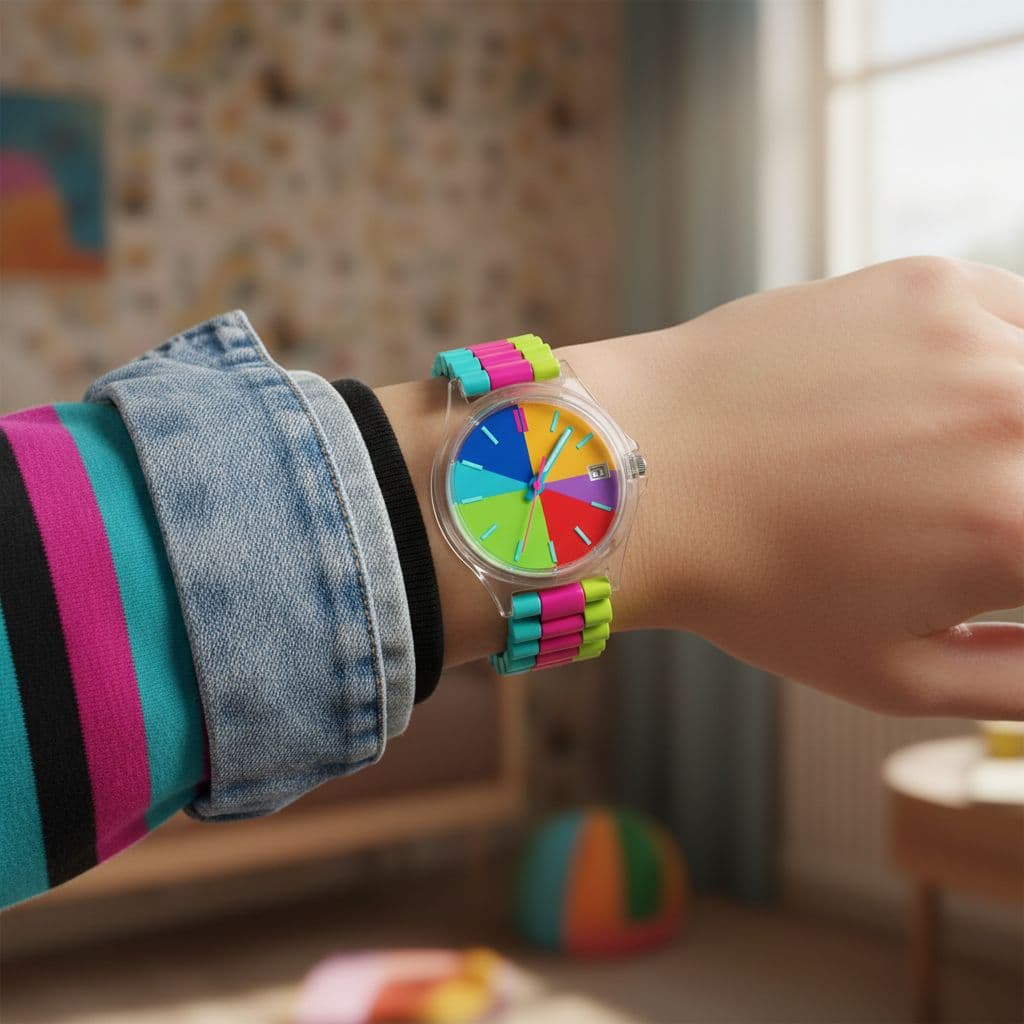
That mix mattered because kids and teens don’t want “sensible.” They want something that feels like theirs. A Swatch looked like it belonged in the same universe as neon socks, jelly bracelets, boomboxes, Trapper Keepers, and MTV after school. It fit the mood. Better than that, it added to it.
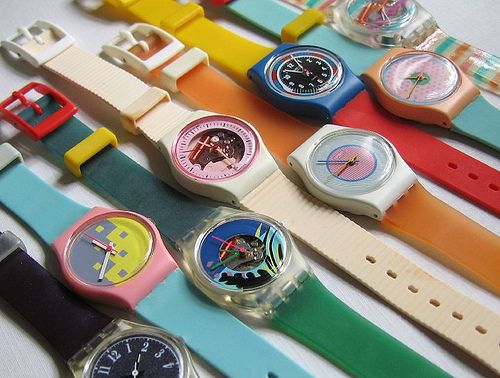
And the colors, wow. Solid brights. Wild prints. Clear plastic. Faces that looked like tiny art projects. Some watches were sporty. Some were weird. Some felt sleek enough for a teen who wanted to look older. Others looked like pure sugar.
A Swatch didn’t whisper “I have a watch.” It shouted “I have taste.”
That’s why the brand hit so hard. It took an ordinary object and made it feel collectible, expressive, almost costume-level fun, but still something you wore every day.
The Playground Economy of Cool
Here’s the part anyone who lived through it remembers in their bones: Swatch watches were social.
Not “social media” social, of course. Better than that. Hallway social. Sleepover social. Lunchtime social. The kind of social where somebody notices your wrist before the bell rings and suddenly you’re in a five-minute conversation about where you got it, what color band you picked, and whether you were going to get another one.
Because one Swatch rarely felt like enough.
That was part of the magic. These watches invited collecting in a way other accessories didn’t. A baseball cap was a baseball cap. A pair of sneakers stayed the same until you wore them out. But Swatch gave you options. Different moods. Different outfits. Different versions of yourself. Monday’s watch didn’t have to be Friday’s watch.
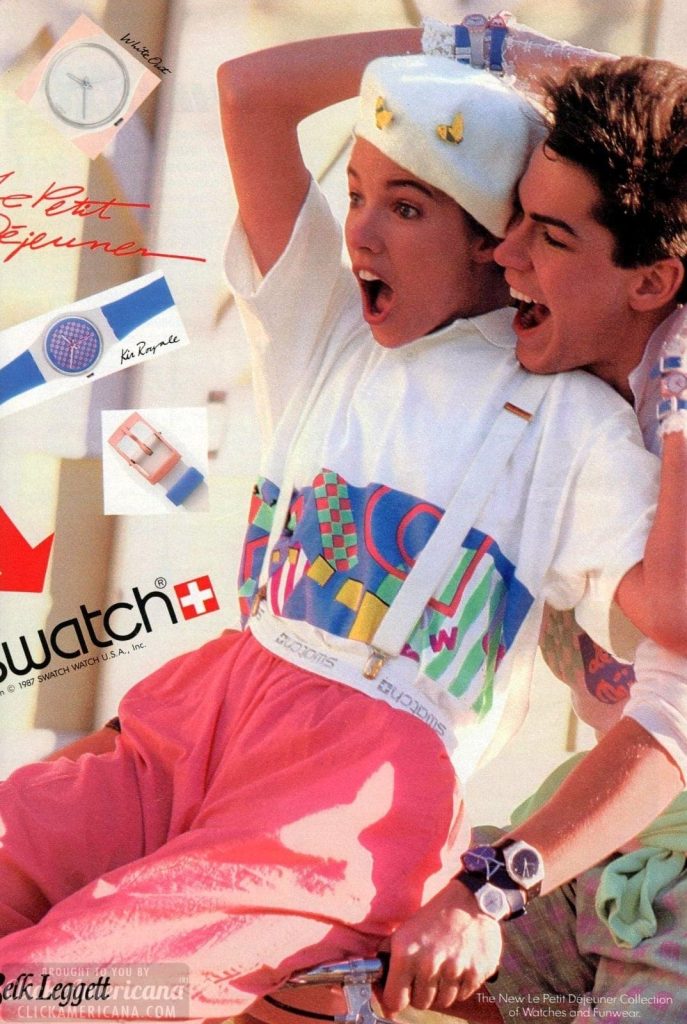
In the late 1980s and through the 1990s, kids learned fast that style wasn’t only about clothes. It was about details. The right scrunchie. The right slap bracelet. The right pair of shades. And on the wrist, a Swatch could do a lot of heavy lifting. It signaled that you were tuned in, maybe a little artsy, maybe a little preppy, maybe a little cooler than you let on.
Some people stacked them. Some wore them loose. Some picked one wild enough to become the whole outfit’s personality. If you had a Swatch and a fresh pair of Keds, or a denim jacket covered in pins, you were making a statement, even if you couldn’t have explained it yet.
The status-symbol part was real too, though it worked differently than a high-end brand. A Swatch wasn’t about old-money polish. It was about access to fun. It said your family had noticed the trend, your birthday gifts were on point, or you had enough saved from allowance money to claim a piece of the moment. For kids, that was huge.
And because they were visible all day, they became part of your identity in motion. You’d reach for a notebook, wave to a friend, grab your backpack, and there it was, flashing color like a tiny billboard for your taste.
More Than a Watch, It Was a Collectible
Swatch didn’t stop at “cute watch.” It built a whole culture around the idea that you might want more than one, then maybe five, then maybe a display case.
That collector streak is one reason the brand stayed hot. Swatches came in rotating designs, special editions, artist collaborations, and models that felt less like accessories and more like pop artifacts. As this piece on Swatch’s collector boom points out, rare editions drew lines, resale interest, and serious fandom, with artists like Keith Haring and Vivienne Westwood entering the picture. That’s not ordinary watch behavior. That’s sneaker-drop energy before sneaker-drop culture swallowed everything.
Kids didn’t always know the full backstory, of course. What they knew was simpler: some Swatches were harder to find, some looked cooler than others, and some made your friends say “No way” the second they saw them. That was enough.
This was also the era of the glass display case, the mall counter, the department store stop that suddenly felt like a candy aisle for fashion people. Looking at Swatches could take forever. You’d scan the faces, compare bands, hold one up to your wrist, then switch to another because maybe the blue one felt more you. Or the clear one. Or the one with the splashy graphic that looked like it belonged in a music video.
There was a giftable charm to them too. Swatch was birthday-present gold. Holiday gold. Graduation gold for the younger set. Parents liked that it was useful. Kids liked that it didn’t feel practical in a boring way. That’s a sweet spot brands spend years chasing.
And once you owned one, you noticed everyone else’s. That’s when the whole thing turned into a tiny, wearable language.
Why They Still Glow in Memory
Lots of trends fade because they were only trends. Swatch lasted in memory because it attached itself to feelings.
It was the feeling of being young and wanting your stuff to look more like you. It was the feeling of opening a box and seeing a burst of color inside. It was the feeling of walking into school with one new thing and knowing people would clock it before first period. That doesn’t disappear easily.
The 1990s kept that energy going because personal style got more mixed and playful. Swatch fit right in with grunge leftovers, rave colors, sporty looks, minimalist phases, and mall-brand everything. A watch that could be ironic, cute, artsy, clean, or loud had room to keep moving.
By the early 2000s, when gadgets started crowding the scene and many watches got chunkier or more tech-coded, Swatch still had a lane. It offered color without looking toy-like, and fashion without asking you to grow up too fast. For older kids and teens, that mattered. You could wear one and feel polished, but never boring.
There’s also something kind of lovely about how analog it all was. No notifications. No charging cable. No menu. You looked down, saw the time, and also saw a little piece of design staring back at you. In an age when so much style now lives on screens, that old pleasure feels even sweeter.
Maybe that’s why the brand still gets warm reactions. A Swatch isn’t only a watch from the past. It’s a memory trigger. One glance and you’re back at the mall, back at the classroom desk, back at the sleepover floor, back in that era when accessories felt like treasures and color felt like a personality trait.
Swatch watches worked because they made an ordinary object feel personal, playful, and a little bit coveted. They were useful, sure, but that was never the whole story.
What kids wanted wasn’t only the time on their wrist. They wanted the color, the attitude, the collectibility, and that tiny flash of cool every time they lifted a hand.
That’s why people still remember them with such affection. Not as gear, not as tech, but as wrist candy with a pulse.