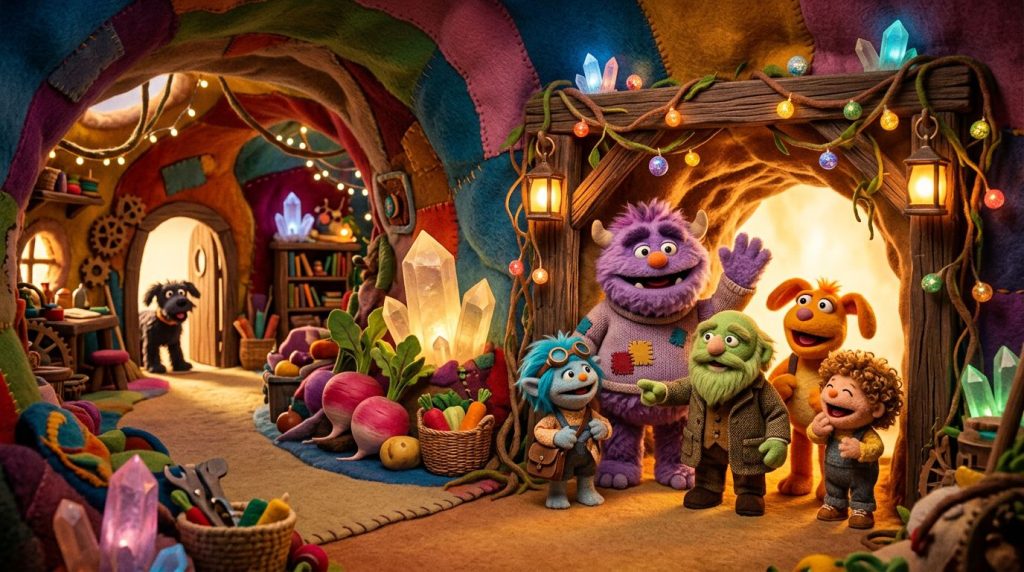
You didn’t merely watch Fraggle Rock. You dropped in. One minute you were on the living-room carpet, probably with a bowl of cereal nearby, and the next you were headed down a hole in Doc’s workshop.
That was the magic trick. This Jim Henson 1980s television series wasn’t a far-off fantasy kingdom with castles and chosen heroes. Fraggle Rock felt close enough to visit after school, every day, if only you could find the right crack in the wall.
It had songs, fuzzy creatures, radish drama, and one enormous dog named Sprocket. Somehow, it also had a whole lot to say.
Key Takeaways
- Fraggle Rock created a living, interconnected underground world where every group’s actions impacted the others, teaching kids about different perspectives without heavy-handed lectures.
- The main characters—Gobo, Red, Wembley, Mokey, and Boober—possessed complex personalities with relatable fears and strengths, avoiding one-dimensional tropes.
- The show’s catchy, emotionally resonant musical numbers served as a core narrative tool, expressing feelings when ordinary dialogue wasn’t enough.
- Unlike action-heavy 1980s cartoons, Fraggle Rock prioritized kindness, active listening, and emotional depth, allowing characters to resolve conflicts through empathy.
- The accessible setting—hidden just behind a workshop wall—made imagination feel physical and left viewers eager to find their own entryway into the cave.
Fraggle Rock Was a World, Not Just a Show
Jim Henson’s series arrived on HBO on January 10, 1983, then ran for five seasons and 96 episodes. The original Fraggle Rock series history is full of impressive facts, but the feeling matters most: it made its setting feel lived in.
There were tunnels. There were caves. There were secret passages, tiny construction sites, gardens, strange rituals, and rooms that looked like nobody had cleaned them in centuries. Perfect.
The show gave kids a place with its own geography. You understood it fast. Fraggle Rock was underground. Outer Space was where the Silly Creatures lived. The Gorgs had a garden. The Doozers built everywhere. The Fraggles were always one snack break away from a crisis.
And everything connected.
A Gorg could stomp around in the garden and cause trouble for a Fraggle. A Fraggle could eat a Doozer construction and cause trouble for the Doozers. Doc could bring home some new human-world object, and suddenly the whole cave had a new mystery on its hands.
Fraggle Rock never treated its small characters as small. Every group’s problem mattered because it changed somebody else’s day.
That was a pretty heady idea for a musical show that also featured brightly colored puppets bopping around to catchy songs. Yet it never felt like homework. Nobody sat you down for a lesson. You simply watched the world bounce, collide, sing, and occasionally panic over a giant radish.
Why Fraggle Rock Felt So Easy to Return To
Most kids’ shows offered an episode. Fraggle Rock offered a neighborhood.
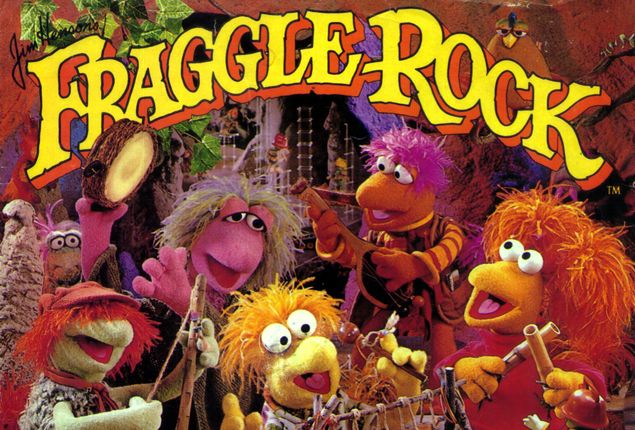
You knew who you’d see when you came back. Gobo, the bright yellow explorer with Uncle Traveling Matt’s postcards from Outer Space. Red, the fearless red-haired dynamo who never waited for permission. Wembley, the sweet, nervous fellow who could see both sides of every argument and then worry about both sides some more.
Mokey had a poet’s heart and a calm voice. Boober saw danger in a sunny day, which made him the patron saint of every kid who checked under the bed twice. Whether they were searching for a lost Celebration Stone or just hanging out in the tunnels, the five friends felt like a real group of pals, each with a clear personality but no fixed role.
Nobody was reduced to one joke.
Wembley could be scared and still show up. Boober could complain and still care. Red could be bossy without becoming the bad guy. Kids noticed that stuff, even if we didn’t have the words for it yet.
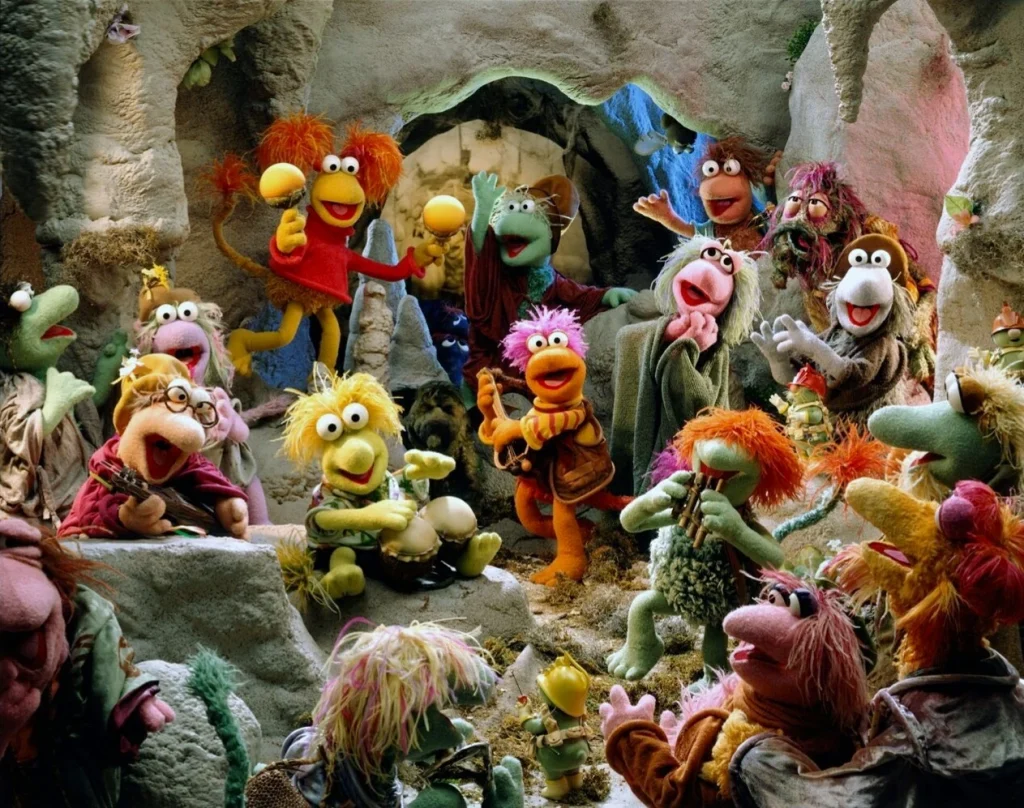
The cave itself had the cozy logic of a favorite blanket. It was colorful but not spotless. A little odd, a little damp-looking, packed with nooks that hinted at stories happening offscreen. You could believe the puppets kept dancing long after the credits rolled.
That sense of continuation is why reruns worked so well. You weren’t starting over. You were checking in.
The Puppet World Had Four Sides to Every Story
The big genius of Fraggle Rock was that no group got the whole picture.
For the Fraggles, the Gorgs were terrifying giants. For the Gorgs, Fraggles were thieving pests raiding their radish patch. The Doozers built beautiful structures, while the Fraggles treated those same structures as lunch. Humans were the mysterious Silly Creatures, busy with baffling things like laundry, mail, and workbenches. When Fraggles needed real wisdom, they even consulted the Trash Heap, proving that every layer of this cave ecosystem had its own voice.
Here was the setup in a nutshell:
| Group | What They Wanted | What Everyone Else Saw |
|---|---|---|
| Fraggles | Fun, food, friendship, adventure | Carefree cave dwellers |
| Doozers | To build and build some more | Tiny workers making snacks |
| Gorgs | To protect their garden and kingdom | Huge, scary radish owners |
| Humans | To live ordinary lives in Outer Space | Strange giants with odd habits |
A lesser show would have made the Gorgs flat-out villains. Instead, Pa Gorg, Ma Gorg, and Junior had their own ridiculous little royal family problems. Junior wanted his father’s approval. Pa Gorg wanted order. Ma Gorg wanted a bit of dignity in a household where both seemed impossible.
The Doozers got an even trickier deal. Their entire culture revolved around building. Fraggles eating their constructions sounded rude on paper, but it was part of the cycle. Once a Doozer structure was eaten, the Doozers could build again.
Kids got a gentle introduction to different needs, different viewpoints, and unintended consequences. No lecture. No giant neon sign saying “MORAL.” Just a small orange Doozer wearing a hard hat and getting on with it.
The show’s original production also matched its big-hearted point of view. It was a collaboration between the United States, Canada, and the United Kingdom, part of what the Jim Henson Company calls an early international television co-production. Different versions even adjusted the human segments for local audiences, guided by the creative vision of Jim Henson and his team.
A world built on connection was made through connection. That feels exactly right.
The Songs Were Tiny Emotional Fireworks
Ask an 80s kid to hum the theme, and there is a decent chance they will immediately launch into “Dance your cares away…” before remembering where they are.
The music gave Fraggle Rock its pulse. Each musical number could be silly, tender, worried, proud, or wildly upbeat. Sometimes a character needed to figure something out. Sometimes they needed to make a mess of it with harmony and hand-claps first.
That was the Henson touch. The songs weren’t a pause in the story. They were the story, only with a stronger beat.
The opening theme promised play, worries left behind, and a place where the fun never ended. Of course, the show did not actually avoid worries. It put them right in the cave with everyone else. Jealousy, fear, loneliness, homesickness, feeling left out, trying to be brave, trying to be useful. The Fraggles sang because regular talking wasn’t always enough.
Even Uncle Traveling Matt’s postcards had their own comedy rhythm. He studied human behavior with total confidence and got almost every detail wrong. A bicycle, a washing machine, a simple phone call, all became baffling evidence of Silly Creatures customs.
For children, it was hilarious. For adults watching Fraggle Rock now, it is also a pretty sharp reminder that everybody thinks their own routine makes perfect sense.
It Was Softer Than Most 80s Adventure Shows
The 1980s had plenty of action-packed cartoons. Lasers flashed. Vehicles transformed. Somebody was always fighting to save something important before the commercial break.
Fraggle Rock had danger too, but its default setting was kindness.
Problems could be solved by listening. Someone might apologize. A character could change their mind. A disagreement did not have to end with a loser getting blasted into space. That was unusual then, and it still feels fresh now.
The show also trusted kids with complicated emotions. Boober’s anxiety wasn’t mocked. Mokey’s sensitivity wasn’t treated as weakness. Wembley wasn’t told to stop being uncertain. Each personality had a place in the group, proving that these incredible puppets could convey real heart on television and even a live stage.
That is why the show has held up better than many childhood favorites. The set design is charmingly handmade. The puppetry is gloriously physical. The lessons still land because they come from character, not a scriptwriter waving a finger.
If you love the decade’s other warm-and-weird touchstones, the 1980s TV nostalgia collection has plenty of rabbit holes waiting. Just don’t be surprised if one memory leads to twelve more.
The Place We Wanted to Find
There was always one question hanging over Fraggle Rock: could you get there?
Doc had his workshop. Sprocket knew something was up. Uncle Traveling Matt came and went through the hole in the wall. The entrance was right there, practically taunting us.
As kids, we looked for versions of it everywhere. Behind the couch. In the backyard shed. At the bottom of a closet. Somewhere between the washing machine and the wall, surely.
That urge says a lot about the show. Fraggle Rock made imagination feel physical. It wasn’t a distant planet or a polished cartoon universe. It was a hidden place beneath ordinary life, loud with music and packed with neighbors. Modern revivals like Back to the Rock and Fraggle Rock: Rock On! on Apple TV+ prove that this underground world still feels just as tangible today.
Frequently Asked Questions
When did Fraggle Rock originally air?
Fraggle Rock premiered on HBO on January 10, 1983, and ran for five seasons with a total of 96 episodes. Created by Jim Henson, it was an international co-production between the United States, Canada, and the United Kingdom.
Why did the different groups in Fraggle Rock conflict with each other?
The conflict arose because no single group had the complete picture of their world. Fraggles saw Doozer structures as snacks, Doozers loved to rebuild, Gorgs viewed Fraggles as radish thieves, and humans were considered mysterious ‘Silly Creatures.’
Are there modern ways to watch Fraggle Rock today?
Yes, the underground world has returned in modern revivals like Fraggle Rock: Rock On! and Back to the Rock, both available on Apple TV+, proving that the franchise still resonates with audiences.
Fraggle Rock worked because it gave childhood a whole second address. You could return to it whenever the theme song started, and the cave would still be there.
Its puppets were funny, its songs were irresistible, and its world had room for every kind of kid. Whether you are revisiting the original episodes or watching Back to the Rock, Fraggle Rock told us that even the smallest corner of the world is connected to somebody else’s.