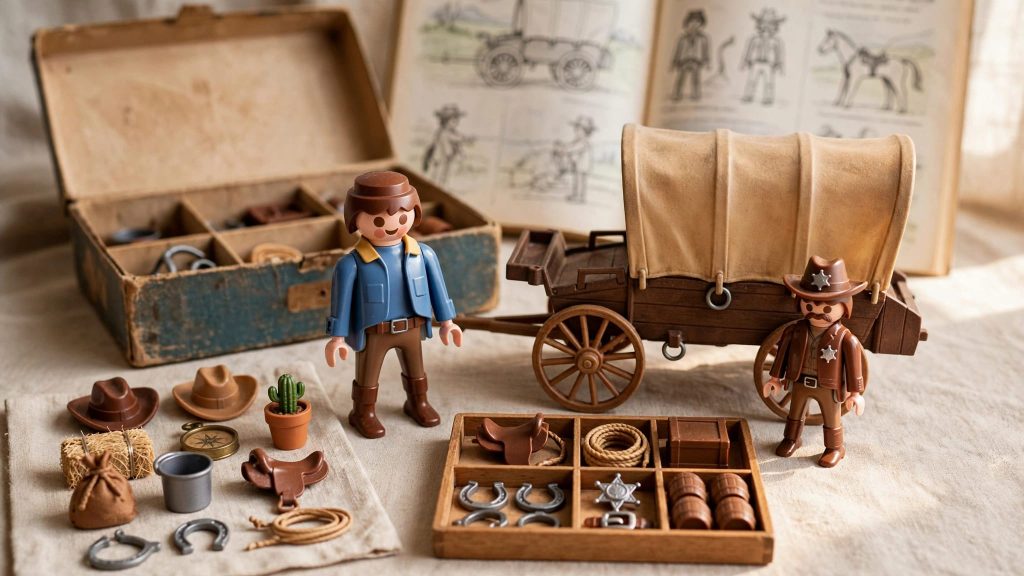
You can identify 1980s Playmobil sets by matching their set numbers, packaging, figures, and accessories to dated catalog entries. The strongest evidence is several matching clues, because that familiar smiling face has survived decades of toy-box adventures.
Maybe you remember the covered wagon. Maybe it’s the tiny sheriff who somehow kept his hat while every other accessory disappeared.
Start with the paperwork, then use those little plastic details to identify loose or mixed vintage Playmobil toys.
Key Takeaways
- Match the set number, country or distributor information, and contents before assigning a release year.
- A molded copyright date can relate to the design rather than the year your particular piece was made.
- Original packaging, correct accessories, and condition matter more than a seller’s enthusiastic “RARE!” headline.
Playmobil’s Beginnings: Small Figures, Big Imaginations
Hans Beck and the First Three Themes
German inventor Hans Beck introduced the toy line in 1974 with a simple figure design. During the global oil crisis, Brandstatter wanted children’s toys that used less plastic. Beck’s approach, described at the 1974 launch, kept Playmobil toys small and left room for imaginative play.
The first three groups, introduced in 1974, were Native Americans, knights, and construction workers. International distribution began in 1975, and roughly 2.2 billion figures had been sold by 2009.
For plenty of future collectors, holiday catalogs such as the Sears and J.C. Penney Wishbooks supplied that first glorious introduction to the 1970s design. Entire little worlds, sitting there between the bicycles and the Christmas dreams.
Why the Faces Look So Familiar
The Museum of Childhood’s Playmobil collection follows Mick Kehoe’s figures from the 1970s through 2018. Their family resemblance is striking.
The museum describes the classic smiling figure as 7.5 cm (3 inches), at 1:24 scale. The brand’s FAQ lists Playmobil figures at 7.2 cm and approximately 1:25 scale. Those descriptions aren’t precise dating tools.
The museum also cites The Guardian’s 2009 account of Brandstatter resisting mechanised features and digital additions that conflicted with Beck’s simplicity. Jason Wilson’s The Playmobil Conundrum connects that approach with independent, imaginative storytelling.
A tiny person. A whole afternoon’s adventure. You supplied the special effects.
Recognizable 1980s Playmobil Sets: Western Favorites
The Wild West makes a useful starting point because Playmobil’s archive supplies concrete references. These are catalog dates, not guarantees about when an individual loose piece was manufactured.
Cowboys and Frontier Buildings
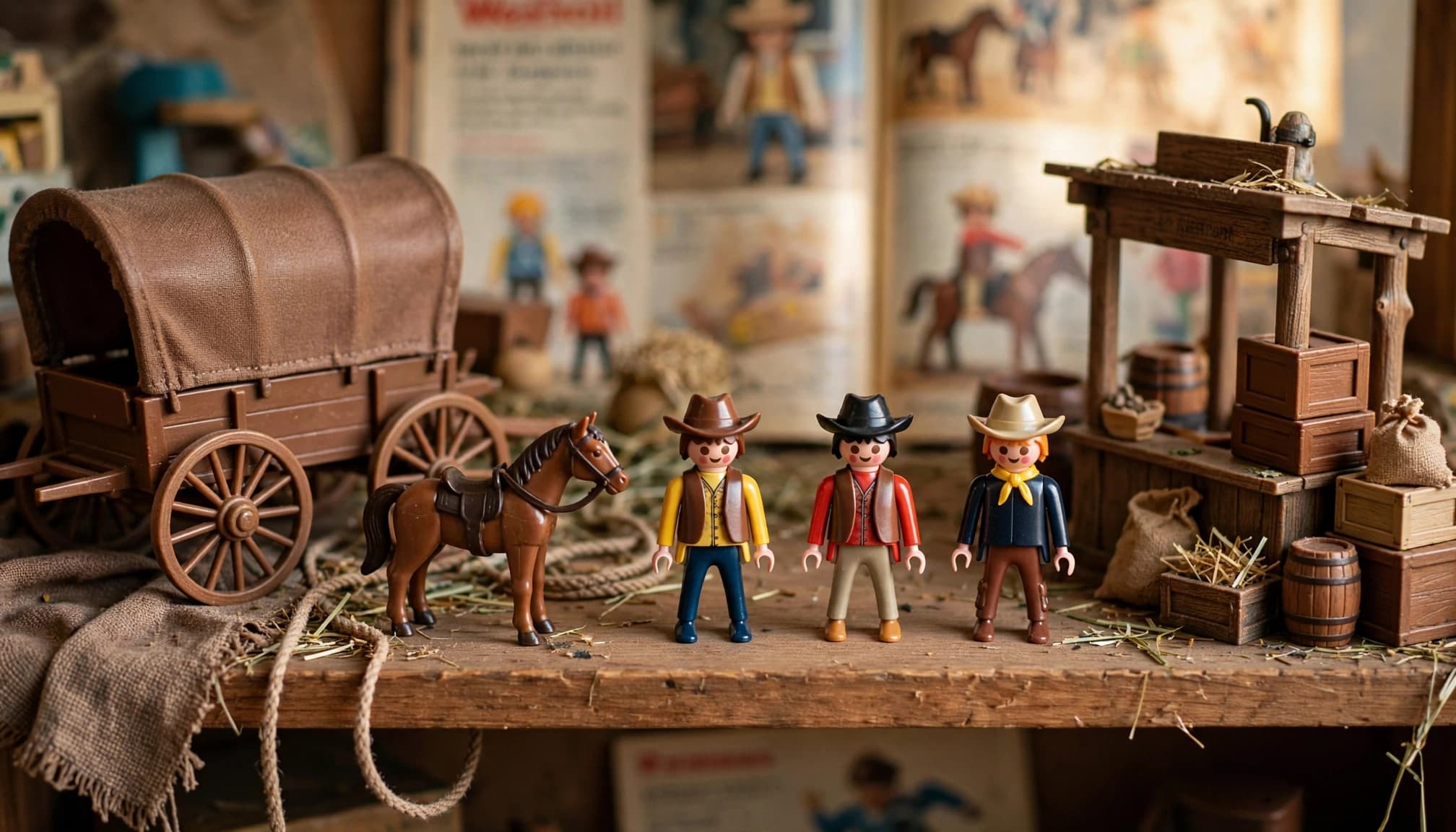
Covered wagons, cowboy hats, horses, and Native American figures are familiar Western collecting territory. A cowboy set needs a documented match for its figures and accessories; a wagon or figure alone doesn’t identify it.
These archive entries give you firmer starting points:
| Archive reference | Year | Set name | Identification starting point |
|---|---|---|---|
| 3636-A | 1982 | Cowboys | Compare the complete figure-and-accessory grouping. |
| 3767-A | 1987 | Western-Schoolhouse | Match the building and school-related contents. |
| 3768-A | 1987 | Western-Ranch | Compare the structure, figures, and ranch equipment. |
| 3769-A | 1987 | Western-Farm | Match the farm building and accompanying pieces. |
| 3770-A | 1987 | Western-Station | Compare the station structure and railway accessories. |
The takeaway? Several similar-looking buildings belong to separate sets. A schoolhouse and a station can lose their identities surprisingly quickly in one giant storage tub.
Western Trains and Coaches
The archive lists 3245-B Westernkutsche, a Western coach, in 1988. Its railway entries that year include 4034-A Westernzug and 4054-A Westernlok/Tender.
Separate cars appear as 4120-A, 4121-A, and 4122-A, covering passenger, livestock, and baggage roles.
A locomotive paired with assorted cars isn’t automatically an original boxed train set. Each component needs its own match. Childhood railway management was wonderfully relaxed about inventory control.
The 1982 McDonald’s Toys Were a Separate Promotion
Yes, Playmobil made its way into Happy Meals. The fries had serious competition.
The 1982 McDonald’s promotion featured five Happy Meal toys: a farmer, an umbrella-carrying woman, a Native American figure, a sheriff, and the sheriff’s horse.
These promotional toys deserve their own identification trail. Don’t assign a retail Playmobil set number just because a figure resembles someone pictured in a Western catalog.
Paper packaging matters here, too. Surviving Happy Meal toys packaging can establish an association that a loose figure can’t. Equally, an old package beside a toy doesn’t prove they originally came together.
The promotion was stopped following concerns about choking risks for children under three. These are vintage collectibles with small parts, not automatic hand-me-downs for toddlers.
Nostalgia is lovely. Age-appropriate play still comes first.
Identify the Set Through Numbers, Packaging, and Catalogs
The most useful detective work brings the box, paperwork, and plastic together. One clue starts the search; agreement between them gives you a stronger identification.
Start With the Full Reference and Market
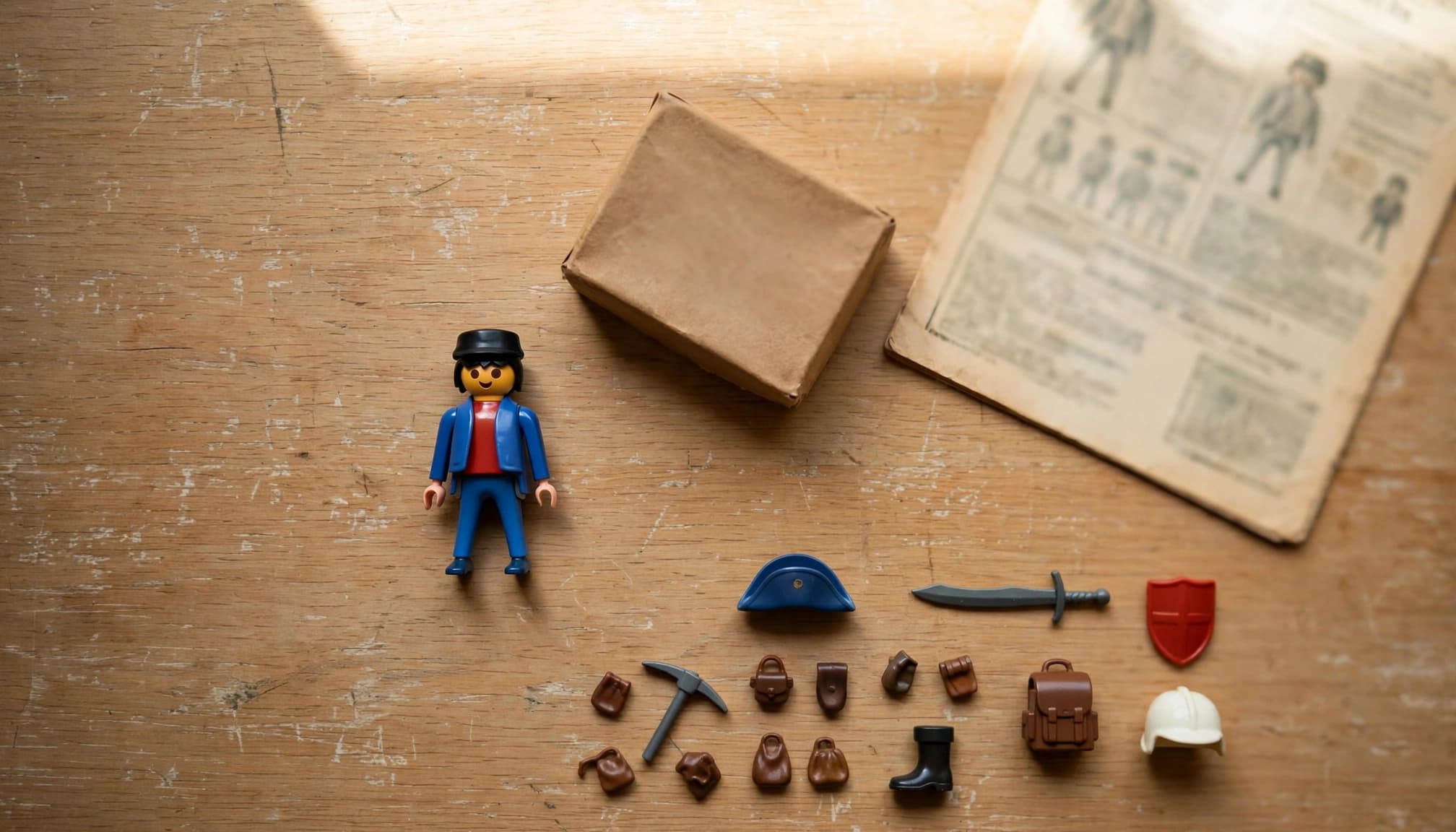
Record the complete set reference wherever it survives: box, instruction sheet, or catalog entry. Keep suffixes in your notes rather than dropping them immediately. The archive’s 3636-A Cowboys entry, for example, also appears in collector references as 3636.
Then compare the language, distributor name, country information, and printed contents. Packaging and included pieces can differ by market and production year.
A different box doesn’t automatically mean a fake. An apparently matching box doesn’t prove that every piece inside belongs there, either.
Catalog dates establish that a version was offered then. They don’t give every surviving example an exact birthday.
Match the Contents, Not Just the Picture
Compare the building sections, vehicle parts, figures, animals, and smaller accessories as a group.
For a wagon, the wheel style, chassis, cover, harness, and horses offer more information together than “it has a white roof.” For figures, compare torso decoration, clothing colors, hair, hats, and hand construction.
Instruction sheets and illustrated inventories help separate included equipment from accessories added later.
An authentic 1980s box can contain a mixed assortment of old and newer parts. Packaging dates the package more confidently than it dates everything inside.
That distinction matters when a seller calls a storage-bin reunion a “complete original set.”
Read the Markings Without Giving Them Superpowers
Molded brand names, copyright lines, part numbers, and country marks are useful identification clues. They aren’t interchangeable.
A copyright year may refer to the underlying design. A molded number may identify an individual component rather than the retail set. Neither, by itself, proves an early production run.
Photographs of the underside, back, and connection points can reveal these details without pulling an old toy apart.
Figure construction helps narrow comparisons, but replacement heads, hair, arms, and accessories complicate the picture. A body and hat can both be genuine Playmobil without having left the factory together.
Color needs similar caution. Yellowing, fading, storage conditions, and camera lighting can change how plastic looks. An unusual shade isn’t automatically a scarce factory variant.
The tiny stamp is a clue. Give it company before giving it a decade.
Original Vintage Sets Versus Later Reissues
Familiar Shapes Can Return
Playmobil’s long-running design language is part of its charm. It also makes dating by appearance alone unreliable.
A later release can resemble an earlier set or reuse familiar components. Distinguish the original production period from a later reissue through its own packaging, reference, documented contents, and decorations.
An early design date on reused tooling doesn’t turn a modern example into an 80s original.
Mixed Sets and Replacement Pieces
A convincing display may combine vintage figures, later accessories, and replacement parts. That’s perfectly enjoyable when described honestly.
Ask whether any pieces are reproduced, repainted, restored, or substituted. Save the seller’s written answer with the listing.
Mismatched finishes, glue, altered stickers, or inconsistent plastic colors warrant closer comparison, but none proves reproduction on its own.
“Original Playmobil” describes the brand. It doesn’t necessarily describe an untouched, all-original set.
What Makes Vintage Playmobil Worth Money?
There isn’t one useful price for “an old Playmobil set.” A loose sheriff, a nearly complete building, and a sealed boxed example belong in different comparisons.
Collectors weigh demand, scarcity, condition, correct accessories, and packaging. Small missing pieces can make a cheap purchase expensive to finish.
Cracked clips, broken tabs, yellowed walls, worn printing, and damaged boxes also affect appeal. A different country mark alone doesn’t establish rarity.
Our guide to buying vintage toys without overpaying follows the same principle: a first-time collector should compare closely matched completed sales rather than ambitious asking prices.
For 1980s Playmobil sets, match the reference, market version, completeness, and condition. Compare sealed examples separately from opened ones.
Then include shipping, tax, fees, and replacement parts in the total. That bargain castle can develop a surprisingly royal budget.
“Boxed” means packaging survives. MIB means mint in box; MISB means mint in sealed box. Those claims still need photographs and a clear description of what’s included.
For a nostalgia shelf, clean and mostly complete can be plenty wonderful.
Frequently Asked Questions
Can You Date a Loose Figure to the 1980s?
Sometimes you can narrow its period through documented combinations of body, decoration, hair, hands, and accessories. A familiar face or molded date alone won’t establish a manufacturing year.
Without packaging or a distinctive documented configuration, a broader date range is more honest than a confident guess.
Is Playmobil Still Being Made?
Yes, Playmobil remains an active toy line, with products marketed and sold in the United States in 2026.
Its familiar figure design lets older and newer characters share adventures. Historical settings have included Egyptian pyramids, Roman soldiers, and medieval villages, though those themes don’t automatically identify an 80s release.
Bring the Right Little World Back Home
Identifying vintage Playmobil works best when the evidence agrees: set reference, period packaging, documented contents, and the pieces themselves.
You don’t need a sealed museum piece to recover the feeling. A correctly identified, well-loved set can bring back that whole carpet-level universe.
The sheriff may have lost his hat. At least you’ll know which adventure he belongs to.