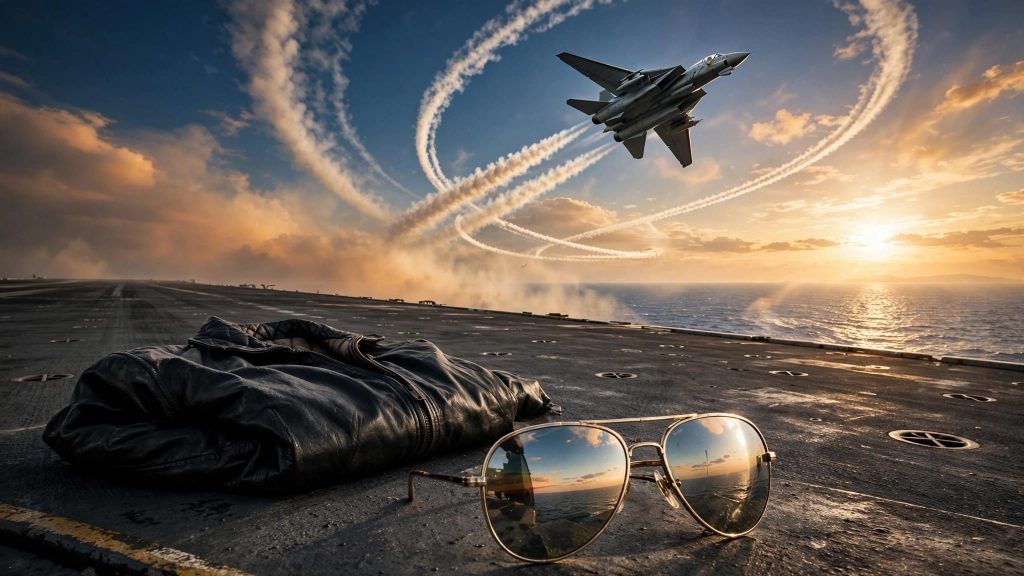
One F-14 Tomcat screaming over the ocean, one pair of mirrored sunglasses, one synth-heavy guitar riff from the Top Gun soundtrack. That combination gave the movie instant pop-culture impact, making every 80s kid look at the sky differently – just like The Karate Kid had every kid running to a dojo.
Top Gun 1986 didn’t invent the image of elite fighter pilots, obviously. This 1986 film turned naval aviation into pure pop-culture rocket fuel, complete with leather jackets, locker-room rivalry, beach volleyball, and a soundtrack built for riding your bike too fast down the block.
The movie’s flight plan was simple: make speed, danger, friendship, romance, and loss look huge. Then put Tom Cruise’s Maverick at the controls.
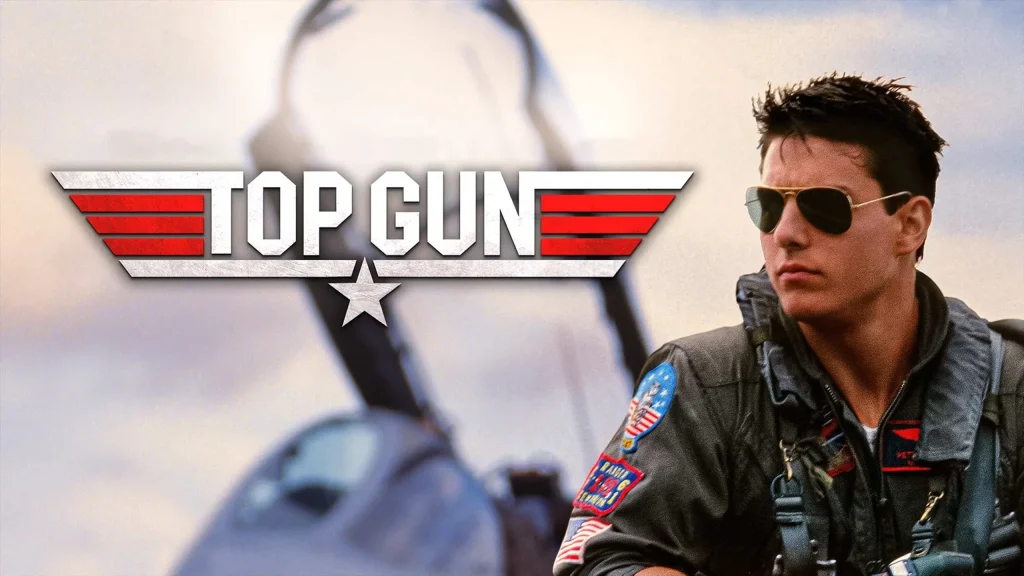
Why Top Gun Made Aviators Cool
Released by Paramount Pictures on May 16, 1986, Top Gun arrived with the volume turned all the way up. Tony Scott gave the action drama film sun-flared skies, blue-tinted shadows, and roaring engines. Even a walk to a motorcycle felt important.
Tom Cruise played Lt. Pete Maverick Mitchell, a gifted Navy pilot who answered to the nickname “Maverick.” He had a need for speed and a talent for making authority figures sigh heavily. He wasn’t neat. He wasn’t safe. But he was impossible to ignore.
The look was half the magic
Before the film, aviator sunglasses were already a classic. After its release, they were practically part of the uniform for anyone with a bomber jacket and a driver’s license.
The movie sold a whole silhouette:
- Ray-Ban-style aviators with gold frames and reflective lenses.
- Flight jackets worn with the collar up, because subtlety had left the building.
- Denim, dog tags, patches, motorcycles, and windswept hair.
- A Tomcat on the tarmac, looking like a futuristic steel shark.
It wasn’t only clothing. It was posture. Maverick stood like the room had been waiting for him.
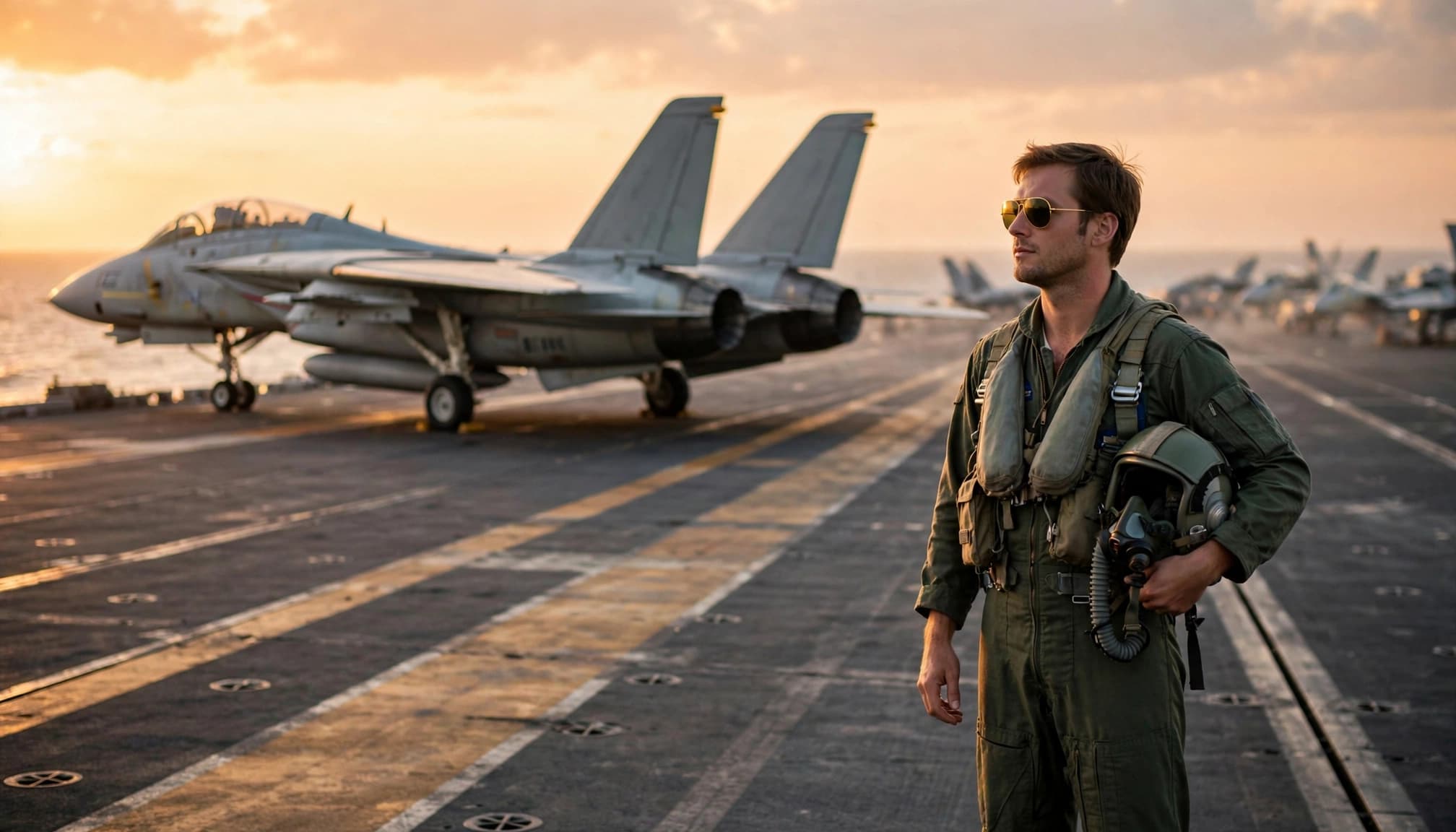
Maverick gave the fantasy a face
Cruise was 23 when the film hit theaters, and the camera knew exactly what to do with him. Maverick had confidence without polish, grief under the bravado, and enough reckless energy to keep Iceman rolling his eyes.
Val Kilmer’s Lt. Tom “Iceman” Kazansky supplied the perfect counterweight. Iceman was cool in the controlled, disciplined way. Maverick was cool because he might fly upside down next to you and ask if you’ve lost that loving feeling.
That clash gave the movie its juice. It wasn’t only about flying. It was about who gets to define greatness.
The Real Top Gun Behind the Movie
The movie borrowed its setting from the real Top Gun, the United States Navy Fighter Weapons School. During this period, the school was based at Naval Air Station Miramar in San Diego, California, and that Naval Air Station Miramar setting helped inspire the film’s Southern California look and golden-hour glow.
The real school began in 1969 after hard lessons from air combat during the Vietnam War. Its work was serious: improve fighter tactics, train crews, and send graduates back to their squadrons as instructors.
Ehud Yonay’s magazine article sparked the idea
Producer Jerry Bruckheimer came across “Top Guns,” a 1983 article by Ehud Yonay published in California magazine. The piece put Navy fighter pilots and their demanding training world on the page.
That article was the spark behind Top Gun, not a scene-by-scene blueprint. Screenwriters Jim Cash and Jack Epps Jr. built a big-screen story around rivalry, romance, danger, and Maverick’s need to prove himself.
The original film’s cast and story details still show how tightly the drama is built around Maverick’s personal journey. The real school had no need for slow-motion volleyball to teach air combat tactics. Hollywood, thankfully, felt otherwise.
What the film got right, and what it pumped up
The movie correctly put a pilot and a radar intercept officer in the F-14 Tomcat. Maverick flies with Lt. Nick “Goose” Bradshaw, played by Anthony Edwards, as his RIO. Goose handles radar, navigation, communications, and weapons systems. He is not a passenger. He is part of the crew.
The film also captured the competitive spirit of elite training. Pilots are graded, challenged, corrected, and expected to learn fast.
Real naval aviation depends on disciplined teamwork, aircraft carrier operations, maintenance crews, briefing rooms, procedures, and judgment. The movie makes room for those things, but it belongs to Maverick’s dramatic point of view.
The fictional enemy aircraft are MiG-shaped and deliberately unnamed. The dogfights exist in a Cold War-flavored world, yet the story avoids naming a nation. That made the action feel dangerous without tying every scene to one real conflict.
The Tomcat Was Top Gun’s Other Star
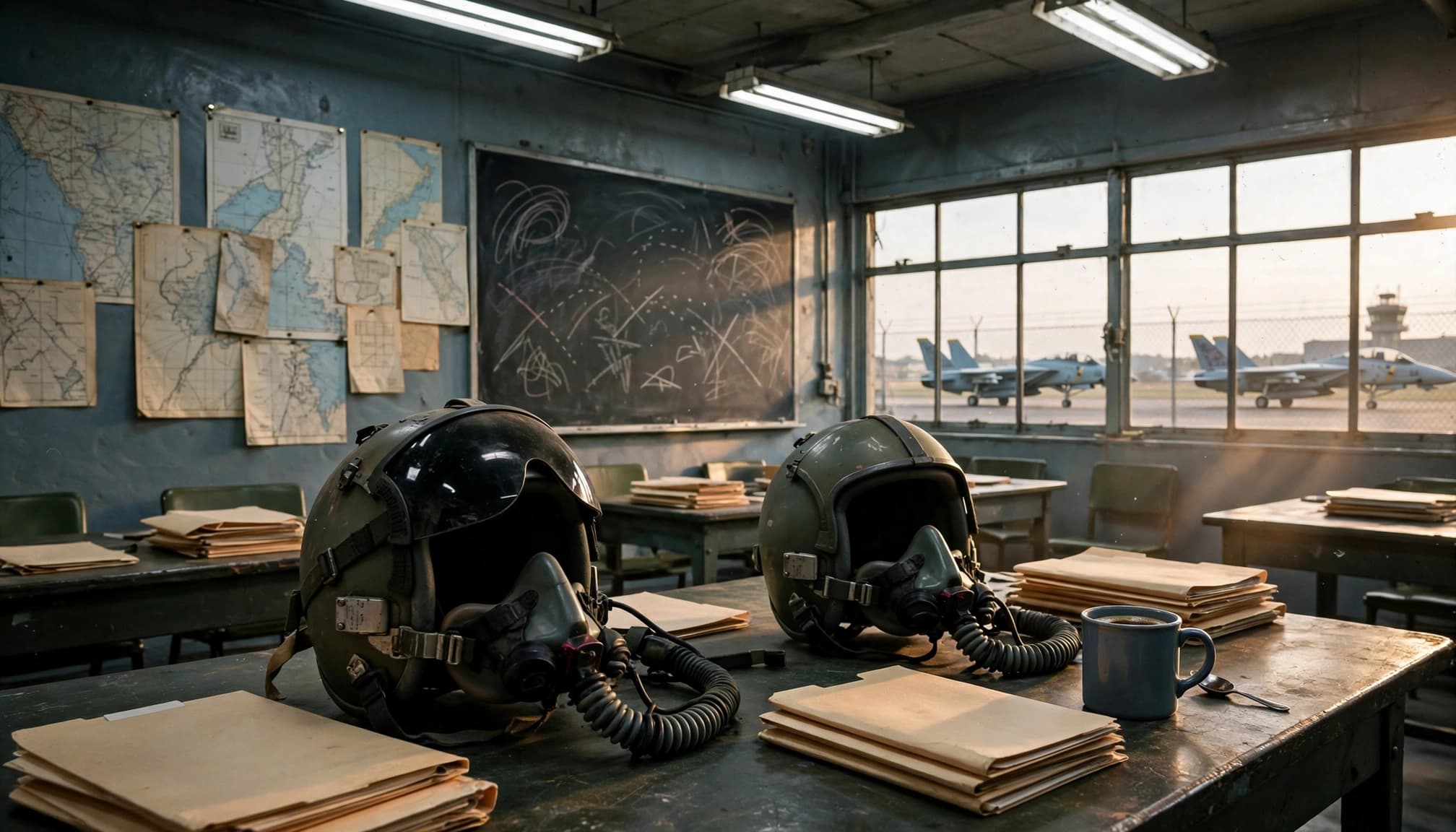
The F-14 Tomcat was a natural movie star. Its variable-sweep wings, twin tails, massive engines, and two-seat cockpit gave it a shape no kid could mistake for anything else.
It had entered Navy service in the 1970s as a fleet-defense fighter. The Tomcat could carry the long-range AIM-54 Phoenix missile and use its AWG-9 radar to track threats at great distance. That technical muscle mattered in real service, even if the movie cared more about dramatic flybys.
The flying footage felt physical
Director Tony Scott and producers Don Simpson and Jerry Bruckheimer worked with Navy officials. With cooperation from the United States Navy, including Naval Air Station Miramar, the crew gained access to aircraft, an aircraft carrier, and operational settings. That gave Top Gun something most action movies couldn’t fake in 1986: real military hardware moving at alarming speed.
The aerial footage feels physical, though the dogfight sequences aren’t a perfect record of aircraft tactics. Some maneuvers and edits exist because they look fantastic, not because they’re doctrinally precise. Visual authenticity doesn’t equal tactical accuracy, but the footage has weight.
During aerial filming, experienced stunt pilot and camera operator Art Scholl was killed when his aircraft went into the Pacific. His plane and body were never recovered. It’s a sobering fact behind a movie that often feels like a two-hour adrenaline rush.
The Top Gun 1986 movie cockpit made skill look glamorous
Aviators had always carried a certain mystique. The film gave that mystique a neon sign.
The film made cockpit teamwork, call signs, flight gear, and aircraft carrier operations visible to millions unfamiliar with them. It presented naval aviation as a personal proving ground, where talent met discipline. Real military aviation also depends on maintenance, briefings, and procedures.
That part landed. Plenty of viewers left wanting aviators, not because they understood naval doctrine, but because the whole thing looked outrageously cool.
A Soundtrack Built for Maximum 80s Volume in Top Gun
If the jets are the muscle, the Top Gun soundtrack is the heartbeat. Kenny Loggins’ opening notes to “Danger Zone” can turn a kitchen floor into a carrier deck.
Berlin’s “Take My Breath Away” supplied the movie’s romantic glow. “Take My Breath Away” won the Academy Award for Best Original Song, and its slow, sweeping sound became inseparable from Tom Cruise and Kelly McGillis as civilian instructor Charlotte “Charlie” Blackwood.
Every song knew its assignment
The soundtrack didn’t politely sit in the background. It strutted into each scene wearing sunglasses.
“Danger Zone” made flying feel reckless and electric. Loggins’ “Playing with the Boys” made volleyball look like an Olympic event for shirtless Navy men. “Mighty Wings” by Cheap Trick cranked up the energy. Then Berlin arrived to slow the whole room down.
The soundtrack album became a multi-platinum success in the United States, a huge result for a film album of its era. For more context on Scott’s stylish career, the Academy’s tribute to Tony Scott is a fitting reminder of the director behind those unforgettable images.
Critics Had Questions, Audiences Bought Tickets for Top Gun
Early reviews were mixed. Critics admired the spectacle but often found the story thin, the romance undercooked, and character development secondary to the hot-shot visuals. Fair enough. Nobody has ever accused the film of being shy about the money shot.
Still, the movie knew what it was selling, and audiences wanted it.
The box office numbers were huge
Made for a reported $15 million, the film got a wide theatrical release through Paramount Pictures. Worldwide box office estimates range from roughly $354 million to $361 million, depending on the source and later accounting. That is blockbuster territory, plain and simple.
It became the highest-grossing film released in the United States in 1986. Not bad for a movie where a training exercise, a locker-room insult, and a jet flyover can all be treated like world history.
Its reviews have shifted over time, too. A look at Top Gun’s critical score and review history alongside Rotten Tomatoes shows the split that has followed the film for decades. Some people see style winning over substance. Others see an expertly tuned pop machine. Both camps have a point. Repeated availability through theaters, television, and home video helped the 1986 film remain part of movie culture.
The movie’s emotional center still hits
For all its swagger, the film has a bruise under the leather jacket. Goose’s death changes the movie’s temperature. Maverick’s confidence collapses, and Tom Cruise lets the grief show.
That is why Top Gun lasts. The jokes, the quotes, and the runway struts are candy. The loss gives the story a pulse.
Meg Ryan, in her brief but memorable role as Goose’s wife Carole, also helped make that turn hurt. One moment you’re singing along. The next, you’re sitting there with your snack bowl wondering who cut onions.
Did the Film Change Military Recruitment?
Top Gun has long been linked with Navy recruiting interest, and it’s easy to understand why. It put the aviation branch of the United States Navy before a huge audience. The work looked exciting, prestigious, and glamorous.
The familiar claim that the film single-handedly caused a massive recruiting surge is too neat. Publicity stories often make that leap, while solid official figures proving one direct cause are harder to find. Any numerical claim should rely on official recruiting data or reputable reporting, with correlation kept separate from causation.
A recruiting poster is not the whole picture
Military aviation is bigger than a perfectly framed sunset. It includes long training pipelines, strict standards, deployments, maintenance work, family separation, risk, and support crews behind every flight.
The screen image centered on fighter pilots, but not every aviator or military professional loved the film. Some admired its energy while rolling their eyes at its tactics, behavior, or soap-opera melodrama. That reaction makes sense. The film is a fantasy with real jets inside it.
Still, it gave many people a first glimpse of naval aviation. It also presented Naval Air Station Miramar as a real institution behind the spectacle. For an 80s kid, that glimpse could be plenty powerful.
Key Takeaways for 80s Movie Fans
- Top Gun was released on May 16, 1986, and became an 80s touchstone.
- Tony Scott directed the film, blending aerial action, romance, and swagger.
- Tom Cruise’s Maverick and Val Kilmer’s Iceman made rivalry look fashionable.
- Ehud Yonay’s 1983 article “Top Guns” inspired the movie’s story.
- The real training school at NAS Miramar, along with United States Navy cooperation, gave the production its unmistakable texture.
- The Tomcat became an instant pop-culture icon.
- Berlin’s “Take My Breath Away” won an Oscar, and the Top Gun soundtrack became an 80s monster.
- Critics had questions, but audiences bought tickets and made the film a hit, as its Rotten Tomatoes reception reflects.
- The movie glamorized aviation, but real naval flying demands teamwork and discipline beyond the fantasy.
Top Gun: The Last Flyby
The film made aviators cool because it made flying feel personal. It was about speed, but also pride, friendship, fear, loss, and the wish to be the best in the room.
Repeated viewing on home video helped preserve the original film’s cultural presence. Jets, fashion, music, and aviator imagery remain instantly recognizable, giving it a lasting pop-culture impact. The later sequel, Top Gun Maverick, renewed that legacy, but the original still owns its particular 80s glow.
Top Gun made flying feel emotional, aspirational, and impossibly cool. The Top Gun 1986 formula still works: frame a great-looking jet against a sunset, turn up “Danger Zone,” and let the inner 80s kid take the controls.
FAQ
What inspired the original Top Gun movie?
The film drew from “Top Guns,” a 1983 California magazine article by Ehud Yonay about United States Navy fighter pilots and the elite training program at Miramar.
Who starred in Top Gun?
Tom Cruise played Maverick, while Val Kilmer portrayed rival pilot Iceman. Anthony Edwards played Goose, and Kelly McGillis played Charlie. Tom Skerritt played Viper, with Meg Ryan, Michael Ironside, Rick Rossovich, Tim Robbins, and James Tolkan in supporting roles.
Where was Top Gun set?
The story places the Naval Fighter Weapons School at Naval Air Station Miramar in San Diego, California. The real TOPGUN school was based there during the period shown, before moving to Naval Air Station Fallon in Nevada in 1996.
What song won an Oscar from the soundtrack?
Berlin performed “Take My Breath Away,” which won the Academy Award for Best Original Song. It’s the Top Gun soundtrack’s defining romantic anthem, even if “Danger Zone” gets the first call when people mention the movie.
Was the flying in Top Gun realistic?
The film used real Navy aircraft and locations, including carrier-based operations aboard an aircraft carrier, giving its aerial scenes a physical punch. Its tactics and character behavior are dramatized. Real fighter aviation is more procedural, team-based, and safety-focused than Maverick’s chaotic moments. The later sequel, Top Gun Maverick, is a separate film from the 1986 original.