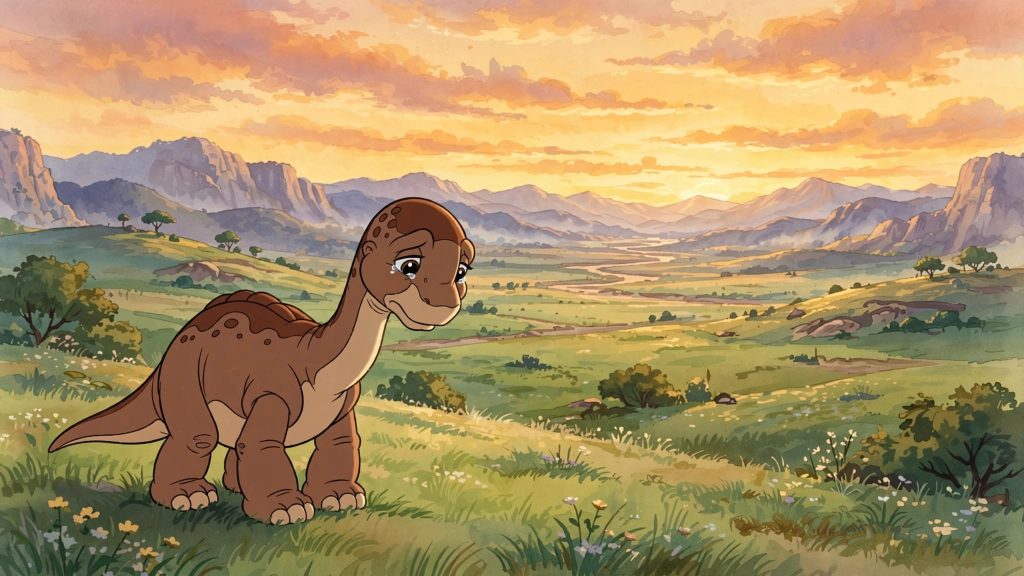
You came for baby dinosaurs, and suddenly a little Longneck was facing something no child should have to face alone.
For plenty of 80s kids, The Land Before Time became an early encounter with loss, wrapped in gorgeous animation and a story about finding your way home. Some cried, some were frightened, and some mostly remembered Ducky, because childhood reactions were never one-size-fits-all.
Revisiting it now means appreciating that sweetness while understanding why Littlefoot’s story could hit so hard.
80s Article Snapshot
•The original pairs an adventure about friendship with a lasting portrayal of parental loss.
•Its G rating doesn’t cancel out frightening scenes; Common Sense Media recommends ages 6+.
•Start with the 1988 film for the story that established the characters, then choose sequels or the TV series for more time with them.
The Land Before Time Had Serious Movie Pedigree
Don Bluth, Spielberg, and Lucas
Released in theaters on November 18, 1988, the original was directed by Don Bluth and distributed by Universal Pictures. George Lucas and Steven Spielberg were executive producers, with Judy Freudberg and Tony Geiss among its creators.
That’s quite a lineup for a movie about tiny dinosaurs with enormous feelings.
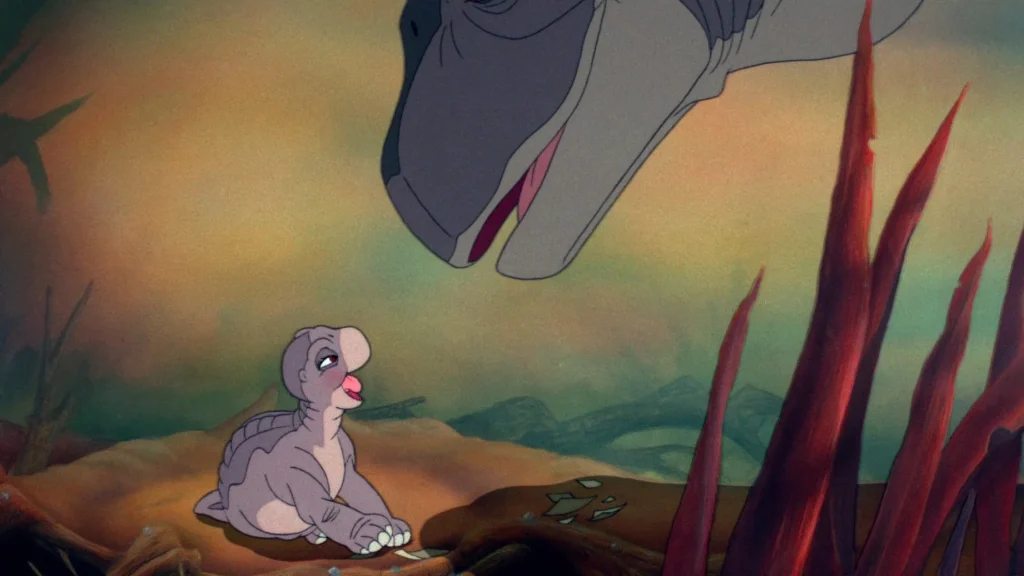
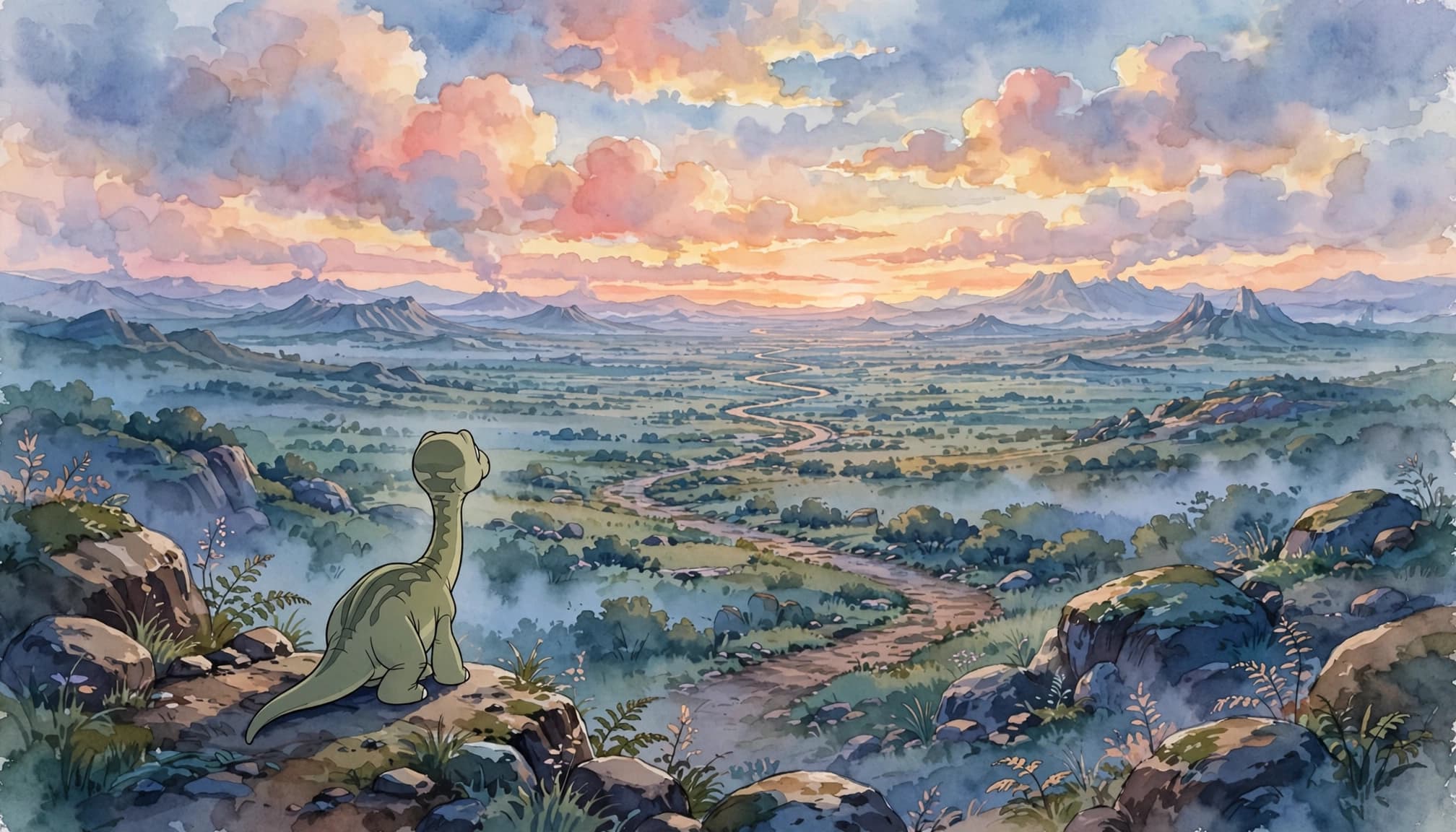
Bluth’s animation gives those feelings room. Littlefoot’s lowered head, hesitant steps, and searching eyes carry emotions that dialogue alone couldn’t deliver. Painted skies and enormous rock formations make the youngsters look wonderfully small.
Our affection for 1980s animated movies has plenty to do with that combination: storybook beauty, expressive characters, and danger that feels bigger than the screen.
The Reviews Tell Only Part of the Story
Rotten Tomatoes lists a 65% Tomatometer score, based on 66 critic reviews, and a 79% Popcornmeter score from more than 250,000 audience ratings. The Tomatometer measures critics’ reviews, while the Popcornmeter reflects audience ratings. Here, the Tomatometer trails the Popcornmeter.
The film is rated G and runs 1 hour, 8 minutes.
Its critics consensus praises the beautiful animation and endearing characters, while finding the sweetness a little excessive for older viewers.
Fair enough. Ducky is pretty adorable.
But the film’s emotional reputation comes from its willingness to let that adorable world contain something painful.
Why Littlefoot’s Loss Felt So Personal
His Mother Feels Like Safety
Littlefoot’s mother protects him, feeds him, and explains the world. She’s the person who knows where they’re going and why everything might turn out okay.
Then she dies after protecting him from a carnivore, the terrifying Sharptooth.
The scene hurts because we’ve already seen their affection. Littlefoot doesn’t lose an abstract grown-up mentioned in passing. He loses the familiar voice that made an unfamiliar world manageable.
For young viewers, that can touch a frightening question: what happens if the person who takes care of me disappears?
Some children could separate the dinosaur story from their own lives. Others needed reassurance. Both responses make sense.
The Sadness Continues After the Scene
The movie doesn’t hurry Littlefoot past his grief. He’s lonely, confused, and hungry. At one point, he mistakes his own shadow for his mother and runs toward it.
That moment?
A whole little heartbreak, without a villain anywhere nearby.
His mother’s guidance remains important, but she doesn’t return to undo the loss. The journey continues with her absence still part of it.
James Horner’s score gives the sadness space, while the animation holds on Littlefoot’s face and movement. We understand what he’s feeling before he finds words for it.
Reaching the Great Valley gives Littlefoot safety and companionship. It doesn’t reverse his mother’s death.
That distinction gives the happy ending its tenderness. The film offers comfort without pretending everything has been repaired.
Five Little Outsiders, One Great Valley
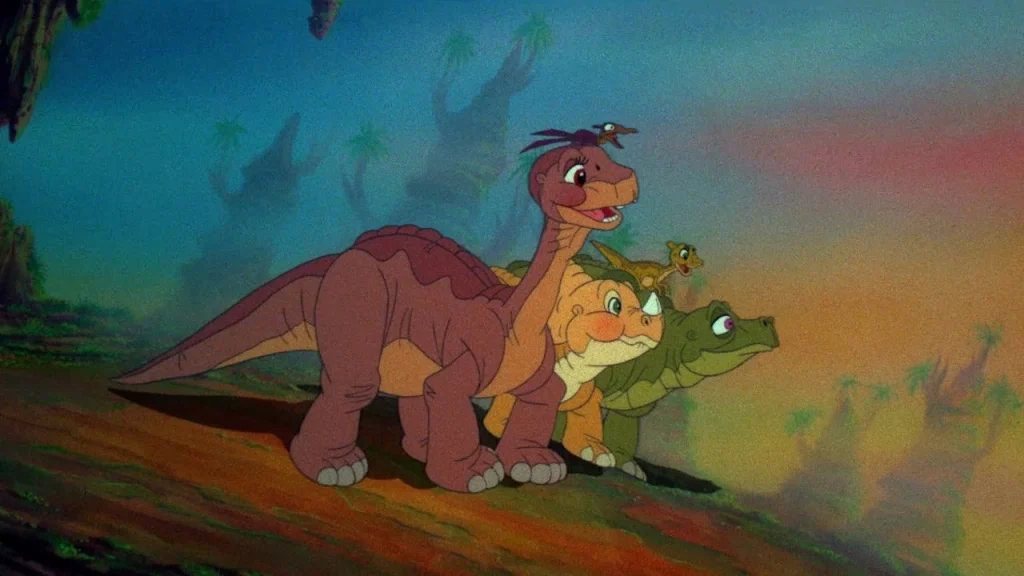
The original Great Valley adventure follows Littlefoot and four companions toward a legendary refuge with food, water, and shelter. In a world battered by disaster and hunger, that green valley sounds like paradise.
His mother tells him how to reach it. Getting there becomes both a survival journey and a way of holding on to her guidance.
Cera is a Triceratops, all stubborn pride and sharp edges. Ducky is a duck-billed dinosaur whose cheerful chatter supplies some much-needed sunshine. Spike is a Stegosaurus with an appetite and very little interest in speeches.
Petrie is a Pteranodon, technically a flying reptile rather than a dinosaur. He’s also afraid to fly, which makes him a rather charming contradiction.
Littlefoot brings them together, though friendship doesn’t arrive fully assembled. They argue, misunderstand each other, and repeat prejudices learned from their elders.
That’s part of the appeal. These kids have different personalities, different strengths, and absolutely no sensible adult available to organize the outing.
Their friendship matters because helping each other is how they survive. Ducky’s sweetness and Cera’s difficult loyalty have real weight.
Is It Too Sad for Young Children?
A G Rating Doesn’t Mean Gentle
Common Sense Media’s parent guide recommends the original for age 6+. It flags Littlefoot’s mother’s death, a T. rex attack, and an earthquake that separates the youngsters from their families.
Those are substantial scares for a short animated movie.
The G rating for The Land Before Time and Common Sense Media’s age 6+ recommendation answer different questions. A general-audience classification doesn’t measure how strongly one particular child might react to parental loss.
Think about your child’s sensitivities. Fear of separation, a recent bereavement, or trouble with threatening animals may matter more than a birthday.
Even a child who meets the age 6+ recommendation may find the opening stretch overwhelming.
Give the Difficult Scene Some Company
For a sensitive child, a plain warning is kinder than a surprise. You can explain beforehand that Littlefoot’s mother dies and friends help him continue his journey.
Use clear language. Describing death as sleeping can create confusion about something children do every night.
Watch together, and leave room to pause. If your child asks whether Littlefoot’s mother returns, answer honestly. The ending is hopeful, but she doesn’t come back.
Afterward, talk about who helped him and which moments felt frightening. You don’t need to turn movie night into a seminar.
Sometimes the useful response is a cuddle, a question answered, or permission to choose something lighter next time.
The goal is to let children enjoy the story without feeling alone with its hardest parts.
The Original and Later Films Feel Different
Start With the 1988 Film
The franchise includes 14 films: the theatrical original and thirteen direct-to-video sequels. The later direct-to-video films are musical adventures, with recurring characters, new visitors, and more time in the Great Valley.
Bluth’s original has a concentrated emotional arc: separation, grief, conflict, and the struggle to reach safety.
The sequels turn that destination into a familiar setting for further adventures. They’re a different viewing experience, even when danger and family worries return.
For a nostalgia night, start with the 1988 movie. It tells a complete story, so there’s no obligation to turn one evening into a fourteen-film assignment.
For children who want more dinosaur company after Littlefoot’s story, the sequels offer that. Their lighter musical approach doesn’t mean every installment has identical age suitability.
The Dinosaurs Kept Going
The franchise’s film and television history includes a one-season, 26-episode television series. It began on Canada’s YTV on January 5, 2007, then premiered on Cartoon Network in the United States on March 5, 2007. Cartoon Network’s March 5 broadcast was the show’s U.S. premiere.
The TV show continues the friends’ adventures rather than retelling the original tragedy.
The franchise also had 14 video games, including eight PC video games, one for Game Boy Color, two for Game Boy Advance, and three for PlayStation. These video games covered four platforms.
By 2000, the franchise had generated $1 billion in retail sales. A The Land Before Time Adventure theme park attraction even ran from 1997 to 1998.
Pretty impressive mileage for five little travelers looking for lunch and a safe place to land.
Where to Watch and Which Format to Choose
For a single return visit, renting the original is the straightforward option. The U.S. streaming and rental listing names Wonder Project Amazon Channel for streaming, with rentals through Amazon Video, Apple TV Store, and Fandango At Home.
Those are distinct options. A rental doesn’t require choosing the entire franchise, while a subscription channel is a different purchase arrangement.
For a household that wants repeat viewings, the Complete Collection makes more sense. Released in June 2016, the 14-film DVD collection packages all the movies on eight discs.
An Amazon listing has shown a $36.95 price and a 4.4-out-of-5 customer rating from 11 ratings. Those figures describe that listing, rather than a permanent price or a large review sample.
The collection is handy for keeping the films together, but a returning 80s fan doesn’t need thirteen sequels to revisit Littlefoot’s first adventure.
Home-release dates can also look confusing. Common Sense Media lists December 30, 2003, under DVD or streaming availability. Rotten Tomatoes lists May 25, 2015, as a streaming release.
Those are different home-release labels, not competing dates for the theatrical premiere. The original cinema release remains November 18, 1988.
Frequently Asked Questions
Is Littlefoot an Apatosaurus or a Brontosaurus?
Descriptions disagree. Wikipedia identifies him as an Apatosaurus, while an Amazon collection description calls him a brontosaurus. The film’s own nickname, “Longneck,” avoids that labeling tangle, and the story never settles whether he’s an Apatosaurus.
For enjoying the story, the important detail is simpler: he’s a young plant-eater learning to survive without his mother.
Is the Original a Musical?
The 1988 film doesn’t pause for the character-led musical numbers familiar from its later direct-to-video films. James Horner’s score carries much of the emotion, and Diana Ross performs “If We Hold On Together.”
That song fits the film’s hopeful finish beautifully. Later direct-to-video entries make songs a regular part of the adventures.
A Little Dinosaur With a Lasting Place in Our Hearts
The Land Before Time gave children a hero who could be frightened, lonely, and loved all at once. Its comfort comes through companionship, with friends helping Littlefoot continue rather than erasing what happened.
That’s why the original deserves more than a nostalgia wink. Behind the cute dinosaurs is a story that takes childhood feelings seriously.
The Great Valley is still lovely. Getting there is what gives it meaning.