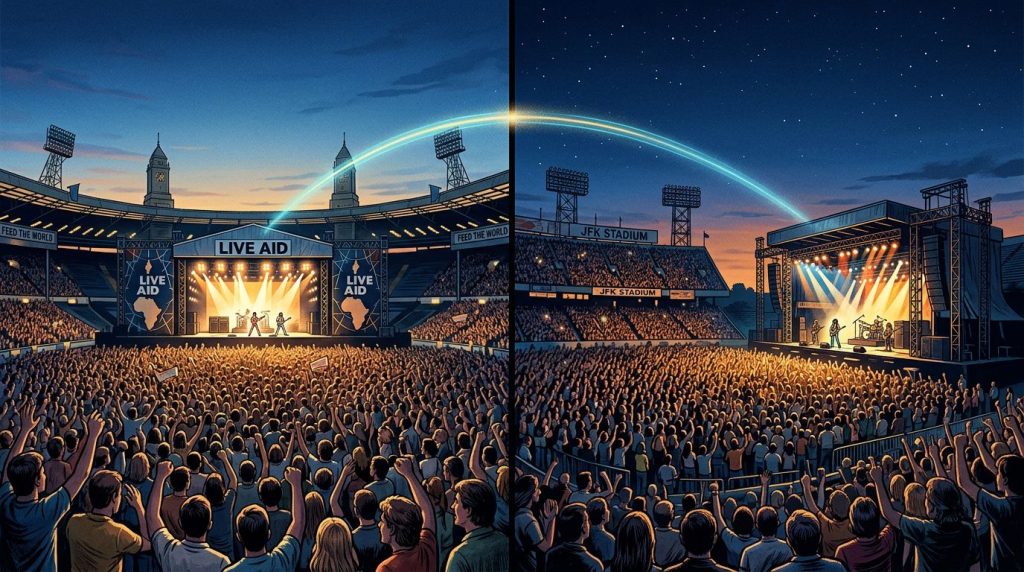
On July 13, 1985, a concert became a phone bank, a satellite experiment, a rock-and-roll relay race, and a shared lump in the throat.
The concert wasn’t the literal day everyone watched. Plenty of people missed it, worked through it, or caught only a few songs. But for millions who did tune in, two stadiums made the world feel unusually small.
It began with the Ethiopian famine, a story that soon led to Do They Know It’s Christmas? and refused to stay on the evening news.
Key Takeaways
- Live Aid took place on July 13, 1985, with simultaneous concerts at Wembley Stadium in London and JFK Stadium in Philadelphia.
- The event grew from the Ethiopian famine crisis, Bob Geldof and Midge Ure’s Band Aid single, and the belief that a benefit concert could turn attention into donations.
- Satellite television made the two stadiums feel connected, while performances by Queen, U2, David Bowie, Paul McCartney, and others became part of live music history.
- The concert raised a huge sum for famine relief, but aid distribution, simplified imagery, and the limits of celebrity-led charity created difficult questions.
- Live Aid’s lasting lesson is that music can move public attention and money, even if it cannot solve a humanitarian crisis by itself.
The Famine Story That Started It
The music came later. First came Michael Buerk’s BBC report on the Ethiopian famine, broadcast on October 23, 1984. Its images of families facing famine hit British viewers with brutal force.
Bob Geldof of the Boomtown Rats saw the report and acted fast. He called Ultravox’s Midge Ure. Within weeks, a messy, brilliant pileup of British pop stars had become Band Aid.
“Do They Know It’s Christmas?” Opened the Door
Recorded in late November, Do They Know It’s Christmas? had a giant chorus and familiar voices. It was a charity single assembled with almost no time for polish.
The December release of Do They Know It’s Christmas? turned that urgency into a chart-topping result. The charity single raised money and made a distant crisis feel immediate.
Like We Are the World, it showed how a massed pop chorus could turn compassion into action. People would respond when pop music made a distant crisis feel immediate. We Are the World would soon reinforce that 1985 charity-song moment.
The influence of Do They Know It’s Christmas? reached beyond its own sales. The charts had answered one question. The success of Do They Know It’s Christmas? gave Geldof and Ure a wild next idea. Why stop at a record, they wondered, when a benefit concert could reach an even larger audience?
A Concert With an Urgent Purpose
Live Aid was never planned as a normal festival. There was no slow summer rollout, no year-long marketing machine, no neat little press plan. Promoter Harvey Goldsmith helped Geldof and Ure turn the idea into a workable production.
The point was famine relief, and the clock was already ticking. As a fundraising initiative, it had a simple bargain. Live 8 later revisited the celebrity-led event model. The songs carried the emotion, and the phone lines had to carry the cash.
Two Stadiums, One Unruly Day
The benefit concert took place simultaneously at Wembley Stadium in London and JFK Stadium in Philadelphia. Britannica’s Live Aid history puts attendance at about 72,000 in Wembley and 89,000 in Philadelphia, which is a whole lot of cheering, sweating, and craning for a view.
London got the early start. Promoter Harvey Goldsmith helped keep the sprawling schedule moving as Philadelphia picked up the baton and the day rolled west.
Wembley Had the Home-Team Electricity
Status Quo kicked off the London show with “Rockin’ All Over the World.” It was an almost comically perfect opener. The title alone felt like a mission statement.
Wembley also gave viewers Elvis Costello, Sting, Howard Jones, David Bowie, The Who, Elton John, Paul McCartney, and, of course, Queen. The backstage pace was frantic. On camera, it looked like a giant 80s mixtape that had somehow sprung to life.
Philadelphia Brought Its Own Heavy Hitters
Across the Atlantic, the JFK bill included Joan Baez, Madonna, Tom Petty, Dire Straits, Neil Young, Eric Clapton, Mick Jagger, Bob Dylan, Phil Collins, and Led Zeppelin. The reunion-sized Led Zeppelin appearance gave the Philadelphia show a built-in historical jolt.
The two cities had different moods. Wembley felt brisk and tightly packed. Philadelphia had a loose, long-haul summer-day energy. The contrast gave every stage performance its own flavor, while both stages fed the same enormous broadcast beast.
How Satellite TV Turned a Concert Into a Shared Event
In 1985, nobody opened an app to watch a festival from the couch. Live Aid’s live broadcast depended on broadcast trucks, landlines, camera crews, control rooms, television networks, and a satellite link-up.
That machinery was as important as the guitar amps, and producer Harvey Goldsmith helped coordinate stage schedules with broadcast timing. A satellite link-up carried handoffs between London and Philadelphia. The control room switched between major performances by Paul McCartney and Led Zeppelin.
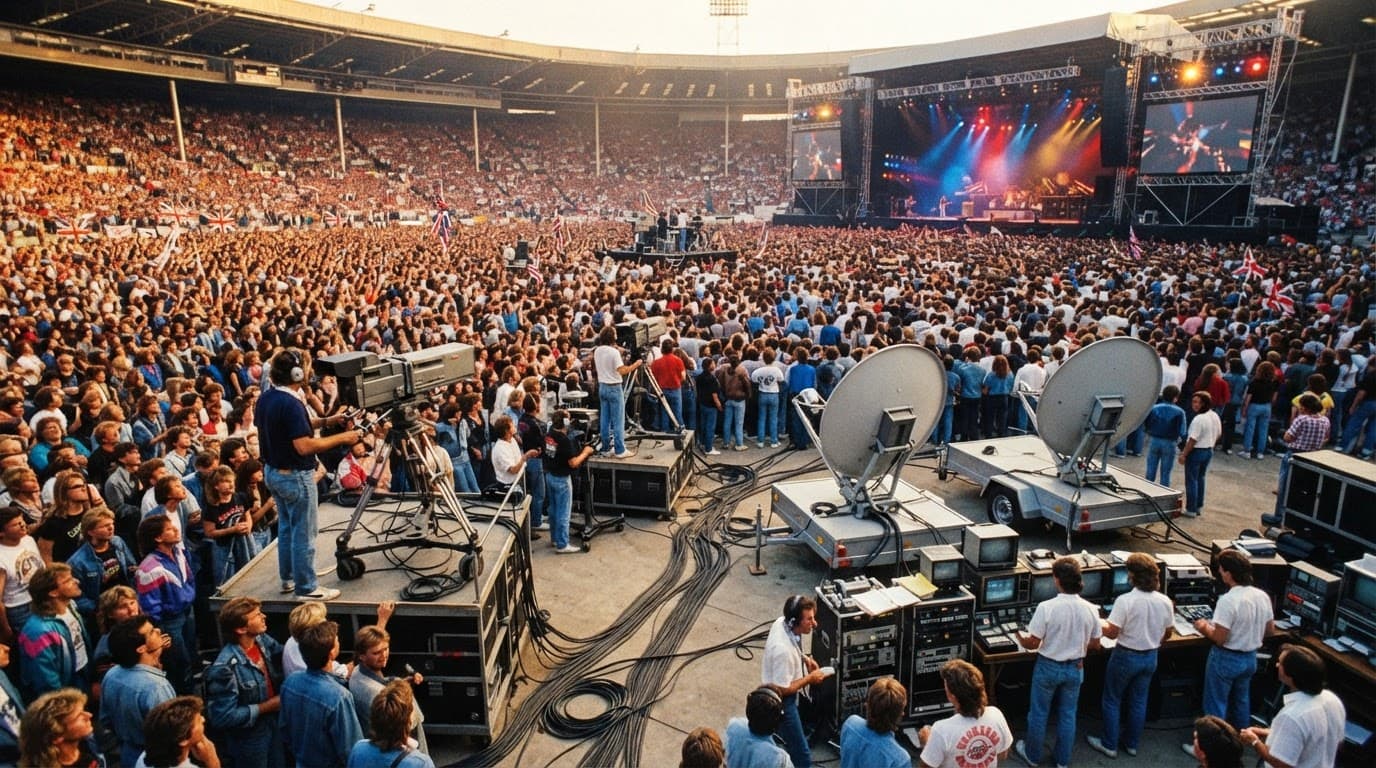
Illustration: Satellite links and television cameras were part of the show’s massive 1985 production.
The Audience Number Needs a Little Context
The familiar claim is about 1.5 billion viewers across more than 100 countries. That’s a staggering estimate for a global television audience, and it explains why Live Aid became legend. Still, it wasn’t a single identical feed seen by every person on Earth.
Broadcasters shaped that global television audience with their own schedules, breaks, presenters, and local coverage. Some households watched all day. Others caught the Do They Know It’s Christmas? segment on one feed, saw Queen, caught Bowie, then headed outside. In Britain, about 30 million people watched some of the broadcast.
That difference matters. Live Aid wasn’t “the concert everyone watched.” It was the concert that made a huge slice of the television world feel connected at once.
A satellite signal can cross an ocean in moments. Getting a performer, a camera crew, and a donation number ready at the same second is the hard part.
The Performances That Still Own the Replay
A massive charity bill guarantees peaks, oddities, and a few moments that make you reach for the sofa cushion. Live Aid delivered every kind of stage performance.
Queen Made Twenty-One Minutes Feel Huge
Queen took the Wembley Stadium stage at 6:41 p.m. Their set lasted 21 minutes. No costume changes. No long speeches. No wandering around looking for the next gear.
Freddie Mercury opened with a shortened “Bohemian Rhapsody,” drove into “Radio Ga Ga,” then turned the stadium into his personal instrument with the famous “Ay-Oh” call-and-response. “Hammer to Fall,” “Crazy Little Thing Called Love,” and “We Are the Champions” followed.
The secret wasn’t a trick. The band understood television timing. Every song had a recognisable opening, and every camera shot found movement. Mercury made eye contact with the farthest seats and people watching at home. That control made Led Zeppelin’s later reunion set feel more exposed by contrast. History’s account of Queen at Live Aid gets into why that short set has become the performance people replay first.
U2, Bowie, McCartney, and the Human Bits
U2’s Bono jumped down to dance with a young fan, stretching the band’s time slot but creating a moment nobody could have scripted. David Bowie introduced famine footage that shifted the mood in an instant.
Paul McCartney’s “Let It Be” began with microphone trouble. Then the song found its footing, joined by a chorus of famous friends. That was Live Aid in miniature, a little chaos, a little courage, then a familiar melody pulling the room together.
The Backstage Marathon Was No Fantasy
The show looked enormous because it was enormous. Promoter Harvey Goldsmith and the organizers were booking acts at breathless speed. Some artists were announced before every detail had been nailed down.
The BBC’s backstage account of Live Aid recalls how Harvey Goldsmith and his team kept the plan moving, even when parts came close to wobbling.
Phil Collins Did Both Sides of the Atlantic
Phil Collins played Wembley, on a bill with Paul McCartney, then boarded Concorde to perform in Philadelphia that same day. That schedule still sounds fake, like something a kid would write on the cover of a Trapper Keeper. It happened.
A planned live chat with Collins during the flight suffered from poor audio. Then he arrived at JFK to sing and play drums during Led Zeppelin’s reunion appearance.
Led Zeppelin Was the Day’s Big Misfire
The day’s biggest misfire came when Led Zeppelin reunited with Collins and Chic drummer Tony Thompson. The lack of rehearsal showed.
The Led Zeppelin set suffered from poor monitors. Page’s guitar was out of tune at points, and Plant’s voice was struggling. Harvey Goldsmith still had to keep the wider schedule moving while the reunion tried to find its footing.
Critics and fans gave the Led Zeppelin set a rough ride, and the band later disliked it too. Live Aid had no safety net. A great performance reached the world instantly through the live broadcast. So did a bad one.
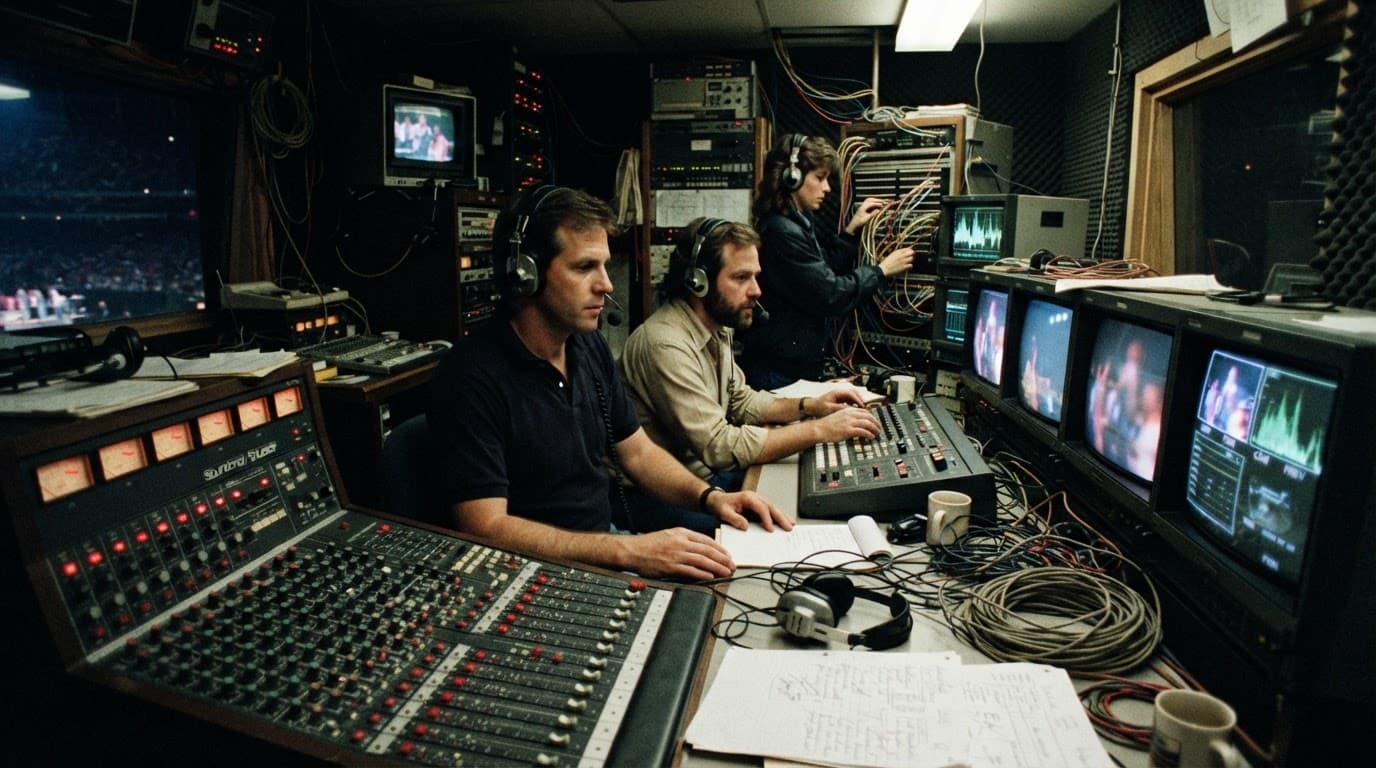
Illustration: The show ran on analog consoles, shouted cues, and a lot of nerve.
Famine Relief, Real Money, Real Questions
The fundraising total depends on which date, currency, and pool of donations a source counts. Published figures range from more than $100 million to about $127 million, while later reporting has put the Live Aid total around £150 million.
Those numbers were never just trophy stats. Bob Geldof and promoter Harvey Goldsmith coordinated the broader campaign. It included Do They Know It’s Christmas?, a charity single, and the parallel We Are the World effort.
The money was meant to provide humanitarian aid, famine relief, and longer-term programs in Africa, especially Ethiopia, during the Ethiopian famine. Proceeds from Do They Know It’s Christmas? and We Are the World supported that goal alongside concert donations. Yet delivering humanitarian aid through a country facing civil war and an authoritarian government was never simple.
The Legacy Includes Hard Questions
Live Aid brought public attention and money to a crisis many viewers had barely understood, making it a powerful fundraising initiative. Do They Know It’s Christmas? and We Are the World helped shape the celebrity-charity model and inspire Live 8. Memorable performances from Led Zeppelin and Paul McCartney helped attract attention and donations.
But the show’s imagery has faced deserved criticism, a concern later revisited by Live 8. Ethiopian people were too often framed as helpless recipients instead of people with agency, history, and political realities of their own. Do They Know It’s Christmas? and We Are the World carried some of that simplified framing. The continued appeal of Live 8 showed the model’s durability, while Led Zeppelin’s star power drew attention more easily than context.
Aid distribution also became a subject of public controversy, with related questions resurfacing around Live 8. A 2010 BBC Editorial Complaints Unit ruling found no evidence to support claims aired in a BBC program that Band Aid and Live Aid money had been diverted.
The concert’s emotional force was real. So were the limits of a concert.
Why the Memory Still Glows
For 80s fans, Live Aid is more than a playlist. It’s Mercury in a white tank top, Bono disappearing into a Wembley crowd, and Phil Collins chasing the sun across the Atlantic. It’s also the thrill of a Led Zeppelin stage performance found in a late-night replay. Television acts less like furniture and more like a front-row seat, with We Are the World making the room feel shared.
Many of us later tried to bottle that feeling on cassette, the same handmade ritual behind classic 80s mixtape culture. A taped-off-TV recording of We Are the World could feel perfect, with a scribbled title and hiss before the chord. A Paul McCartney appearance could make the cassette feel like a private keepsake.
Some of us captured Do They Know It’s Christmas? straight from television, accepting the hiss as part of the memory. That charity-song culture became part of the wider 1980s memory. Do They Know It’s Christmas? made pop solidarity feel like a broadcast event.
A Led Zeppelin replay could still become part of that private ritual. Not every televised set was polished, though, and a Led Zeppelin performance could make rough edges feel human. Live 8 later reached for the same shared feeling.
Years later, Live 8 tried to make distant viewers feel present. We Are the World belonged to that larger 1980s charity-music memory.
Even Live 8 could echo that scale, but Live Aid still felt singular. Live Aid also proved that stadium rock could give rock music a purpose beyond album sales. The music was huge. The need behind it was bigger.
Frequently Asked Questions
What was Live Aid 1985?
Live Aid was a benefit concert held on July 13, 1985, to raise money for famine relief in Ethiopia. It took place simultaneously at Wembley Stadium in London and JFK Stadium in Philadelphia, with a live broadcast linking the two events.
Why was Live Aid organized?
The concert grew out of public attention to the Ethiopian famine, particularly after Michael Buerk’s BBC report in October 1984. Bob Geldof and Midge Ure first organized Band Aid’s “Do They Know It’s Christmas?” and then expanded the campaign into a global benefit concert.
How many people watched Live Aid?
The commonly repeated estimate is about 1.5 billion viewers in more than 100 countries. That figure represents a broad global audience rather than one identical broadcast, since networks used different schedules, presenters, and local coverage.
What was the most famous Live Aid performance?
Queen’s 21-minute set at Wembley is generally regarded as the event’s defining performance. Freddie Mercury used songs including “Radio Ga Ga,” “Hammer to Fall,” and “We Are the Champions” to turn the stadium and television audience into one huge singalong.
How much money did Live Aid raise?
Published totals vary according to the date, currency, and donations included, with estimates ranging from more than $100 million to about $127 million and later figures around £150 million. The money supported famine relief and humanitarian aid, though distributing assistance in Ethiopia’s political and wartime conditions was complex.
The Day the TV Became a Stadium
Live Aid 1985 remains a thrilling piece of 80s pop history because it was a benefit concert with both polish and panic. Its live broadcast delivered electric performances, malfunctioning microphones, impossible logistics, and a reason for all that noise.
Its cultural memory includes Do They Know It’s Christmas?, a song that still carries the event’s urgency. We Are the World gave that era another anthem for collective action.
Live 8 later revisited that global reach for another generation. We Are the World remains part of the same cultural afterlife, while Live 8 carried the model toward a new audience.
The day also held sharp contrasts. Led Zeppelin’s reunion became unforgettable, while Led Zeppelin’s shaky edges made the day’s risks visible. Paul McCartney offered another reminder that even icons meet human limits.
The fundraising initiative aimed to support humanitarian aid, but money raised and lives changed aren’t the same measure. As a historical event, it matters because it revealed that distinction.
Its best lesson isn’t that music can fix a humanitarian crisis on its own. It’s that attention can move people, and what happens after that attention arrives matters just as much.